Orthopedic, Vein & Sleep Marketing
Orthopedic, Vein & Sleep Marketing Measured Across the Gap, Not Inside It
These three specialties share a problem no other vertical on this site has in the same form: a payer gate sits between the click and the procedure. Conservative therapy has to be documented. Authorization has to be obtained. A sleep study has to be read. The patient who books in March was acquired in December, and a program reported on a 30-day window will call that campaign a failure and switch it off. We build for the real interval, hold the patient through it, and report on what actually got done.
The coverage gate
The lag is not a delay. It is the product.
In a cash-pay elective practice the distance from click to procedure is measured in weeks and it is mostly the patient deciding. Here the distance is measured in months and most of it is documentation the practice is required to produce. That interval is where every one of these programs is won or lost, and it is invisible to any report that ends at the lead.
Illustrative. Requirements vary by plan, by state and by procedure.
Click
Search, ad, referral or AI answer
The only moment most programs measure.
Evaluation
Consult and diagnostic imaging or study
Duplex ultrasound, weight-bearing films, home or in-lab sleep study.
Documented trial
Weeks to months, in the chart
Compression and conservative care for veins; conservative management for joints; an initial therapy trial for sleep.
Authorization
Prior auth, with evidence attached
Denied or delayed if the documentation does not establish medical necessity.
Procedure
The outcome the practice sells
Commonly a full quarter after the click that produced it.
Published requirements for venous ablation commonly run six to twelve weeks of documented conservative therapy on commercial plans, and three to six months under Medicare, with ultrasound-documented reflux. A campaign judged before that clock runs out is being judged on the wrong event.
What the platforms restrict
Sleep apnea is named in the policy. Joints and veins are covered by it.
Google restricts personalized advertising for physical health conditions, chronic conditions, and the products and procedures used to treat them. Sleep apnea devices appear in the policy’s own examples. Chronic joint disease and chronic venous insufficiency sit squarely inside the same category, and invasive procedures are named separately.
Restricted means the targeting features most agencies build their proposals around are not available to your account for this content: advertiser-curated audiences, Customer Match from a patient list, your-data segments, lookalikes and audience expansion. Campaigns keep serving. The audience simply stops applying, silently, which is why practices rarely find out from the platform and usually find out from us.
What remains is enough, and it is more durable: high-intent search where the patient states the problem in the query, Google’s own predefined audiences, honest geography, organic and AI answer visibility across a long research window, and offline conversions that report outcomes without building an audience out of patients.

The patient you already paid for
Most of these funnels leak hardest after the diagnosis.
Every one of these specialties has a large, well-documented population that enters care and then falls out of it. In sleep medicine it is the patient who is diagnosed and cannot tolerate the first-line therapy: Medicare’s own adherence standard asks for at least four hours a night on seventy percent of nights within a consecutive 30-day period in the first three months, and published long-term adherence runs far below it. In orthopedics it is the patient who is evaluated and is not yet a surgical candidate. In vein care it is the patient whose plan denies authorization on a documentation gap.
In a lead-count program all three simply disappear, and they disappear as successes, because a consult happened. In a program built around the practice’s full service line they route: to an oral appliance or a stimulation evaluation, to a non-surgical pathway, to a corrected submission. Same acquisition cost, a completely different outcome.
This is the single largest recoverable number in the vertical, and it is the one nobody reports on, because seeing it requires following the patient past the consult.
Cannot tolerate first-line sleep therapy
Oral appliance or stimulation evaluation, inside your practice
Not yet a surgical candidate
Non-surgical pathway, with a scheduled reassessment rather than a goodbye
Authorization denied on documentation
Corrected submission, tracked to the decision instead of written off
Diagnosed elsewhere, shopping for a surgeon
Second-opinion pathway built for a patient who already has a diagnosis

Organic and AI answers
The research starts at a symptom and ends at a surgeon’s name.
These patients do not begin by searching for you. They begin by searching for what is wrong, and increasingly they read an AI summary of it before they read a website. Nothing in a paid account reaches that moment, and the restricted-audience rules mean there is no retargeting waiting for them afterwards either.
The asset that works is content specific enough to be cited: what the evaluation involves, what coverage actually requires, what the alternatives to the obvious procedure are, and what recovery honestly looks like. Structured data machines can read, and practice information consistent everywhere it appears. Nobody can promise an AI citation. We measure visibility on the questions that matter to your practice and report the trend.
Two economies, one account
Covered care and cash-pay care cannot share a cost target.
These practices run two businesses at once. One is billed through a plan, gated by authorization, and constrained by schedule. The other is paid for at the front desk, decided in weeks, and priced openly. They have different acquisition costs, different close rates and different reasons for a patient to choose you, and blending them into one cost-per-lead target guarantees that whichever is larger quietly subsidizes whichever is worse.
We separate them in the account structure and in the report, so a decision about the cash-pay line is made on the cash-pay line’s own numbers. It is the same discipline that makes by-procedure attribution worth insisting on everywhere else on this site.
Covered
- Judged on authorized, completed procedures
- Reported across a window long enough to contain the gate
- Insurance and coverage questions answered on the page, because they convert
- Referral relationships treated as a channel with its own measurement
Cash-pay
- Judged on booked and paid procedures, at its own cost target
- Priced or ranged openly, because the researcher is comparing
- Never permitted to borrow a covered outcome as proof
- Claims held to the same evidence bar as everything else we write
Where we stop
The cash-pay adjunct market is where the compliance exposure lives.
Orthobiologic and regenerative marketing is the fastest-moving copy in this vertical and the most dangerous. Outcome percentages for stem cell and platelet-rich plasma injections circulate freely in agency decks and clinic pages, and most of them have no documented FDA approval for the indication being advertised behind them. Running them risks the practice’s reputation, its ad accounts and, in the worst case, a regulator’s attention.
So this is a published limit rather than a judgment call made per campaign. We will not write an efficacy claim for a treatment lacking documented approval for that indication, we will not imply a guarantee, and we will not use a device or brand mark in an ad without documented authorized-provider status. If a competitor down the road is doing all three, that is not evidence it is safe. It is a list of what happens first when the category gets enforced.
- Outcome or success percentages for regenerative injections without documented approval for the indication
- “Avoid surgery” framing presented as a clinical outcome rather than a possible one
- Guarantees, “100% success”, or “no downtime” where downtime exists
- Device or brand marks used in ads without documented authorized-provider status
- Any copy that describes the reader’s own body or condition back to them
Every ad, landing page and claim runs through the same compliance review before it goes live, and we flag violations by name rather than softening them.

Paid search
Symptom queries and procedure queries are two different businesses.
A person searching “knee pain when climbing stairs” and a person searching “partial knee replacement cost near me” are months apart and worth entirely different bids. In these three specialties the symptom query arrives first, in volume, and it is where the referral-shopping patient can still be captured before somebody else defines the diagnosis for them.
Search Partners stay off on every local clinic campaign, negatives are built before launch, and the conversion the account optimizes toward is the one the practice actually sells.
- Symptom, condition and procedure intent separated, never one blended campaign
- Covered and cash-pay service lines split at the campaign level
- Insurance and coverage queries served directly rather than deflected
- Second-opinion intent worked as its own lane
- Bidding pointed at consults and completed procedures, not at form fills
What you see
A window long enough to contain the gate.
Every inquiry keeps its source. Consults, authorizations and completed procedures are matched back to the campaign that produced them and returned to the ad platforms as offline conversions, so the algorithm is trained on the outcome rather than on the form fill.
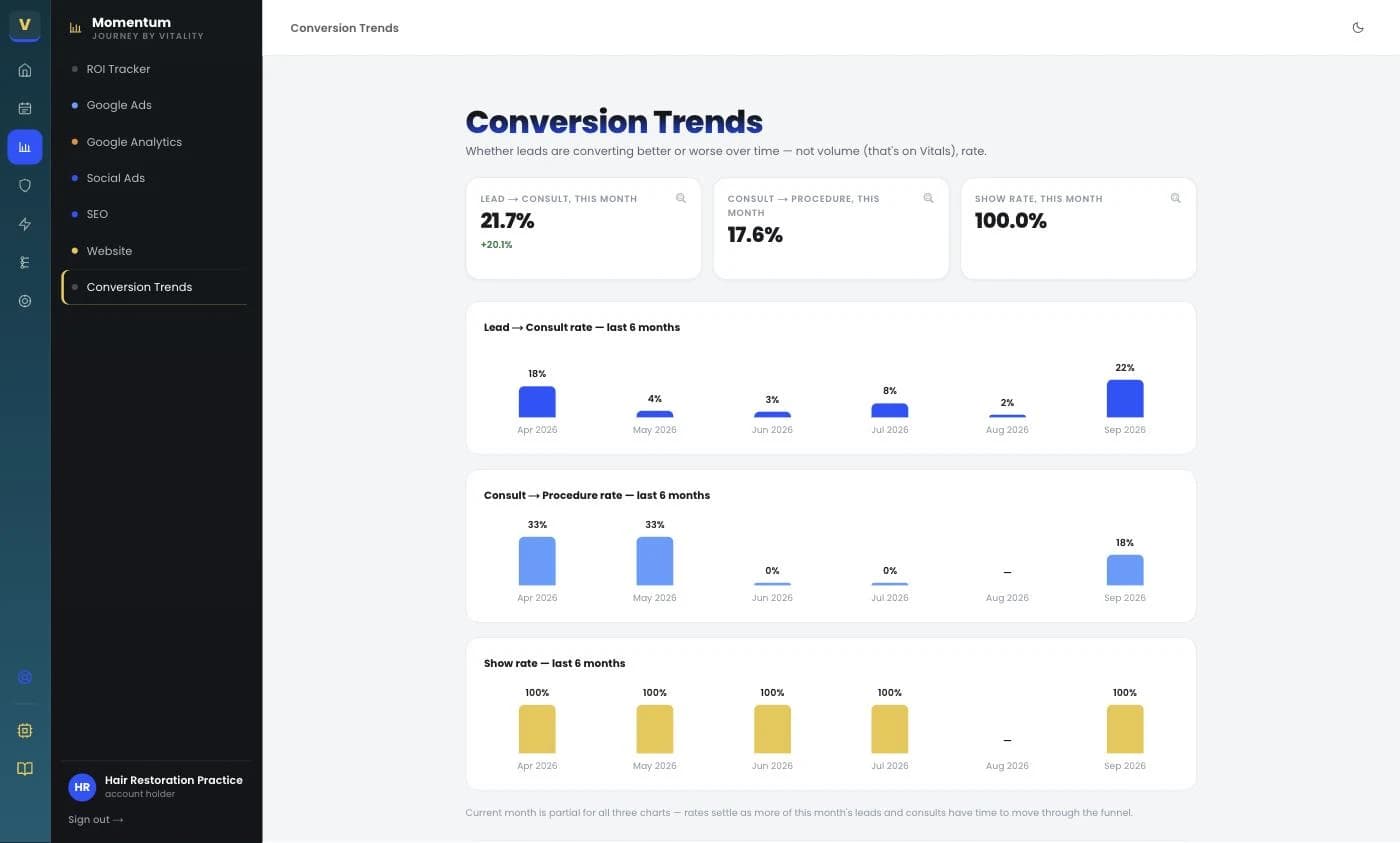
Because the interval here is measured in months, the reporting window is too. A cohort acquired in one month is followed to the procedure it produced in another, which is the only honest way to read a program with a payer gate in the middle of it. The account is yours and every figure traces to your own records.
What an engagement includes
Built for a funnel with a payer in the middle of it.
The difference between this and a generic medical marketing retainer is almost entirely in what happens after the lead, which is also where these practices lose the most money.
- Compliance review of every ad, landing page and claim before it runs
- Covered and cash-pay service lines separated in structure and in reporting
- Paid search and paid social managed to cost per qualified consult
- SEO and AI answer visibility on symptom, coverage and alternative queries
- Speed-to-lead and nurture built to survive an authorization interval
- Routing for patients who do not proceed on the first pathway
- Offline conversion attribution to consults and completed procedures
- Cohort reporting across a window long enough to contain the gate
Attribution
Counted in procedures completed, across the interval it takes.
A lead is not a result and, in a specialty with prior authorization in the middle, neither is a consult. The result is an authorized, completed procedure, and that is what every campaign here is judged on, by procedure and by service line, in accounts you own.
Getting there takes offline conversion tracking rather than a pixel: the click identifier is preserved in hidden fields at inquiry, the outcome is matched back when it finally happens, and only the outcome is returned to the platform. No patient detail leaves your systems to make the number appear.
It is the same closed-loop system we have run in hair restoration since 2011, a specialty with the same long consideration cycle and the same compliance exposure. The full architecture is documented on our methodology page.
Questions
Orthopedic, vein and sleep marketing, answered straight
Our procedures are insurance-covered. Does performance marketing even work?
It works, but it has to be measured differently. The mistake is not running the campaigns, it is judging them on a window shorter than the authorization interval. Published requirements for venous ablation commonly run six to twelve weeks of documented conservative therapy on commercial plans and three to six months under Medicare, so a program assessed at 30 days is reporting on inquiries and calling it performance. We report leading indicators weekly and judge the program on completed procedures, by cohort.
Why can we not retarget people who visited our sleep apnea pages?
Because Google restricts personalized advertising on this content and names sleep apnea devices in the policy itself. Chronic joint and venous conditions are covered by the same rule, and invasive procedures are named separately. Advertiser-curated audiences, Customer Match, your-data segments, lookalikes and audience expansion are all unavailable for it. Campaigns keep running and the audience quietly stops applying, which is why this usually goes unnoticed for months.
Can we advertise stem cell or PRP treatments?
Not with efficacy claims, and not with outcome percentages, unless there is documented FDA approval for the specific indication. That is a published limit rather than a case-by-case judgment. We will write about the evaluation, what the treatment involves and who it is considered for. We will not write the success rate, and we will tell you plainly when a claim already on your site needs to come down.
How do we capture patients who were diagnosed somewhere else?
With a second-opinion pathway built for a patient who already has a diagnosis and a recommendation, which is a completely different conversation from a symptom searcher. It is one of the highest-intent lanes in this vertical and it is almost never run deliberately, because it needs its own content, its own campaign and a front desk that knows what to do with the call.
We run both covered and cash-pay services. Should they share a budget?
They can share a budget. They must not share a cost target or a report. The two lines have different acquisition costs, different close rates and different buying decisions, and blending them means the healthier line silently pays for the weaker one for as long as nobody separates them. We split them in the account structure on day one.
How do you track marketing through to a completed procedure?
Through offline conversion tracking. Each inquiry keeps its source, campaign and keyword in hidden form fields; consults, authorizations and completed procedures are matched back and returned to the ad platforms as conversion events, with no patient detail leaving your systems. Reports then show cost per consult and cost per completed procedure by campaign, and the platforms optimize toward those outcomes rather than toward whoever fills in a form.
Go deeper
Related work and free tools.
Find out what happens to your patients after the lead.
The Practice Growth Audit traces demand, response and follow-up from first click through authorization to completed procedure, including the patients your current reporting writes off. Free, built by hand, yours to keep.