Fertility & Men’s Health Marketing
Fertility & Men’s Health Marketing Without the Audiences You Cannot Use
Reproductive medicine and men’s health are the two verticals where the standard agency playbook is not just risky, it is switched off at the platform. Retargeting, lookalikes and patient-list matching are all restricted by Google policy on exactly this content, and your single strongest proof point, your success rate, is governed by federal statute and by SART’s advertising rules. What is left is a harder, better program: demand captured at the moment of intent, two decision-makers served instead of one, and every cycle start and program start traced back to the campaign that produced it.
The audience wall
Half the tactics in the pitch you were shown are prohibited here.
Google restricts personalized advertising for content about pregnancy and infertility treatment, and for any health issue associated with intimate body parts or functions, which covers the whole of men’s health. Restricted is not a warning label. It removes specific targeting features from your account for this content, and it does so quietly: campaigns keep running, the audience simply stops applying. An agency that sells you a retargeting funnel here is either unaware or counting on you not checking.
Switched off for this content
- Advertiser-curated audiences
- Customer Match from a patient list
- Your data segments
- Lookalike segments
- Audience expansion
What the program runs on instead
- High-intent search, where the patient declares the need in the query
- Google’s own predefined in-market and life-event audiences
- Location and demographic targeting, used honestly
- Organic and AI answer visibility across a research window measured in months
- Offline conversions, which report outcomes back without building an audience
Source: Google Ads “Health in personalized advertising” policy. The same policy names invasive procedures and chronic conditions, so it reaches further into this vertical than most practices expect.
Two people, one decision
Your fertility inquiry is usually a household, not a patient.
Almost every other specialty markets to one person. Reproductive medicine markets to two, and they rarely arrive at the same conclusion at the same time. One partner researches for months before saying anything. The other engages at the consult, or at the invoice. A funnel built for a single decision-maker gets the first partner and loses the household, and the loss looks identical to a lead that simply went cold.
That changes what the marketing has to do. Content has to answer the question each partner is actually asking, including the male-factor questions that half of practices bury three clicks deep. Nurture has to survive a decision that pauses for a month and restarts. And the consult has to be bookable by whichever partner is ready first, without asking the other to start over.
The men’s health side of the practice is the same insight running the other direction. A man researching low testosterone, erectile dysfunction or a vasectomy reversal is the least likely patient in medicine to call a front desk on the first visit. The program is judged on whether it gave him a path that did not require one.
Partner one researches, silently
Weeks to months of reading before any contact. This is where organic and AI answers do the work no ad can do, because there is nobody to retarget yet.
The conversation happens at home
Cost, odds, timing, and what the alternative looks like. Your pages are being read aloud. Write them for that room.
One partner reaches out
Speed to response decides whether the second conversation happens with you or with the next clinic on the list.
Both attend the consult
Two sets of questions, one hour. Practices that prepare for that convert at a different rate than practices that do not.
The decision pauses
Finances, insurance, a holiday, a second opinion. Nurture that assumes a linear funnel loses the patient here, and never learns it did.
A cycle or program starts
This is the outcome the program is judged on. Not the form fill, and not the consult.

Privacy, and why it is structural here
A fertility inquiry is health data from the first field.
In most specialties the health-data exposure starts at a form. Here it starts at the URL. A visitor on a page about recurrent pregnancy loss, low sperm count or erectile dysfunction has disclosed a condition before typing anything, and every advertising pixel on that page carries the page identity with it.
So the build is different. No standard advertising or analytics tag on treatment, condition or consult pages. Inquiries captured first-party with the click identifier preserved in hidden fields. Outcomes returned to the ad platforms as offline conversions, which is the one path that tells the algorithm what worked without telling it who.
This is also what keeps the program legal to run at all. A practice that handles patient inquiry data through a vendor needs a signed business associate agreement with that vendor. We hold one where the work requires it, and we tell you plainly when a platform will not sign.
The number you may not advertise with
Your success rate is regulated. Treat it that way before somebody else does.
Fertility is the only specialty on this site whose headline marketing claim is governed by a federal statute. The Fertility Clinic Success Rate and Certification Act of 1992 created the reporting regime; SART’s advertising guidelines sit on top of it and are explicit that SART Clinic Specific Data may not be used to rank or compare clinics, that superiority claims are unacceptable, and that advertising must not lead patients to believe their chances are better than they are.
A 2020 review of 165 SART member clinic websites found 73% fully compliant either at first look or within 14 days of being notified. The remaining quarter were not running rogue campaigns. They were quoting a real number in a way the guidelines do not permit, usually a stale one, usually written by a marketing vendor who had never read the guidelines.
We write to the rule rather than around it. Live birth data per cycle initiated and per retrieval, current, sourced, with the population it describes stated plainly. No ranking, no comparison, no "highest in the region." That is a harder ad to write and a much easier one to defend, and it survives the day a competitor complains.
What we write
What we never write
Report live birth per cycle initiated and per retrieval, current and dated
Quote a single percentage with no denominator, no year and no population
Describe your own outcomes in your own patient population
Rank or compare your clinic against others using SART data
Name the factors that move the number, age first
Imply a prospective patient should expect the clinic average
Refresh every figure when the reporting cycle refreshes
Leave a number from three reporting years ago on a live page
Organic and AI answers
The research window is months long and mostly invisible.
A couple weighing IVF reads for a long time before they contact anyone, and increasingly they read an AI answer rather than a page of blue links. Nothing in a paid account reaches that window: there is no click to retarget and no audience to build. The only asset that works there is content specific enough to be cited.
That means real answers on cost and financing, on what the odds depend on, on what male-factor evaluation involves, and on what the first eight weeks actually look like. Structured data that machines can read. Practice information consistent everywhere it appears. Nobody can promise an AI citation, and anyone who does is selling something. We measure visibility on the questions that matter to your practice and report the trend.


The men’s health lane
Telehealth prescribing is a certification gate, not a copywriting problem.
Testosterone therapy, erectile dysfunction, weight management and the rest of the men’s health category sit inside Google’s healthcare and medicines policy. A practice that prescribes in person and advertises the consult is on ordinary ground. A practice that prescribes through telehealth is not: Google requires LegitScript healthcare certification before those ads run at all, and an uncertified account does not get a warning, it gets a policy block.
Most men’s health practices discover this the week their campaigns stop. We check it before a dollar is committed, because the certification takes time to obtain and there is no copy edit that substitutes for it.
The copy rules underneath are ours and they do not move. No prescription drug names used promotionally without the certification that permits it. No language that describes the reader’s own body back to them, which is both the fastest route to a disapproval under Google’s personalized advertising policy and the wrong way to talk to a man who has been putting this off for two years. We sell the evaluation. The practice decides the treatment.
- Certification status confirmed before launch, not after the first block
- Prescription and trademark terms handled under the Medical Ads Compliance Bible
- Consult-first framing across every campaign in the category
- Discreet paths to booking that never require a phone call to start
- Landing pages that carry no advertising pixel on any health-intent step
Paid search
Intent is the only audience left, so it has to be worked properly.
With behavioral targeting off the table, the query is the whole signal. That makes keyword discipline the difference between a program that books cycles and one that buys traffic: cost, insurance, second opinion and male-factor queries behave nothing alike, and broad match will happily spend a fertility budget on pregnancy content.
Search Partners stay off on every local clinic campaign, negatives are built before launch rather than harvested after, and bidding is pointed at the outcome the practice actually sells.
- Query-level control, because the query is the only targeting signal you keep
- Separate campaigns for fertility and men’s health, never one blended account
- Insurance and cost queries served honestly, since they convert and they pre-qualify
- Male-factor terms run deliberately rather than as an afterthought
- Bidding pointed at consults and cycle starts, not at form fills
What you see
The portal every client gets, pointed at the outcome you sell.
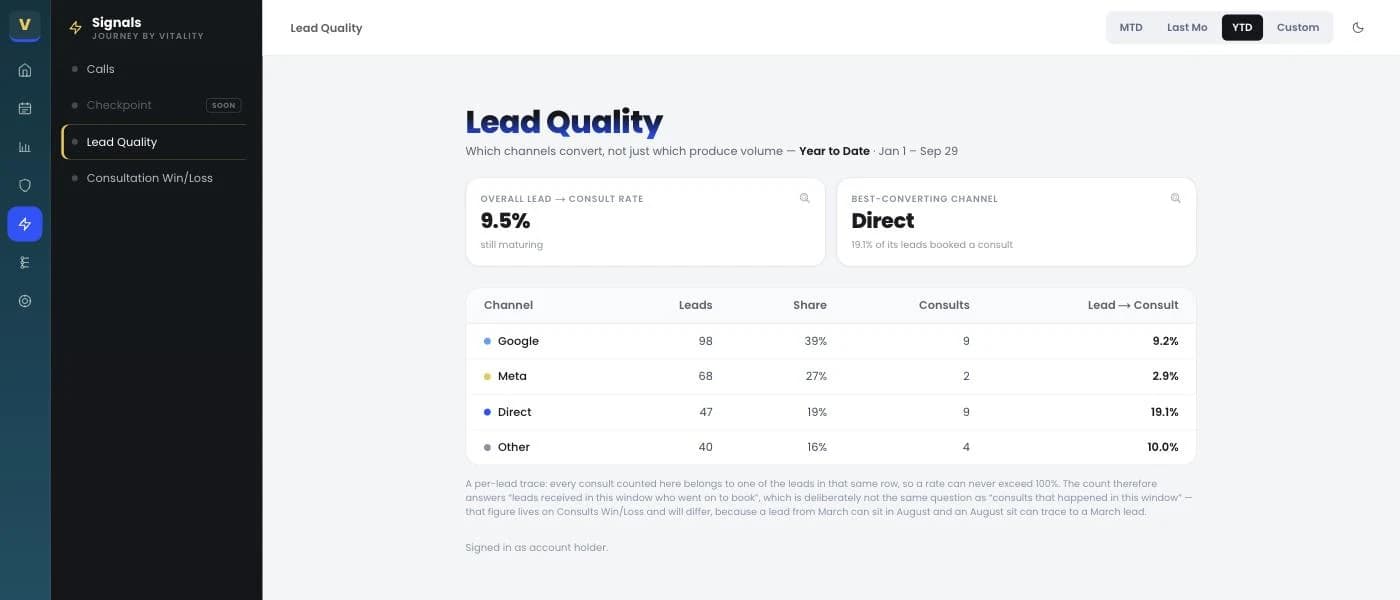
Every inquiry keeps its source. Every consult and every cycle or program start is matched back to the campaign that produced it and returned to the ad platforms as an offline conversion. What you read is not a channel report, it is a ledger: what was invested, what it produced, and what the return was, month by month.
The account is yours. The data is yours. You can audit any figure on any screen against your own records, which is the point of publishing definitions before numbers.
What an engagement includes
One program across both sides of the practice.
Fertility and men’s health are usually run by two vendors who never speak, which is how a practice ends up with two definitions of a lead and two versions of its own results. One program, one set of definitions, one report.
- Compliance review of every ad, landing page and claim before it runs
- Success-rate presentation written to SART guidance and kept current
- LegitScript and certification status confirmed ahead of any telehealth campaign
- Paid search and paid social managed to cost per qualified consult
- SEO and AI answer visibility across the full research window
- Speed-to-lead and nurture built for a decision that pauses and restarts
- Offline conversion attribution to consults, cycle starts and program starts
- Business associate agreement in place wherever inquiry data is handled
Attribution
Counted in cycles and programs started.
An inquiry is not a result. A consult is not a result either, in a specialty where a consult can precede a decision by two months. The result is a cycle started or a program started, and that is what every campaign here is judged on, by campaign and by service line, in accounts you own.
Getting there takes offline conversion tracking rather than a pixel: the click identifier is preserved in hidden fields at inquiry, the outcome is matched back when it happens, and the outcome alone is returned to the platform. No patient detail leaves your systems to make the number appear.
It is the same closed-loop system we have run in hair restoration since 2011, a specialty with the same months-long consideration cycle and the same compliance exposure. The full architecture is documented on our methodology page.
Questions
Fertility and men’s health marketing, answered straight
Can fertility clinics run Google Ads at all?
Yes. Treatment and consult advertising runs normally in the United States. What is restricted is personalized advertising on this content: Customer Match, your-data segments, lookalikes, audience expansion and advertiser-curated audiences are all unavailable for fertility, pregnancy and intimate-health topics. Campaigns still serve. They simply cannot be steered by an audience you build, which is why intent-led search and organic visibility carry more weight here than in any other specialty we work in.
Why can we not advertise our success rates the way we want to?
Because two rules sit on top of them. The Fertility Clinic Success Rate and Certification Act of 1992 governs reporting, and SART’s advertising guidelines govern use: no ranking or comparison of clinics using SART data, no superiority claims, and nothing that leads a patient to believe their chances are better than they are. Live birth per cycle initiated and per retrieval, current and sourced, is the presentation that both converts and survives scrutiny.
Do we need LegitScript certification?
If any part of the practice prescribes through telehealth, almost certainly yes, before Google will run those ads. An in-person practice advertising consultations generally does not. It is the first thing we check on a men’s health account, because the certification takes time and no amount of copy editing substitutes for it.
Is it safe to put a fertility quiz or self-assessment on our site?
Only if it is built as a health-data intake, which most are not. A visitor entering age, cycle history or a diagnosis has handed you health information through a browser, and on a typical site that page carries the same advertising pixels as the homepage. Built correctly the tool still qualifies and still books: pixels stay off the collection steps, responses are captured first-party, and only the outcome goes back to the ad platforms.
How do you market the men’s health side without sounding like a supplement ad?
By selling the evaluation rather than the outcome, and by never describing the reader’s own body back to him. That is our standing rule for invasive and sensitive care, and it also happens to be what Google’s personalized advertising policy requires. The practical result is copy that reads like a physician’s practice instead of a direct-response funnel, which is the only version that earns the first call.
How long before we can judge the program?
Long enough to see a decision cycle complete. Initial workup commonly runs six to eight weeks, and a stimulation cycle through to a pregnancy test commonly runs another six to eight, so a fertility program judged at 30 days is being judged on inquiries rather than outcomes. We report leading indicators weekly from day one and hold the program to cycle starts once the first cohort has had time to arrive.
Go deeper
Related work and free tools.
Find out what your funnel is really producing.
The Practice Growth Audit traces demand, response and follow-up from first click to cycle start, and tells you which of the tactics you are currently paying for are permitted in your category. Free, built by hand, yours to keep.