




PRP marketing restrictions are the reason so many hair restoration and aesthetics practices watch their ad accounts get suspended without warning. The treatment sits in a regulatory gray zone: legal to perform in a physician’s office, yet classified by the major ad platforms as speculative and experimental. That mismatch catches practice after practice off guard. This guide is the complete map of what you can and cannot say when marketing PRP for hair loss across paid search, paid social, and organic content, and what to build instead when the paid channels close.
Our original piece on PPC for PRP hair loss covered the Google Ads problem. This pillar expands that foundation across every platform, every regulator, and every content surface a practice owns.
Why PRP Marketing Restrictions Exist
Platelet-rich plasma occupies an unusual position in medicine. The centrifuge systems used to prepare it are legitimate, FDA-cleared devices. The injections themselves are legal under the practice of medicine. But no PRP product or protocol holds FDA approval as a treatment for androgenetic alopecia. That last fact drives everything else in this guide.
Platelet-Rich Plasma (PRP)
A concentration of platelets derived from a patient’s own blood, prepared with an FDA-cleared centrifuge device and reinjected at the treatment site. The devices are cleared by the FDA; the use of PRP for hair loss is an off-label clinical application, not an FDA-approved therapy.
Ad platforms do not evaluate clinical nuance. They draw hard category lines, and PRP lands on the wrong side of the line that matters most: unproven or experimental medical treatment. Google made this explicit in its September 2019 healthcare policy update, which prohibited ads for stem cell therapy, cellular therapy, gene therapy, and similar regenerative products lacking established biomedical or scientific basis. PRP is treated as cellular therapy under this framework.
The commercial consequence is severe because the demand is real. Patients actively search for PRP, practices want to meet that demand, and an entire cottage industry of ad vendors promises workarounds. Most of those workarounds violate policy, and the penalty is rarely limited to one rejected ad. Platforms suspend accounts, and appeals against experimental-treatment suspensions rarely succeed.
Understanding PRP marketing restrictions therefore starts with accepting the premise behind them: regulators and platforms treat PRP for hair loss as a promising but unproven therapy, and every rule downstream flows from that classification.
Google Ads PRP Marketing Restrictions
Google’s Healthcare and medicines policy is the controlling document for search, display, and YouTube ads. For PRP, the operative section is the prohibition on speculative and experimental medical treatments. This is a prohibition, not a certification gate. There is no form to fill out, no LegitScript equivalent, and no country where Google permits direct PRP promotion for hair loss.
What triggers a disapproval
Google’s automated review reads far more than your headline. Disapprovals and account-level enforcement have been triggered by each of the following:
- Ad copy naming PRP or close variants: platelet-rich plasma, PRP injections, PRP therapy, vampire treatments.
- Keywords targeting PRP queries, even when the ad copy itself is clean. Google evaluates the keyword, the ad, and the landing page as one unit.
- Landing pages that promote PRP, including pages an ad never linked to. Crawlers evaluate the destination domain, and a promotional PRP service page can restrict every campaign in the account.
- Blog content that reads as promotional. A single blog post positioning PRP as an effective treatment has triggered account-wide restrictions for practices whose ads never mentioned the treatment.
That third and fourth pattern surprises practice owners most. The account bans we see in audits rarely come from a rogue ad. They come from a well-meaning marketing team running compliant ads for hair transplant consultations while the same domain hosts a PRP service page promising regrowth. Google reads the domain, connects the two, and enforces at the account level.
The repeat-offender ladder
Since 2021 Google has operated a strike system for many policy categories, and experimental-treatment violations compound quickly: first a warning, then temporary holds, then suspension. Suspended accounts lose history, quality signals, and remarketing audiences that took years to build. For a practice spending five figures monthly, the rebuild cost dwarfs whatever the PRP campaign would have earned. We covered the tactical details, including which ad formats fail fastest, in the original PPC for PRP hair loss analysis.
Three ban patterns from real audits
Across the compliance audits we run for hair restoration and aesthetics accounts, PRP enforcement follows three repeatable patterns.
Pattern one: the inherited service page. A practice hires a new agency to run transplant campaigns. The agency never mentions PRP. Six weeks in, every campaign is restricted because a PRP service page from a previous vendor still promises “natural regrowth without surgery.” The agency did not create the violation, but the account absorbed it. Domain audits before launch exist to catch exactly this.
Pattern two: the keyword expansion. A performing search campaign gets broad match expansion, the algorithm discovers cheap PRP queries, and the account starts serving transplant ads against platelet-rich plasma searches. Google reads the keyword-to-landing-page pair as experimental-treatment promotion and issues a policy strike. The fix is preventive: PRP terms belong in the negative keyword list of every hair restoration account, permanently.
Pattern three: the helpful blog post. A staff member publishes “5 Reasons PRP Is the Best Treatment for Thinning Hair.” Organic content is not reviewed by the ads system until the domain is, and when the crawler finds it, the restriction lands account-wide. Educational PRP content survives review; superlative promotional content does not. The difference is claim structure, which the compliant-marketing section below breaks down.
The strategic read on Google’s trajectory is consistent with everything else the platform has done in healthcare: policy tightens over time, and enforcement automation improves every quarter. Our review of the future of healthcare advertising on Google goes deeper on where this is heading.

How Google Ads enforcement escalates from a single PRP ad to account-level suspension.
Meta, TikTok, and YouTube Rules for PRP
Paid social operates under different policy documents but arrives at a similar destination. Each platform adds its own restrictions on top of the experimental-treatment problem.
Meta (Facebook and Instagram)
Meta’s ad standards restrict PRP promotion through three separate policy layers. The personal attributes policy prohibits ads that imply the viewer has a health condition, which eliminates most hair loss targeting language. The health and wellness restrictions limit how ads can depict bodies and outcomes. And the unacceptable business practices rules catch exaggerated regenerative claims. Before-and-after imagery deserves special mention: Meta restricts images that show idealized or unexpected results, and hair transformation photos are among the most commonly rejected creative formats in the aesthetics vertical. Repeated rejections degrade account quality scores, which raises costs on every campaign the practice runs, not just the offending one.
TikTok
TikTok’s ad policies are the most restrictive of the major platforms for medical aesthetics. Cosmetic procedure ads face country-level restrictions, before-and-after content is prohibited in ads, and injectable treatments are broadly banned as ad subjects in the United States. Organic TikTok content is governed more loosely, which is why the platform still matters in an off-platform strategy, but paid PRP promotion is effectively closed.
YouTube
YouTube ads run on Google Ads infrastructure and inherit the full Healthcare and medicines policy, including the experimental-treatment prohibition. Organic YouTube content follows community guidelines instead, which permit educational medical content with appropriate context. The same video can be fine as organic content and banned as an ad.
| Platform | Direct PRP ads | Before/after creative | Primary policy risk |
|---|---|---|---|
| Google Search | Prohibited | N/A | Account suspension via experimental-treatment policy |
| Meta (FB/IG) | Restricted to prohibited | Restricted | Account quality degradation, ad rejection cascades |
| TikTok Ads | Prohibited (US) | Prohibited | Advertiser account ban |
| YouTube Ads | Prohibited | Restricted | Inherits Google Ads enforcement |
| Organic content (all) | Permitted with care | Platform rules vary | FTC substantiation, board rules |
FTC, FDA, and State-Level Rules
Platform policy is only half the map. Federal and state regulators impose obligations that apply to every marketing surface, including your website, email, and organic social.
The FTC standard: substantiation
The FTC’s Health Products Compliance Guidance requires that health claims be backed by competent and reliable scientific evidence before they are made. Claiming PRP regrows hair, thickens hair, or stops shedding is a health claim. The current evidence base for PRP in androgenetic alopecia is a set of small trials with heterogeneous protocols and mixed results, which is precisely the kind of record the FTC considers insufficient for strong efficacy claims.
The FTC’s updated Endorsement Guides extend the same standard to testimonials. A patient testimonial that says “PRP gave me my hair back” is an efficacy claim the practice adopts by publishing it. The old defense of adding “results may vary” no longer works; the guides state plainly that disclaimers do not cure an unsubstantiated typicality claim. Practices must also disclose any material connection, including discounted treatments given in exchange for reviews.
The FDA position
The FDA’s consumer guidance on regenerative medicine draws the line clearly: PRP preparation devices hold 510(k) clearance, but that clearance does not extend to marketing PRP as a treatment for hair loss. Describing PRP as “FDA-approved” in any patient-facing material is false and is one of the fastest ways to attract both regulator and platform attention. The agency has issued warning letters across the regenerative medicine category to clinics making unapproved treatment claims, and its enforcement posture has tightened since the discretion period for regenerative products ended in 2021.
State medical boards
State boards regulate physician advertising independently of the FTC, and several states impose disclosure requirements that catch multi-provider practices: the name of the supervising or treating physician in advertisements, rules on advertising under trade names, and restrictions on advertising off-label uses without disclosure. Board complaints are public record in most states, so a single competitor or unhappy patient filing over a PRP claim creates a durable paper trail. Before running any PRP content, verify the advertising chapter of your own state’s medical practice act, and if you operate in multiple states, verify each one.

Three regulators, three separate obligations that apply to every PRP marketing surface.
What Compliant PRP Marketing Looks Like
PRP marketing restrictions close the direct-promotion path, but they leave a workable lane open: educational, consult-first marketing that describes the service without claiming outcomes. The practices that navigate this well share a set of habits.
Compliant framing, side by side
The difference between banned and compliant copy is usually the claim structure, not the topic. Compare the patterns:
- Banned: “PRP regrows thinning hair in 3 sessions.” Compliant: “Our practice offers PRP as one of several hair restoration options. A consultation determines whether you are a candidate.”
- Banned: “FDA-approved PRP therapy.” Compliant: “PRP is prepared with FDA-cleared devices and offered as an off-label treatment for hair loss.”
- Banned: “Guaranteed thicker hair or your money back.” Compliant: “Published results vary by patient and protocol. We review the current evidence with you before recommending treatment.”
Notice what the compliant versions do: they describe the service, cite the regulatory status honestly, and route the efficacy conversation into the consultation room where individualized medical advice belongs. This consult-first structure is the same architecture we recommend for every invasive or restricted procedure, and it converts. The consultation is the product your marketing sells; the treatment decision happens inside the doctor-patient relationship.
Landing pages that survive review
A compliant PRP page reads like a patient education resource, not a sales page. It covers the mechanism, the preparation process, the off-label status, candidacy factors, and what a consultation involves. It avoids superlatives, outcome percentages pulled from single small studies, and urgency devices. It never appears as the destination of a paid ad. And because ad crawlers evaluate the whole domain, even practices that only advertise transplant services should audit their PRP pages against these standards.
Photos and testimonials
Before-and-after photos of PRP patients carry three simultaneous obligations: written patient consent that covers marketing use, honest presentation with matched lighting and grooming, and platform-specific placement rules that generally keep them off paid placements. Written testimonials must pass the FTC standard above. The safest testimonial content focuses on experience rather than outcome: how the practice communicated, what the visits were like, how questions were handled. Experience claims need no clinical substantiation.
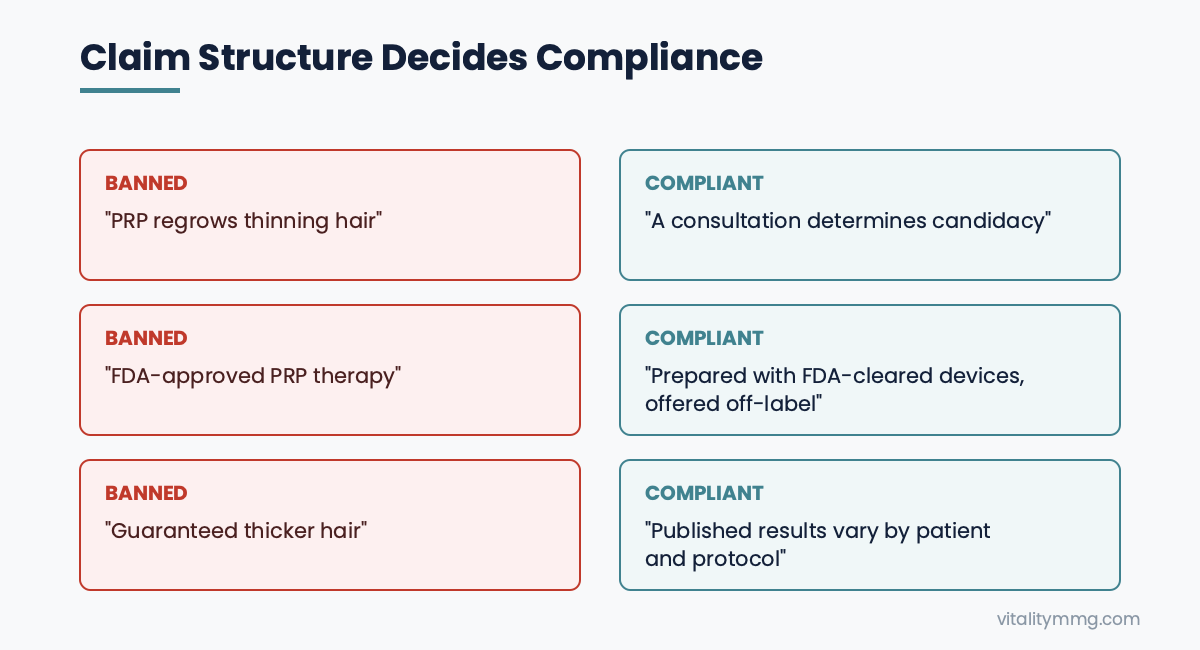
Claim structure, not topic, separates banned PRP copy from compliant copy.
Build the paper trail before you need it
Compliant framing only protects a practice that can prove it. Keep a dated archive of every ad, landing page version, and email that mentions PRP, along with the substantiation file behind any factual statement you publish. When a platform reviewer, a board investigator, or an FTC inquiry asks why a claim was made, the practices that answer with documentation close the matter quickly. The practices that answer with memory do not. This habit costs an hour a month and converts PRP marketing restrictions from an existential account risk into a manageable operating constraint.
Off-Platform Strategies That Outperform Paid Ads
When paid channels are closed, the practices that win PRP demand are the ones that own the organic surfaces where patients research. This is not a consolation prize. Organic capture of PRP queries compounds, costs nothing per click, and cannot be suspended.
Organic search and content
Google’s ad policy does not govern its organic index. A deep, honest, well-structured PRP resource can rank for the exact queries you cannot buy, and AI search surfaces increasingly cite exactly this kind of content. The requirements are the ones this guide models: accurate regulatory framing, no outcome promises, real clinical specificity. Pair the pillar resource with supporting posts and route readers toward consultation booking, the same architecture behind our hair restoration lead generation system.
Email nurture
Email is the least restricted channel in this entire guide. Once a prospect opts in, you can discuss PRP candidacy, evidence, pricing, and process in depth, subject only to FTC truthfulness standards and CAN-SPAM mechanics. Practices that pair an educational lead magnet with a structured nurture sequence convert restricted-treatment demand that paid ads can never touch. The sequence design principles in our consultation conversion framework apply directly.
The channels that need caution
Google Business Profile posts should stay away from promotional medical claims entirely; profile suspensions are harder to appeal than ad disapprovals. Organic social can host educational PRP content, but the moment a post is boosted it becomes an ad and inherits every restriction in this guide. And any tracking stack behind PRP content must respect health-data rules; our analysis of patient data breach liability covers why the tracking layer is its own compliance surface.
One adjacent lesson worth borrowing: the med spa vertical faced this exact playbook with GLP-1 marketing, and the compliant-framing patterns transfer almost one to one. Our guide on what med spas can and cannot say about GLP-1 shows the same consult-first architecture applied to a different restricted treatment.

Owned channels capture PRP demand that paid platforms will not sell you.
PRP Marketing Restrictions: Common Questions
Can I run Google Ads for PRP hair loss treatment at all?
No. Google’s experimental-treatments policy prohibits ads promoting PRP for hair loss in every country, with no certification path or exception process. Ads, keywords, and landing pages are evaluated together, so routing a clean ad to a PRP page fails the same review. The workable move is advertising the consultation for hair restoration broadly while keeping PRP promotion out of the paid funnel entirely.
Can I call PRP “FDA-approved” if the centrifuge device is cleared?
No. Device clearance under 510(k) covers the equipment that prepares the plasma, not the treatment of hair loss. Marketing that transfers the device’s regulatory status to the therapy is a false claim under FTC standards and a red flag for platform reviewers. The accurate formulation is that PRP is prepared with FDA-cleared devices and offered off-label for hair loss.
Can I boost an organic post about PRP?
Boosting converts organic content into an ad, and the full set of PRP marketing restrictions applies the moment money is behind the post. A compliant educational post can be rejected as a boosted placement, and repeated rejections damage the ad account’s standing. Keep PRP content organic and put paid budget behind unrestricted consultation offers instead.
Do these restrictions apply to my website and email too?
Platform policies govern paid placements, but the FTC substantiation standard and your state medical board’s advertising rules apply to every surface you publish on, including your website, email sequences, and social profiles. Ad platform crawlers also read your domain when reviewing your account, so a non-compliant PRP page hurts you even if you never advertise it.
What should a practice run in paid channels instead?
Consult-first campaigns for hair restoration as a category. Sell the evaluation, the diagnostic workup, and the credibility of the practice. That structure is fully policy-compliant, it captures the same patient demand upstream of any treatment decision, and it feeds every service line you offer rather than one restricted procedure.
Key Takeaways
- No PRP protocol is FDA-approved for hair loss; every platform and regulator rule flows from that classification.
- Google prohibits PRP promotion under its experimental-treatments policy, and enforcement reaches landing pages and blog content, not just ads.
- Meta, TikTok, and YouTube each restrict PRP ads through separate policies; organic content follows different, looser rules.
- The FTC requires competent and reliable scientific evidence for efficacy claims, and testimonials carry the same burden as ad copy.
- Compliant PRP marketing is consult-first: describe the service, state the off-label status honestly, and sell the evaluation.
- Organic search, content, and email nurture capture PRP demand that paid channels cannot, and they compound instead of getting suspended.
Audit Your PRP Marketing Before Google Does
VMMG builds compliant growth systems for hair restoration and aesthetics practices, with medical ad policy expertise generalist agencies cannot match.