




In August 2020, Bosley, Inc., one of the best known names in hair transplant and hair restoration care, suffered a ransomware attack that exposed the personal and medical information of more than 100,000 people. The company did not notify those individuals until January and February of 2021, months after the breach occurred. A negligence lawsuit followed, and Bosley settled for $500,000 without admitting wrongdoing. For hair restoration and medical aesthetics practice owners, the headline number is not the real story. The real story is patient data breach liability: how it gets calculated, why a company with 100,000-plus affected patients can settle for half a million dollars, and what that gap between theoretical exposure and actual payout should tell you about protecting your own practice before you become the next case study.
What Happened in the Bosley Data Breach
Bosley operates hair transplant and hair restoration clinics across the United States, and by 2020 had built a large enough patient base that a single incident touched more than 100,000 people. In August 2020, the company’s systems were hit by ransomware. Attackers accessed personal information that included Social Security numbers, driver’s license numbers, financial account details, medical information, and health insurance data, according to court records cited by Top Class Actions and Mason LLP, the firm that represented the class.
Bosley did not send breach notification letters until January and February of 2021, five to six months after the incident. That gap became part of the legal claim. The lawsuit alleged negligence: that Bosley failed to properly protect patient and customer information, and that it delayed notifying the people whose data was exposed. Delayed notification matters because it extends the window in which stolen Social Security numbers and financial information can be used for identity theft before the affected person even knows to watch for it. The U.S. District Court for the Central District of California later granted final approval of the resulting settlement, as reported by Bloomberg Law.
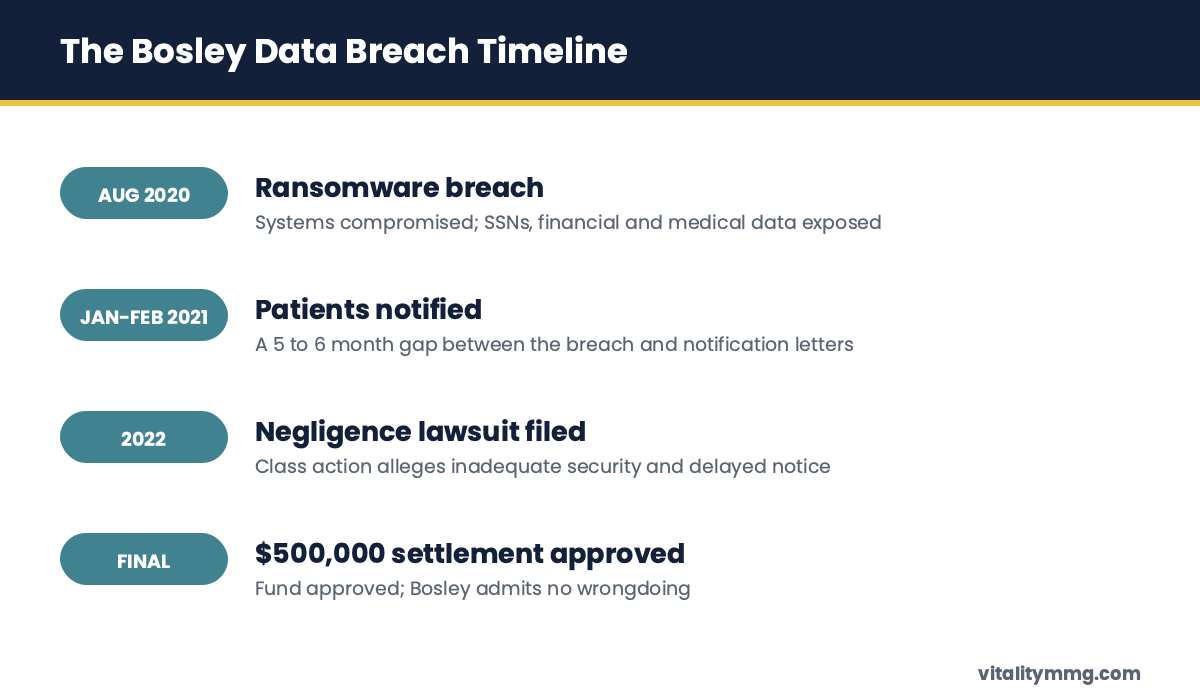
The notification gap between the August 2020 breach and the January to February 2021 notice became part of the negligence claim against Bosley.
Understanding Patient Data Breach Liability in a Class Action Settlement
Patient data breach liability in a case like this does not work the way most practice owners assume. Bosley was not fined $500,000 by a regulator. It agreed to fund a $500,000 settlement to resolve a civil class action, and it admitted no wrongdoing as part of that agreement. That distinction matters, because it shapes what the settlement fund actually pays out and to whom.
The settlement created two tiers of compensation. Ordinary expense reimbursement covered documented costs such as credit monitoring, card replacement, and up to four hours of lost time at $20 an hour, capped at $300 per claimant. Extraordinary expense reimbursement covered actual, documented financial losses tied to fraud or identity theft resulting from the breach, capped at $5,000 per claimant. California residents in the class were eligible for an additional $50 in statutory damages under the CCPA, bringing their combined maximum to $5,350. The named plaintiffs who brought the case each received a $1,250 service award, and class members also received two years of fraud monitoring.
Claims-made settlement
A settlement structure where affected individuals must proactively submit a claim, often with supporting documentation, to receive payment. Unlike a straight per-person payout, the settlement fund only pays claimants who file, which is why the total fund can land far below the number of eligible people multiplied by the maximum award.
That structure, claims-made, is the detail that determines how much a company like Bosley actually pays. It is also the detail most people skip past when they read a settlement headline. Negligence claims like the one brought against Bosley typically argue two separate failures at once: inadequate security controls that allowed the breach to happen, and an unreasonably slow response once it did. Either failure on its own can support liability, and the settlement fund is priced to resolve both theories together, not just the underlying breach.
Why Bosley’s Actual Payout Was Far Below the Theoretical Exposure
Run the math on paper and the numbers get large fast. More than 100,000 people were notified of the breach. If every one of them had a documented claim for the full $5,000 extraordinary expense reimbursement, the theoretical exposure would run past $500 million, roughly a thousand times larger than the fund Bosley actually agreed to pay.

Theoretical maximum exposure at the $5,000 per-claimant cap compared with the $500,000 settlement fund Bosley actually agreed to pay.
Bosley never came close to that number, and the reason is not that its lawyers found a loophole. It is how claims-made settlements work as a category. Two structural limits shrink the theoretical figure down to the actual one. First, the extraordinary expense cap limits what any single claimant can recover, no matter how large their actual loss. Second, and more significant, the claims-made process requires each affected person to find the notice, understand it, gather documentation of a financial loss connected to the breach, and file a claim before a deadline. Industry data on claims-made data breach settlements consistently shows that only a small share of eligible class members, typically in the low single digits to low double digits as a percentage, ever file a claim at all. Bosley’s own participation rate was not confirmed in public reporting, but the pattern across this settlement category is well documented.
That combination, a per-claim cap plus a claims-made filing requirement, is why a breach affecting more than 100,000 people can resolve for $500,000 rather than the hundreds of millions the raw math implies. Bosley did not out-negotiate the exposure. It benefited from a settlement mechanism that most breached companies use, and that mechanism is not something a practice owner should count on for their own business.
The Patient Data Breach Liability Math Every Practice Owner Should Run
Here is the mistake to avoid: reading the Bosley outcome as proof that a data breach is an affordable risk. Patient data breach liability is not just the dollar figure a company ends up paying after litigation. It is every cost that happens before a settlement is ever discussed: forensic investigation, breach notification logistics, credit monitoring vendor contracts, legal defense, regulatory inquiries, and the reputational cost of a practice’s name becoming associated with a compromised patient database.
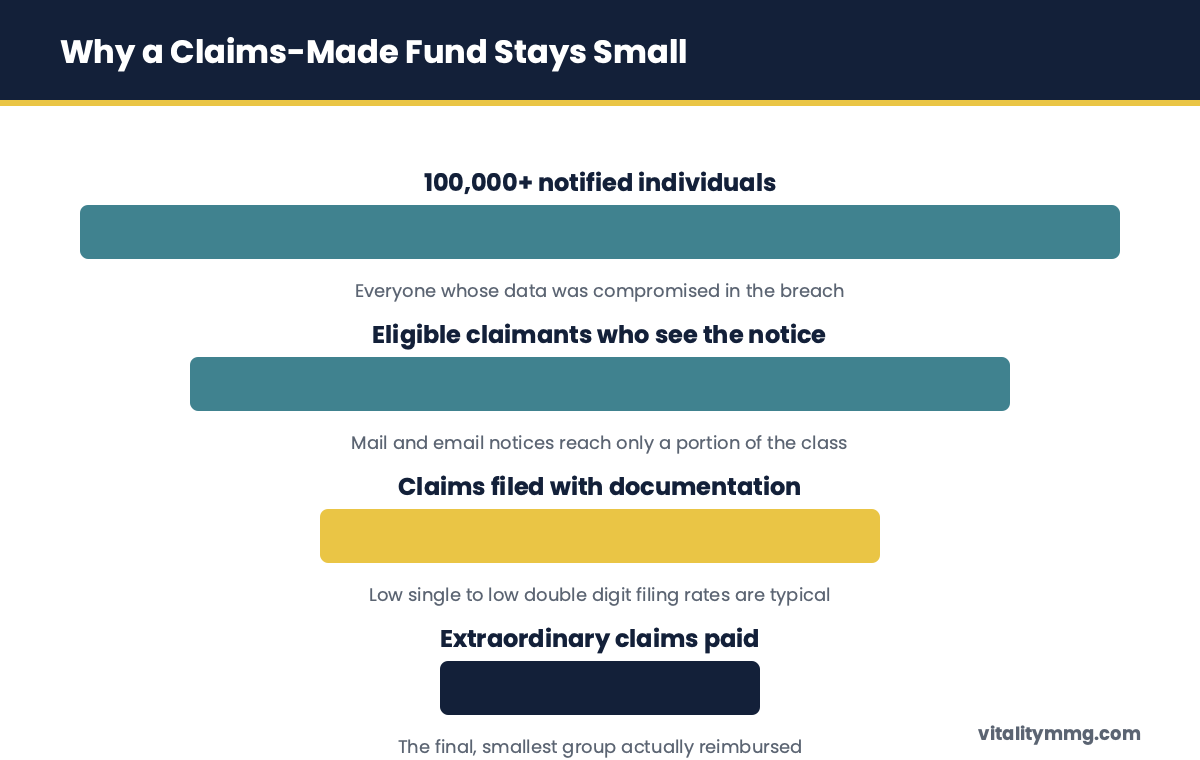
A claims-made settlement narrows at every stage: eligible class members, notified individuals, filed claims, and paid claims.
For a hair restoration or aesthetics practice, the exposure looks different than it did for Bosley, but the underlying math is the same. Your patient records already carry the categories of data that make a breach reportable and litigable: names, contact information, financial details tied to payment plans, and health information connected to consultations and procedures. A single-location practice does not need 100,000 affected patients to face a serious event. A few thousand patient records, or even a few hundred if the exposed data includes Social Security numbers or payment information, is enough to trigger state breach notification laws, legal exposure, and the same negligence theory that was brought against Bosley.
The claims-made settlement structure that capped Bosley’s payout at $500,000 is not a safety net you can plan around. It is a downstream legal mechanism that only applies after a breach has already happened, after your practice’s name is already in a notification letter, and after the trust you spent years building with patients is already damaged. The only version of this math that works in your favor is the one you run before a breach, not after.
How Hair Restoration and Aesthetics Practices Reduce This Exposure
Bosley protected itself financially the way most breached companies do, through a settlement structure and a no-fault admission, not through pre-breach investment in security or a fast response when the incident happened. Practices that want to avoid ending up in the same position start earlier, in three places.
Invest in data security before you need it
Encrypt patient data at rest and in transit, limit who inside the practice can access full patient records, and require multi-factor authentication on every system that touches scheduling, billing, or clinical notes. Ransomware attacks like the one that hit Bosley typically exploit a single weak entry point, not a sophisticated breach of a hardened system.
Build a breach response plan before an incident, not during one
The notification gap in the Bosley case, five to six months between the breach and the notice, became part of the legal claim against the company. A practice with a documented incident response plan, including who investigates, who drafts notifications, and how quickly they go out, closes that gap and reduces both legal exposure and patient harm.

Four pre-breach investments that reduce patient data breach liability before an incident ever happens.
Manage vendor risk with signed agreements, not assumptions
Most practices hand patient data to more outside vendors than they can list from memory: scheduling software, payment processors, marketing platforms, and analytics tools. Any vendor that touches protected health information should be under a signed Business Associate Agreement before that access is granted, not after a breach forces the question. A vendor’s own security failure can still create liability for the practice that hired them, which is exactly the theory the Bosley plaintiffs used against the company that held their data directly.
Audit how your tracking and advertising infrastructure handles patient data
Data breach liability is not limited to a ransomware event. HIPAA-incompatible tracking, standard analytics pixels sitting on consultation or treatment pages, and remarketing lists built from patient behavior are their own category of exposure that regulators and plaintiffs’ attorneys have increasingly targeted. Google’s own advertising policies for medical practices have tightened around exactly this issue, and campaigns built around prescription-related search terms, the kind covered in our guide to advertising hair loss treatments compliantly, carry the same underlying risk if tracking is not built correctly from the start.
This is the same ground VMMG’s compliance-first methodology is built on, and it is why our hair restoration lead generation work starts with an audit of how a practice’s website and ad accounts already handle patient data, not after a launch. If you are in California, that review should also cover your CCPA obligations for how patient and consumer data is disclosed and handled. A free compliance audit is one of the fastest ways to see where your own practice stands before a regulator, a plaintiff’s attorney, or a ransomware group finds out first.
Key Takeaways
- Bosley’s $500,000 settlement followed a 2020 ransomware breach that exposed data on 100,000+ people and a notification delay of five to six months, the basis of the negligence claim against it.
- The $5,000 extraordinary expense cap is a per-claimant maximum, not proof of Bosley’s total exposure. At that cap, the full class’s theoretical exposure would have run past $500 million.
- Claims-made settlements pay only the people who file a claim, which is the structural reason Bosley’s actual payout landed so far below the theoretical number, not clever legal strategy.
- Practice owners should treat patient data breach liability as a pre-breach investment decision, covering security, response speed, and HIPAA-aware tracking, not a post-breach settlement calculation to lean on.
Find Your Practice’s Data Exposure Before Anyone Else Does
VMMG builds hair restoration and aesthetics marketing on a compliance-first foundation, including how your website and ad accounts handle patient data.