By Jennifer Marlowe, VMMG · April 7, 2026
[toc]
PPC for PRP hair loss is one of the most frustrating challenges in medical marketing today. Your practice offers a high-demand, high-margin treatment that patients are actively searching for online, and Google will not let you advertise it directly.
Since October 2019, Google has classified platelet-rich plasma therapy as a “speculative and experimental medical treatment.” That means any ad, landing page, or even a blog post on your domain that mentions PRP can trigger disapprovals, campaign shutdowns, or strikes against your entire account.
But “banned from Google Ads” does not mean “impossible to market.” Practices that understand the policy and build their PPC for PRP hair loss strategy around it are generating consultations every week. Here is how.
Why Google Blocks PRP Hair Loss Ads
Google’s
speculative and experimental medical treatment policy lists platelet-rich plasma by name as a restricted example. The policy puts PRP in the same category as stem cell therapy and gene therapy. You cannot run ads promoting PRP, and you cannot send paid traffic to any page that mentions it.
The enforcement goes further than most practice owners expect. Google’s crawlers scan your entire landing page for restricted terms. In some cases, having PRP content anywhere on the same domain has triggered suspensions on campaigns for completely unrelated services like FUE transplants.
One mention of “platelet-rich plasma” buried in a blog post can take down your entire ad account under Google’s three-strike policy. We covered how these structural shifts are hitting clinics in our post on
Google Ads policy changes affecting medical practices.
This policy has not changed in any meaningful way through 2026. Google does allow “exclusively educational” content about cell therapies, but the exception is narrow and risky to test with real ad spend on the line.
The Landing Page Firewall: How to Run PPC for PRP Hair Loss Services Without Getting Banned
The single most important move is building a clean wall between your ad destinations and your PRP content.
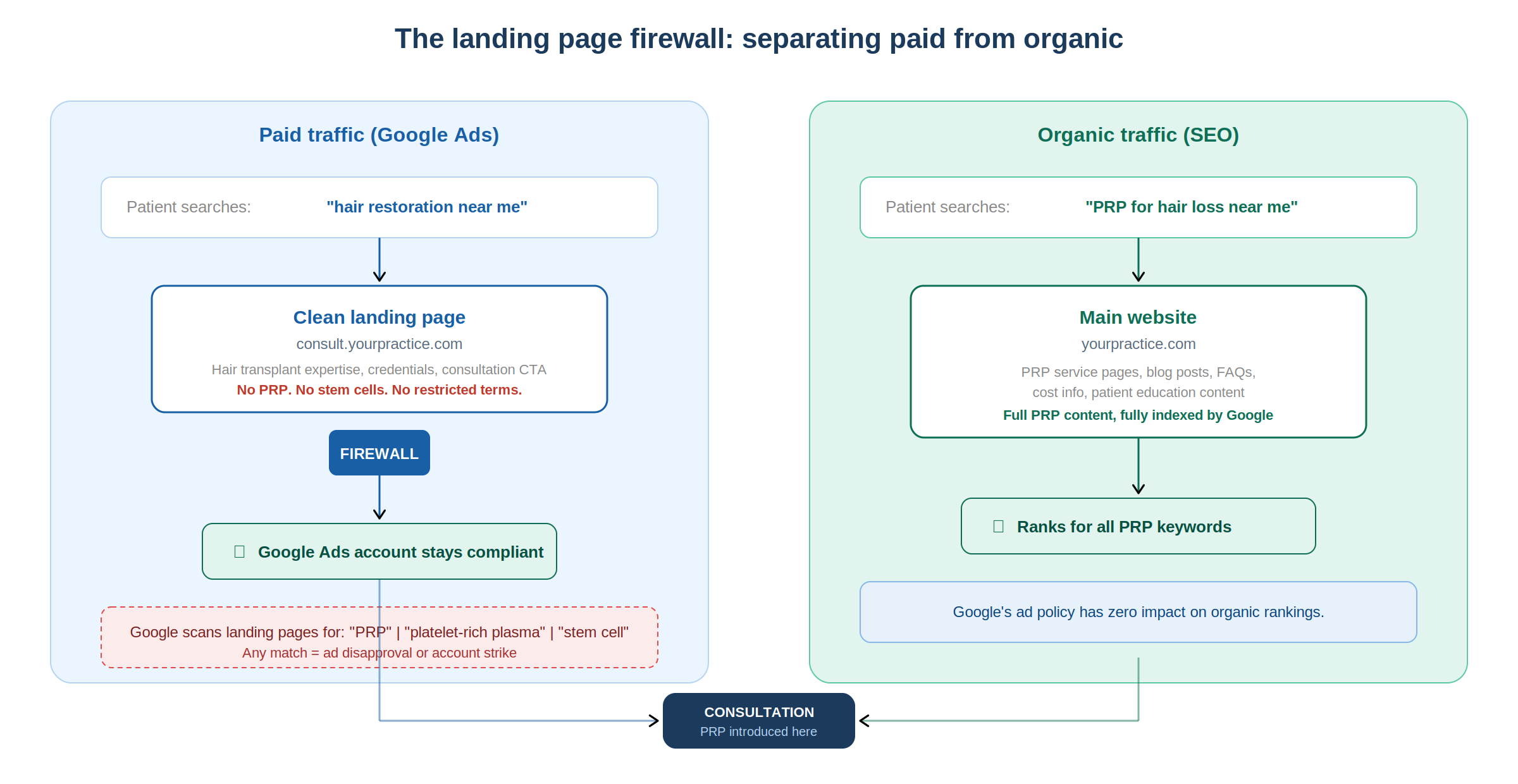
Create dedicated landing pages on a subdomain that receive all your paid traffic. These pages promote your compliant services: hair transplant consultations, non-surgical assessments, general hair restoration expertise. Zero mention of PRP, stem cells, or any restricted terms.
A subdomain like consult.yourpractice.com keeps the content isolated so Google’s crawlers do not associate your ad landing page with restricted content elsewhere on the root domain.
Your main website keeps all its PRP content intact. Service pages, blog posts, FAQs about cost and expected results. That content ranks organically and is completely unaffected by Google’s
Healthcare and Medicines advertising policy.
Here is how the patient journey bridges the gap. A prospect enters through a Google Ad for “hair transplant consultation,” lands on your clean page, sees your credentials and results, and calls or fills out a form. During intake, your team identifies their goals. By the time they sit in the consultation chair, PRP enters the conversation as a clinical recommendation. The conversion happens in the exam room, not in the ad copy.
Running Google Ads for Hair Restoration Without Mentioning PRP
Patients searching for PRP are also searching for “hair restoration near me,” “non-surgical hair loss treatment,” and “best hair loss doctor [city].” These terms are fully compliant and carry strong commercial intent.
A person researching PRP for hair loss has already decided to spend money solving their problem. Your ads just need to earn the click on broader terms, then let your website and consultation process do the rest.
Structure your campaigns around procedure-specific ad groups for each compliant service. Use tight geo-targeting with location customizers in your headlines. Run aggressive negative keyword lists, reviewed weekly, to filter out informational queries that waste budget.
Make sure call extensions are active. Hair loss patients in the 35-65 demographic, which represents the bulk of PRP and transplant revenue, prefer to pick up the phone.
Cost-per-click in hair restoration runs $8 to $25+ depending on market competition. With procedures ranging from $5,000 to $15,000, the math works if your landing pages convert and your front desk responds within five minutes. That is why our approach to
hair restoration lead generation pairs campaign management with staff training and CRM-driven follow-up.
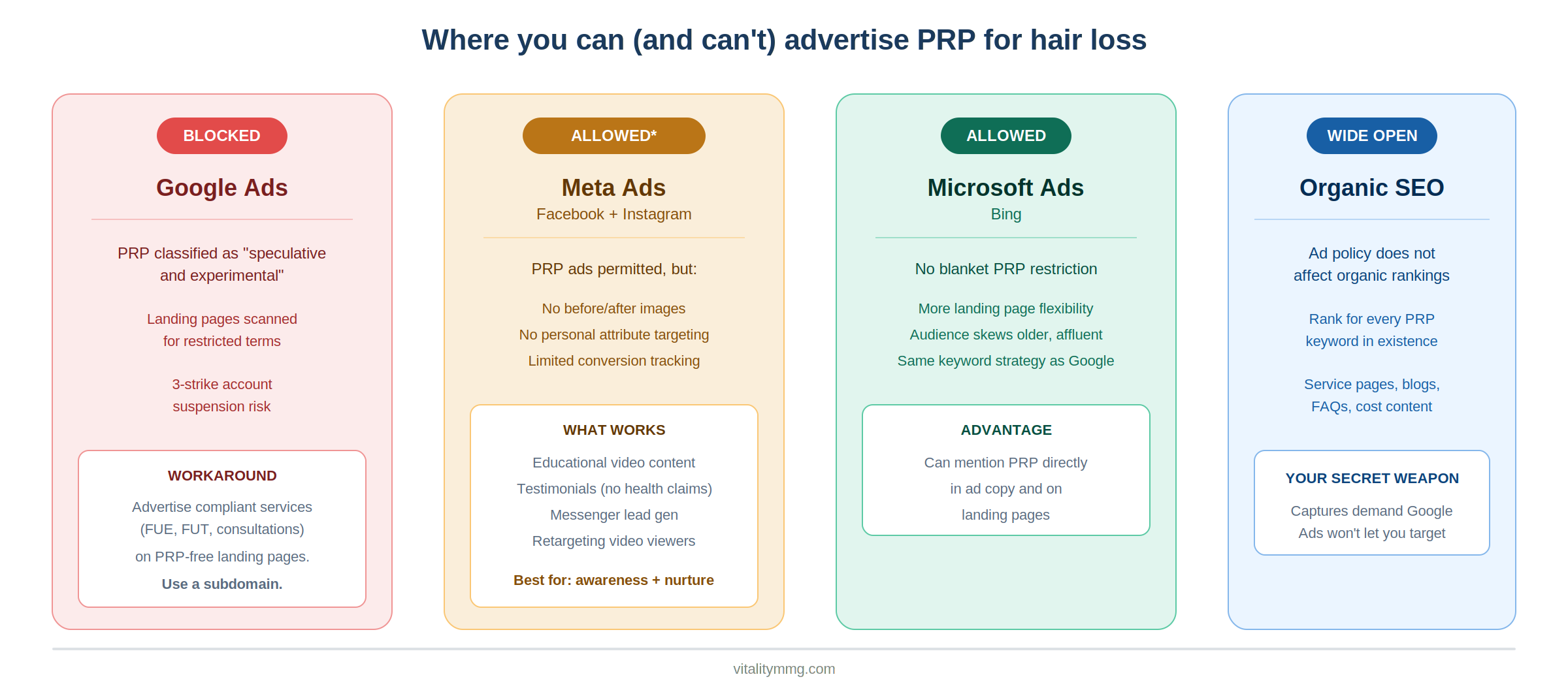
4 Channels for PPC for PRP Hair Loss Marketing: What Is Allowed and What Is Not
Google Ads: Blocked
Direct PRP promotion is prohibited. Use the landing page firewall strategy described above. Advertise compliant services on PRP-free pages.
Meta (Facebook and Instagram): Allowed With Restrictions
PRP ads are permitted but limited. No before-and-after images, no personal attribute targeting, and limited lower-funnel conversion tracking. Educational video content, patient testimonials without health claims, and Messenger-based lead generation work best. Retargeting video viewers with follow-up content is especially effective. Learn more about how we build
paid social campaigns that drive qualified leads for practices like yours.
Microsoft Ads (Bing): Allowed
No blanket PRP restriction. Bing’s audience skews older and more affluent, which maps well to the typical hair restoration patient. Apply the same keyword strategy as Google with more landing page flexibility.
Organic SEO: Wide Open
Google’s ad policy has zero impact on organic rankings. You can rank for every PRP keyword in existence. This is the most overlooked opportunity in PPC for PRP hair loss strategy, and we cover it in the next section.
Why SEO Is Your Best PPC for PRP Hair Loss Complement
While competitors strip PRP content from their sites out of ad-policy fear, you can dominate organic search for terms like “PRP for hair loss near me,” “PRP hair treatment cost,” and “is PRP worth it.”
Communities like Reddit’s r/tressless (nearly 100K subscribers) and HairLossTalk forums are filled with patients debating PRP effectiveness, sharing cost breakdowns, and asking where to find reputable providers. Those conversations are your content roadmap.
Build comprehensive service pages, FAQ sections, and blog posts that answer exactly what prospective patients are asking online. Optimize each PRP page for local search by including city-specific content and making sure your Google Business Profile lists PRP-related services.
The organic content strengthens your paid strategy too. A patient who clicks a Google Ad for “hair restoration consultation” and then finds detailed PRP content on your site is far more likely to book. The practices that commit to compliant PPC paired with aggressive PRP-focused SEO end up owning more real estate on page one than competitors relying on a single channel.
Is Your PRP Marketing Strategy Costing You Patients?
Google’s PRP ban is a detour, not a dead end. But most practices are still stuck at the roadblock, either avoiding paid advertising altogether or running campaigns that put their account at risk every time a crawler finds “platelet-rich plasma” on a landing page.
The practices filling their PRP consultation calendars right now are doing three things:
1. Running compliant PPC on clean, separated landing pages to capture high-intent hair restoration traffic.
2. Owning PRP-related organic search with authoritative content their competitors are too afraid to publish.
3. Layering Meta retargeting to stay visible through a decision cycle that can stretch weeks or months.
If any of this sounds familiar, whether it is disapproved ads, a suspended account, rising cost-per-lead, or simply not knowing if your current setup is compliant, we have seen it, fixed it, and built systems that prevent it from happening again.
Vitality Medical Marketing Group works exclusively with hair restoration and aesthetic practices. We built our reputation managing paid search and SEO for over 50 hair restoration clinics, and we understand the compliance landscape because we live in it every day.
Schedule Your Free Strategy Audit
We will review your current Google Ads setup, identify compliance risks, evaluate your organic PRP visibility, and show you exactly where leads are falling through the cracks. No obligations. Just a clear picture of what is working, what is not, and what to do next.
Call us at 631-919-0009 or book a discovery call here.