Hair Transplant Marketing Compliance Starts with What You Say About FUE and FUT
Hair transplant marketing compliance is not optional, and the fastest way to fail at it is to let your website or ad copy make claims that clinical guidelines explicitly prohibit. If your practice markets FUE as “scarless” or promises “guaranteed results,” you are not just risking an ad disapproval. You are exposing your practice to regulatory action, patient complaints, and the kind of online reputation damage that no amount of ad spend can fix.
The problem is widespread. Practices across the country are running Google Ads, publishing blog posts, and posting on social media using language that the
International Society of Hair Restoration Surgery (ISHRS) has flagged as misleading. The ISHRS has issued a formal consumer alert specifically about false advertising in hair restoration, and that alert reads like a checklist of phrases still appearing on practice websites today.
This post breaks down the specific claims you need to remove from your marketing, why they create risk, and what to say instead.
Banned Phrases: What Hair Transplant Marketing Compliance Actually Prohibits
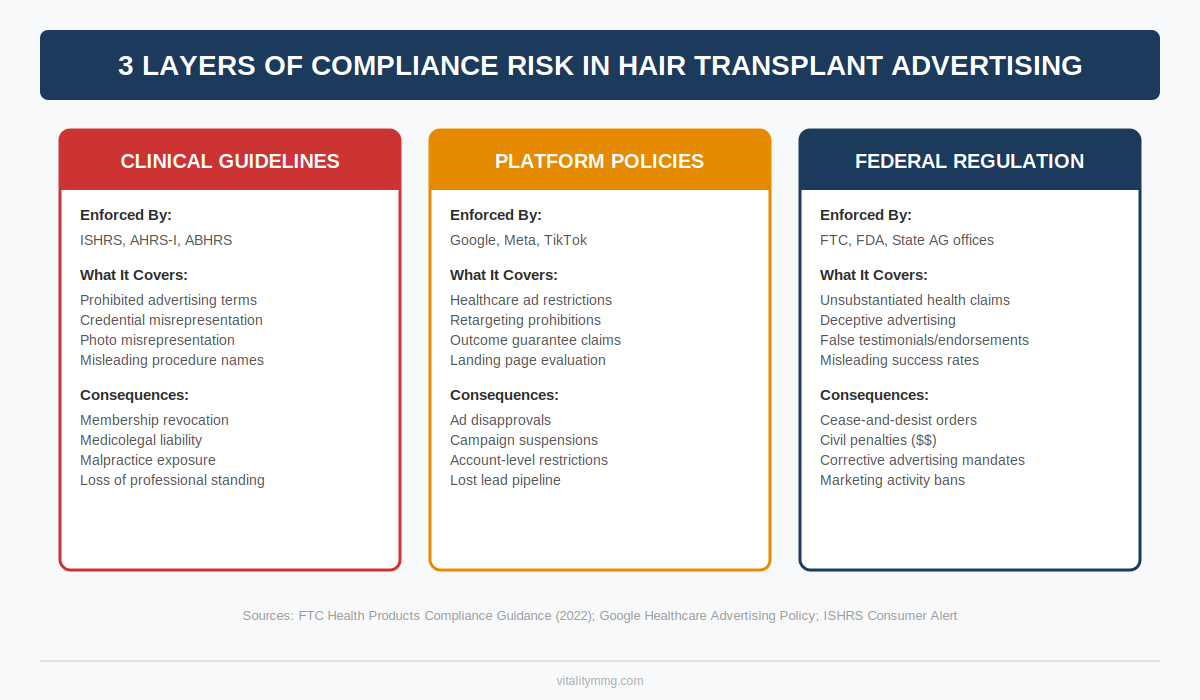
Published clinical practice guidelines from the Association of Hair Restoration Surgeons of India (AHRS-I) and the ISHRS maintain an explicit list of marketing language considered misleading to the public. These are not suggestions. They are professional standards, and violating them can trigger medicolegal consequences.
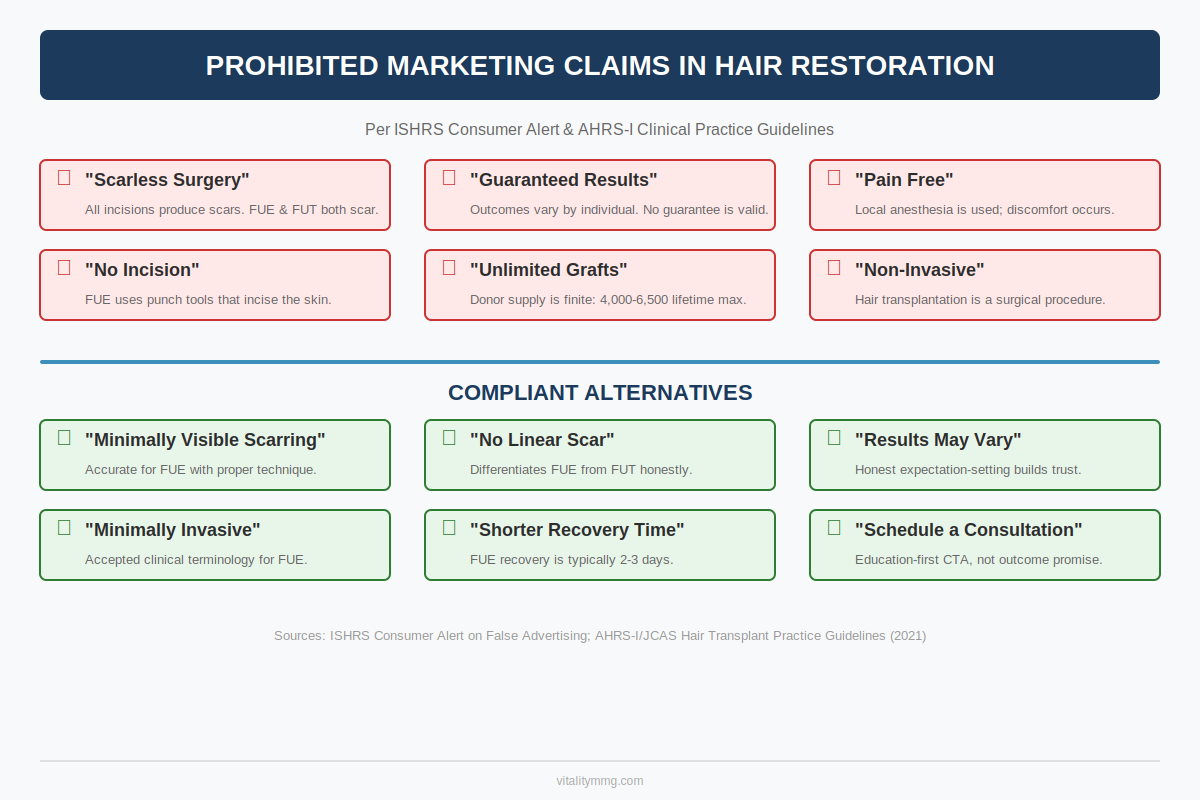
The prohibited phrases include: “scarless surgery,” “no incision,” “no touch,” “no cutting,” “cloning,” “hair multiplication,” “non-invasive,” “eliminates the need for additional procedures,” “pain free or no pain,” “unlimited grafts,” and “guaranteed results.”
If any of those phrases appear on your website, in your Google Ads, on your social media, or in your consultation materials, they need to come down. Not because a marketing agency told you so, but because the professional bodies governing your surgeons’ credentials say so.
Why “Scarless FUE” Is the Most Dangerous Claim in Hair Transplant Marketing
The single most common hair transplant marketing compliance violation is the claim that FUE is a “scarless” procedure. The ISHRS has addressed this directly, stating that any incision entering the skin beyond the most superficial depths will produce a scar. FUE creates small, circular, dot-like scars at each extraction site. FUT produces a linear scar. Both produce scars. Neither is scarless.
What the Clinical Evidence Actually Shows
FUE uses punch tools typically ranging from 0.8mm to 1.0mm in diameter. Each extraction leaves a tiny wound that heals into a small, round scar. When hundreds or thousands of grafts are extracted, those scars accumulate across the donor area. With proper technique and appropriate harvesting density, they can be virtually undetectable under normal hair length. But “undetectable under normal conditions” is not “scarless.”
What Your Marketing Should Say Instead
Replace “scarless” with accurate, still-compelling language.
“Minimally visible scarring” is honest.
“No linear scar” accurately distinguishes FUE from FUT without overpromising.
“Dot-like scars that are typically undetectable at normal hair lengths” gives patients the full picture and builds trust. Patients who feel informed convert at higher rates and leave fewer negative reviews. Accuracy is not a marketing disadvantage; it is a competitive edge.
Google Ads and Hair Transplant Marketing Compliance: The Platform Enforces It Too
Even if a practice ignores clinical guidelines, Google will not. Google’s healthcare and medicines advertising policy applies heightened scrutiny to elective medical procedures, and hair restoration falls squarely within that scope. Practices advertising on Google have already experienced significant disruptions from
Google Ads policy changes affecting medical practices.
What Gets Ads Disapproved
Google’s systems increasingly evaluate implied promises, visual cues, and overall messaging structure. Ads or landing pages that lead with outcome guarantees, before-and-after photos without proper context, or claims that overstate the certainty of results face higher disapproval rates. The phrase “guaranteed results” alone can trigger a policy review that pauses your entire campaign.
Additionally, Google restricts retargeting for healthcare services entirely. You cannot follow prospective patients with display ads after they visit your site. This makes your initial ad copy and landing page experience critical, because you get one shot to earn the click and convert the visit.
FTC Substantiation Requirements Add Another Layer
The
FTC’s Health Products Compliance Guidance requires that all health-related advertising claims be truthful, not misleading, and backed by competent and reliable scientific evidence. This applies to hair transplant practices. If your website claims a specific success rate, a particular growth percentage, or outcomes that are not substantiated by published clinical data, the FTC can pursue enforcement action including cease-and-desist orders, mandated corrective advertising, and civil penalties.
FUE vs. FUT: How to Market Both Without Hair Transplant Marketing Compliance Risk
The goal is not to stop marketing FUE or FUT. It is to market them accurately. Both are excellent procedures with distinct advantages, and your patients deserve honest information about each.
For FUE, emphasize: minimally invasive extraction, no linear scar in the donor area, shorter recovery time (typically 2 to 3 days), and suitability for patients who prefer shorter hairstyles. These are all clinically accurate and compelling selling points.
For FUT, emphasize: the ability to harvest more grafts in a single session, the gold-standard status for maximizing follicular unit yield, and the advantage for patients with advanced hair loss who need high graft counts. FUT remains the preferred method when donor supply needs to be maximized over a patient’s lifetime.
For both, disclose: that all surgical hair restoration involves scarring, that results vary by individual, that ongoing medical management may be needed to address progressive hair loss, and that multiple sessions may be required. These disclosures are not just ethical. They protect your practice legally and build the kind of patient trust that drives referrals and five-star reviews.
Your
hair restoration lead generation strategy should be built on this foundation. Leads generated through honest, compliance-first messaging convert better, cancel fewer consultations, and produce higher patient satisfaction scores.
An Audit Checklist for Hair Transplant Marketing Compliance
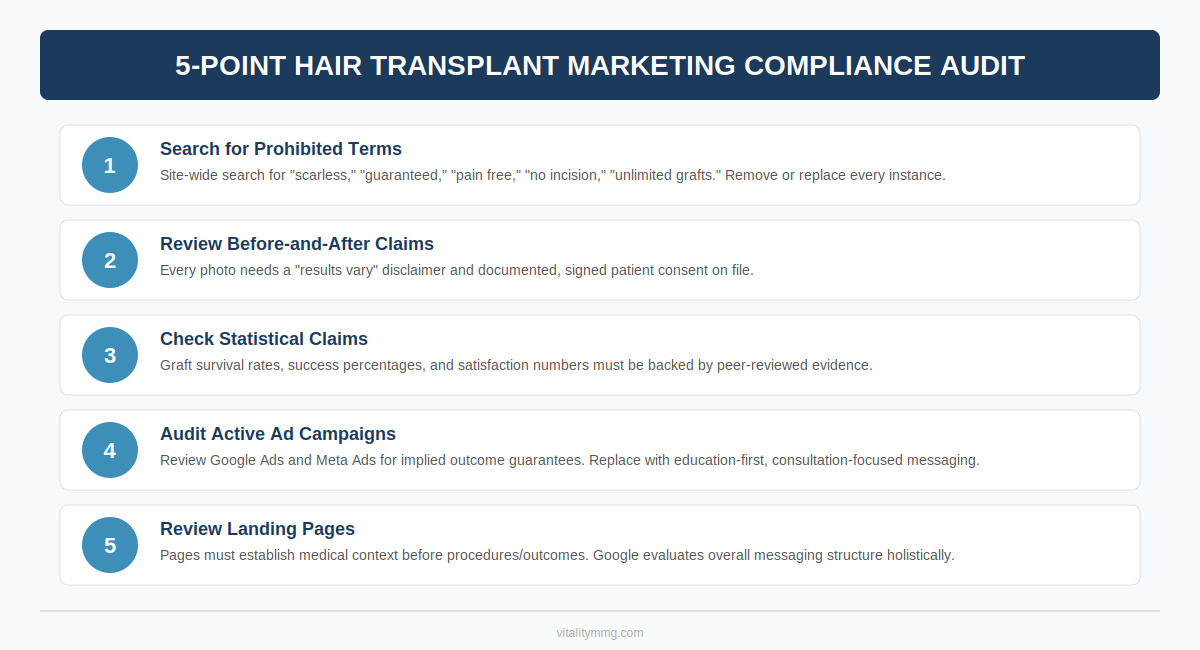
Run this hair transplant marketing compliance audit across your website, Google Ads, Meta ads, social media profiles, and printed consultation materials.
1. Search for prohibited terms. Do a site-wide search for “scarless,” “guaranteed,” “pain free,” “no incision,” “unlimited grafts,” and every other term on the ISHRS prohibited list. Remove or replace every instance.
2. Review all before-and-after claims. Ensure every before-and-after photo includes a disclaimer that results vary. Verify that you have documented, signed patient consent for every image used in marketing.
3. Check statistical claims. If your site claims a specific graft survival rate, success percentage, or patient satisfaction number, confirm it is backed by published, peer-reviewed evidence. Unsubstantiated statistics are an FTC liability.
4. Audit your ad copy. Review every active Google Ads and Meta Ads campaign for implied outcome guarantees. Replace them with education-first messaging that invites consultations rather than promising results.
5. Review landing pages. Google now evaluates landing pages holistically. Pages that jump directly to procedures and outcomes without establishing medical context, evaluation criteria, and appropriateness are more likely to face delivery issues.
Your
paid social campaigns for aesthetic practices need the same level of scrutiny. Platform policies on Meta and TikTok are tightening for healthcare advertisers, and what passes today may not pass next quarter. Rather than checking every page by hand, you can run a free
hair restoration compliance audit that scans your entire site against 238 flagged ISHRS and FTC phrases and emails the report in about five minutes.
Build Your Marketing on Compliance, Not Around It
If your practice is still running ads or publishing content with claims that clinical guidelines prohibit, your hair transplant marketing compliance is on borrowed time. Google policy changes, FTC scrutiny, ISHRS consumer alerts, and an increasingly educated patient base all point in the same direction: practices that market honestly will win.
The good news is that compliance-first marketing is not weaker marketing. It is stronger. Patients who choose your practice based on accurate information are better candidates, more satisfied with their outcomes, and more likely to refer others. Compliance-first marketing also means leading with credentials you can prove. Promoting a verifiable signal like
ABHRS board certification converts more consultations than leaning on prohibited claims.
Vitality Medical Marketing Group builds hair restoration marketing systems that are compliant from the ground up, designed for practices that want to grow without risking their reputation or their ad accounts.
Schedule Your Free Strategy Audit
Call us directly at
631-919-0009 or
schedule a consultation to get started.