




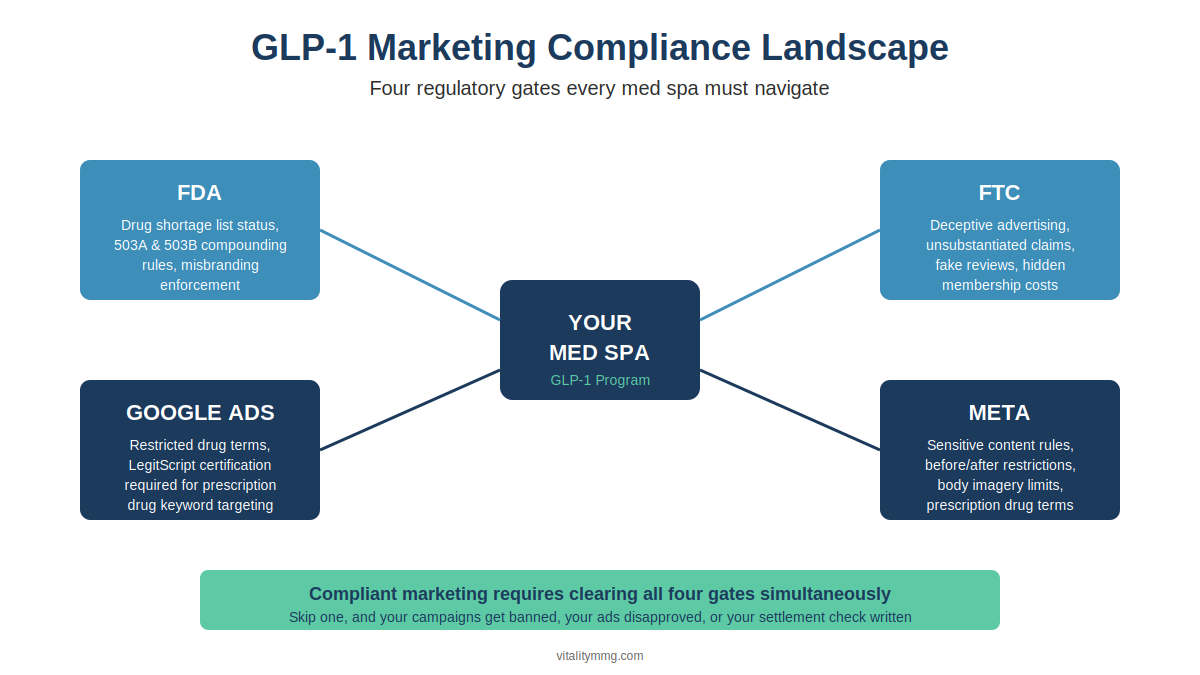
On April 30, 2026, the FDA moved to permanently shut the door on bulk-compounded weight loss drugs, proposing to exclude semaglutide, tirzepatide, and liraglutide from the 503B bulks list. For med spa owners, the timing matters. GLP-1 marketing for med spas has never been more legally fraught, and the practices that don’t understand the new rules are about to get hit twice: once by tightening Google Ads enforcement, and again by FTC actions that have already cost competitors six-figure settlements.
This guide covers what your med spa can legally say about semaglutide, tirzepatide, and compounded GLP-1 programs in 2026: the platforms, the regulators, and the messaging frameworks that won’t get your accounts banned.
What changed on April 30, 2026, and why it matters
The FDA’s proposed rule is significant for one reason: it would close the last remaining legal pathway for 503B outsourcing facilities to compound semaglutide, tirzepatide, and liraglutide from bulk substances. The shortage list pathway already closed when the FDA declared both shortages resolved in late 2024 and early 2025. The bulks list pathway was the backup. Now that’s going too.
The public comment period runs through June 29, 2026. Practical reality for most med spas hasn’t changed: 503A patient-specific compounding remains legal under narrow exceptions, but routine compounding that produces “essentially a copy” of Ozempic, Wegovy, Mounjaro, or Zepbound has been off-limits since mid-2025.
If your practice still advertises “affordable compounded semaglutide” as a routine offering, you have a legal exposure problem before you have a marketing problem.
Google Ads rules for GLP-1 marketing for med spas
Google Ads treats prescription drug terms as restricted content. Targeting keywords like “semaglutide,” “Ozempic,” “Wegovy,” “tirzepatide,” “Mounjaro,” or “Zepbound” requires LegitScript certification, which has its own application process, fees, and ongoing compliance requirements.
Most med spas are not LegitScript certified. That means most med spas cannot legally bid on the high-intent search terms patients actually use. In August 2025, Google deprecated its internal “Restricted Medical Content” label. The label is gone. The underlying policy stayed, and enforcement has gotten stricter.
What gets your med spa ads disapproved
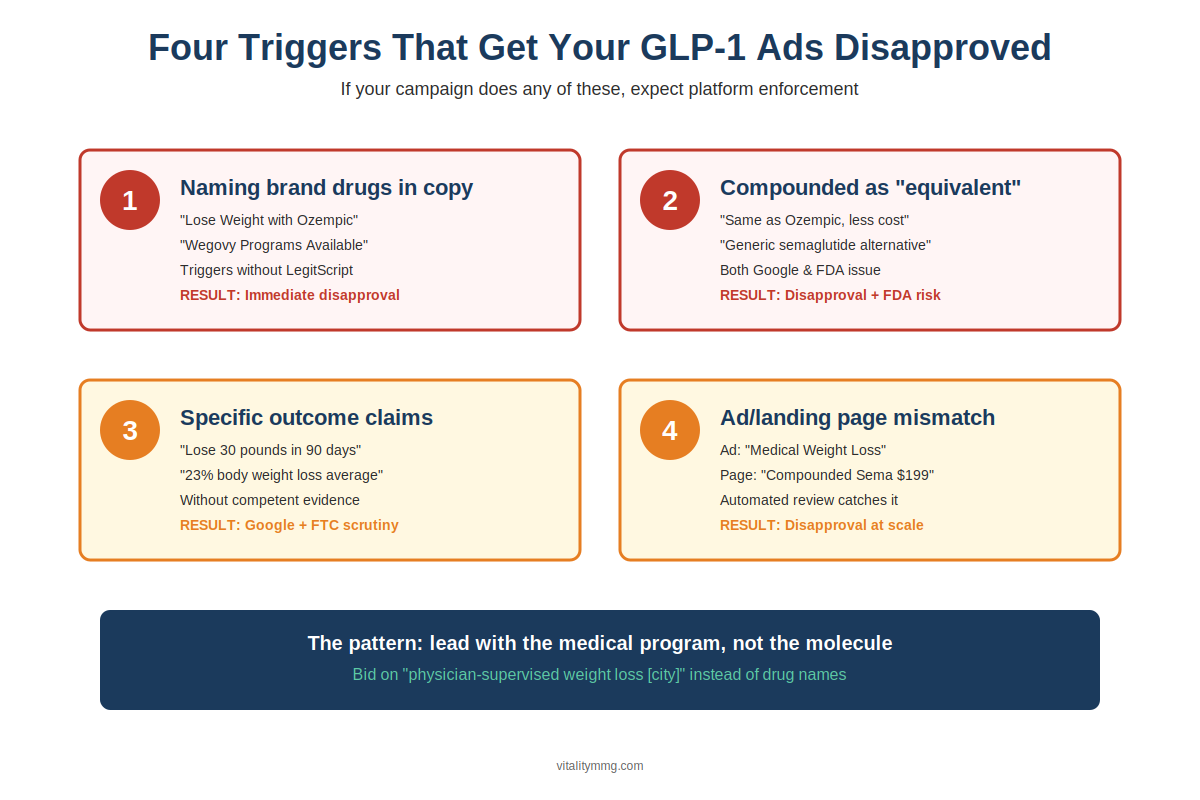
The fast path to ad disapproval, in plain language:
Naming brand-name drugs in copy. Headlines like “Lose Weight with Ozempic” get flagged immediately if you’re not certified.
Promoting compounded versions as equivalent. Any phrasing that suggests compounded semaglutide is “the same as” the FDA-approved product is both a Google policy violation and a potential FDA misbranding issue.
Making weight loss outcome claims. Specific claims like “lose 30 pounds in 90 days” trigger both Google policy and FTC scrutiny without competent scientific evidence.
Landing pages that contradict your ads. If your ad says “Medical Weight Loss” but your landing page says “Compounded Semaglutide $199/month,” Google’s automated review will catch the mismatch.
Meta and paid social compliance
Meta’s policies overlap with Google’s in spirit but differ in execution. Prescription drug names trigger restrictions, and Meta also treats weight loss content as a sensitive category. Before-and-after photos, body measurements, scale weights, and “transformation” framing get flagged whether you name a drug or not.
Practices doing compliant paid social for aesthetic services have learned to lean on lifestyle imagery, professional credibility signals, and indirect demand generation rather than direct outcome claims. Educational content performs. Outcome bragging gets banned.
What the FTC is actually enforcing
The Federal Trade Commission’s December 2025 final order against telehealth company NextMed is the clearest enforcement signal med spa operators have right now. The case involved a $150,000 settlement and explicit prohibitions against future deceptive practices.
NextMed advertised low monthly membership prices ($138 to $188) without disclosing that the price excluded the cost of the actual GLP-1 drug, lab work, and physician visits. They claimed members lost an average of 53 pounds and 23% of body weight without scientific substantiation. They posted fake positive reviews, used testimonials from people who were not actual patients, and offered Amazon gift cards in exchange for removing negative reviews.
The FTC’s final order establishes that disclosure must be clear and conspicuous, weight loss claims must be substantiated, and review manipulation is grounds for enforcement.
Three FTC traps med spas walk into
Membership fees that hide the real cost. If your $199/month “weight loss program” doesn’t include the medication cost, that needs disclosure with the same proximity and prominence as the price itself. Footnotes don’t count.
Aggregate weight loss claims without substantiation. “Patients lose an average of X pounds” requires evidence specific to your patient population. Pulling stats from clinical trials of branded drugs and applying them to your compounded program is the exact pattern the FTC went after.
Selective review solicitation. Asking only happy patients for reviews, removing negative reviews in bad faith, or incentivizing review removal all fall within the conduct the FTC has banned.
Building a compliant strategy for GLP-1 marketing for med spas
The practices succeeding share a common structure: they lead with the medical program, not the molecule. They compete on physician oversight, lab work, follow-up cadence, and integrated wellness coaching. The drug is one component, not the headline.
This positioning matters legally and competitively. It keeps you out of Google’s restricted drug term sandbox and gives you defensible substantiation for your program claims. Competitively, it differentiates you from the telehealth race-to-the-bottom on monthly compounded semaglutide pricing.
Channel strategy that works
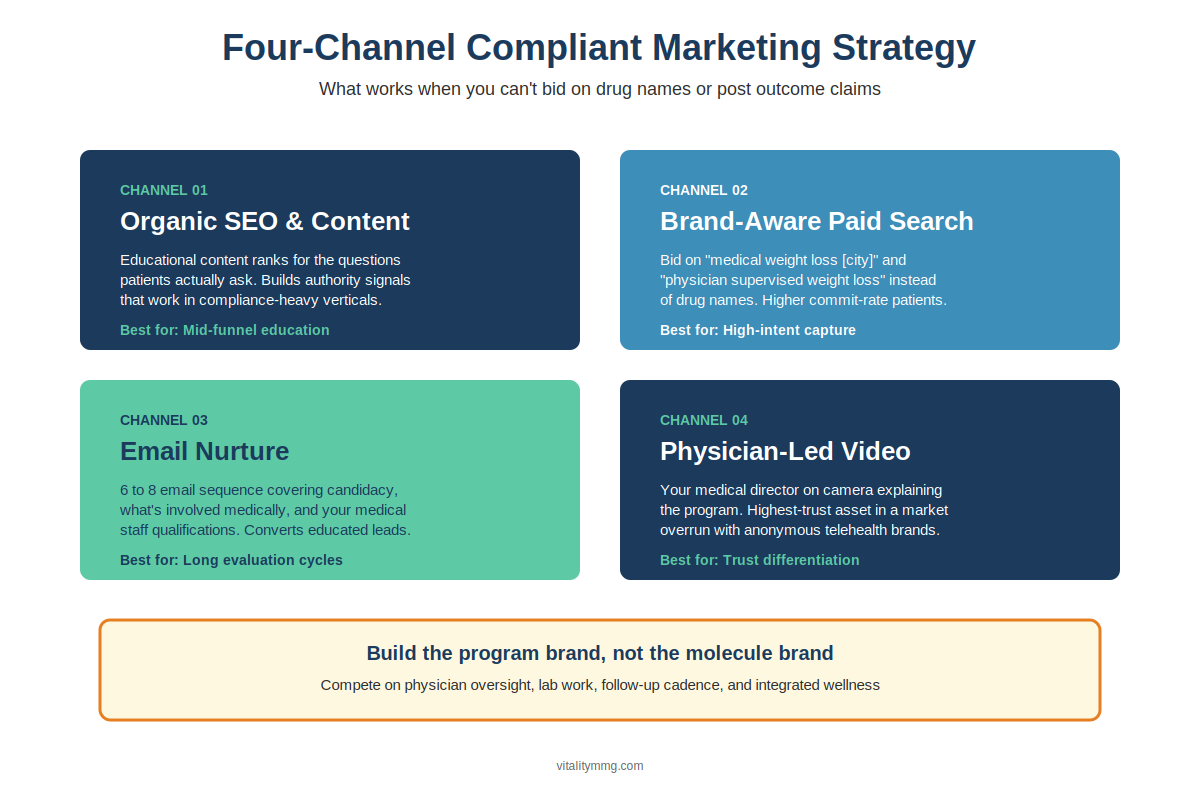
Organic SEO and content. Educational content ranks for the questions patients actually ask. This builds authority signals that work in adjacent compliance-heavy verticals.
Brand-aware paid search. Bid on “medical weight loss [city]” and “physician supervised weight loss” instead of drug names. These bring patients ready to commit to a clinical relationship.
Email nurture for the educated lead. Patients evaluating medical weight loss research the topic for weeks. A 6 to 8 email sequence covering candidacy, what’s involved medically, and the qualifications of your medical staff converts at significantly higher rates than direct ad-to-booking funnels.
Physician-led video content. Your medical director on camera explaining your program is the highest-trust asset you can build. It signals legitimacy in a market overrun with anonymous telehealth brands.
The bottom line for your practice
GLP-1 marketing for med spas in 2026 is not impossible, but it requires more discipline than most practices are bringing to it. Stop naming drugs in ads. Stop quoting weight loss numbers you can’t substantiate. Stop hiding the real program cost behind a low membership fee. Build the program brand, not the molecule brand.
Practices that get this right have a structural advantage: while competitors chase ad disapprovals and FTC letters, you build trust, rank for searches that actually convert, and own a defensible market position.
Ready to build a compliant GLP-1 program?
If your med spa runs GLP-1 weight loss services and you’re worried about ad disapprovals, FTC exposure, or the regulatory shifts coming this summer, you’re not alone. Most practices are flying blind on compliance. VMMG works exclusively with aesthetic and surgical practices to build compliance-aware marketing programs that drive consultations. We handle the policy minefield so your team can focus on patients.
Or call us at 631-919-0009 to talk through your current GLP-1 program with a marketing strategist who knows the space. You can also book a consultation for a compliance audit of your current campaigns and website.