



Google is changing what it means to be found, and the future of healthcare advertising will be decided by which practices adapt first. AI Overviews and AI Mode are moving answers above the classic list of links, search behavior is shifting toward zero-click results, and the rules for advertising medical services keep tightening. For aesthetic, plastic surgery, and hair restoration practices, this is not a distant trend. It is the next 24 months of patient acquisition.
The practices that win will not be the ones with the loudest ads. They will be the ones whose expertise is structured, citable, and compliant enough for both Google’s algorithms and its AI systems to trust. Here is what is actually changing and what to do about it.
What Google’s AI Shift Means for the Future of Healthcare Advertising
Google is openly steering toward AI-led search. Sundar Pichai has said he is comfortable with AI Mode eventually replacing classic search, framing it as a seamless transition away from ten blue links. The usage data shows the direction of travel, even if the absolute numbers are still small.
AI Mode adoption is still under a quarter of one percent of searches, so it is not replacing your campaigns tomorrow. The slope is what matters. When the dominant search platform commits to an interface, the future of healthcare advertising bends toward that interface whether the curve takes one year or three.
AI Mode
A conversational, generative search experience inside Google that returns a synthesized answer drawn from multiple sources, rather than a ranked list of links. AI Overviews are the summary blocks that appear above traditional results; AI Mode is the fuller chat-style experience.
There is a cost reality working in your favor. AI Overviews are roughly 30 times more computationally expensive than traditional result extraction, which makes them harder to monetize at Google’s scale. That economic pressure is pushing Google toward a hybrid advertising and subscription model and means paid placements are not disappearing. They are being repackaged inside AI surfaces. Practices that already invest in AI-optimized and geographic search strategies are positioning for that repackaging instead of reacting to it.
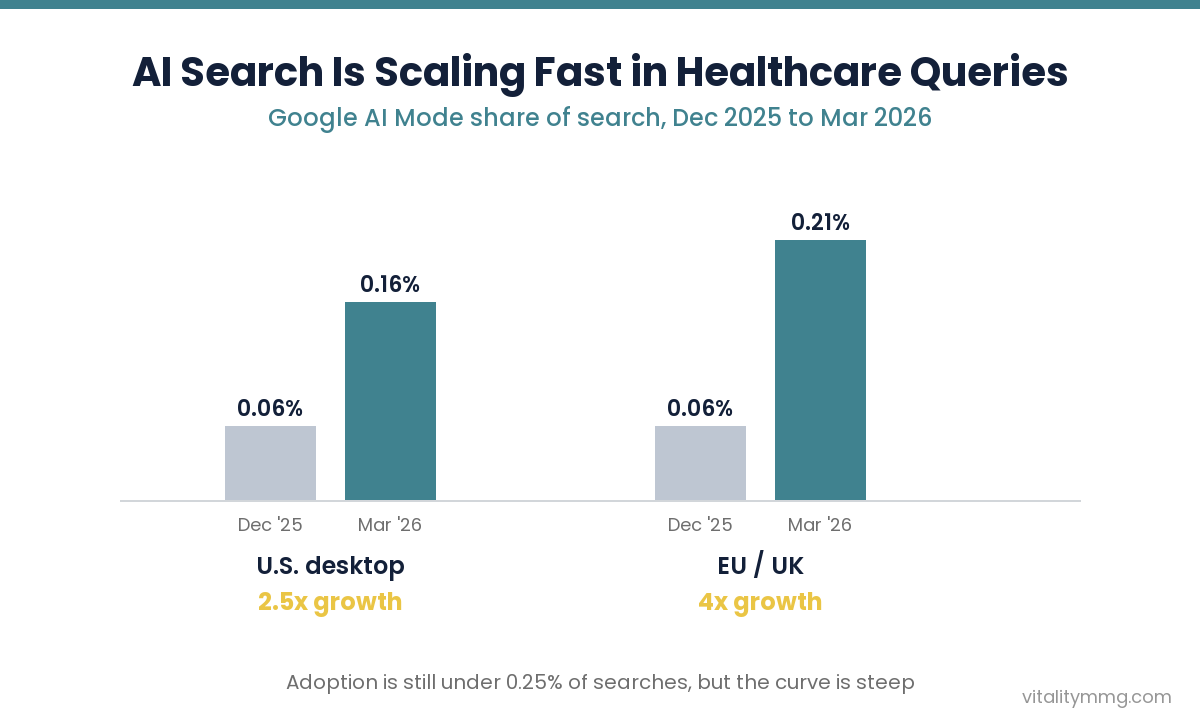
Google AI Mode share of search grew sharply between December 2025 and March 2026, even as total adoption stayed under 0.25%.
Zero-Click Search Is Rewriting Patient Acquisition
The most immediate change is not the technology, it is the behavior. More searches now resolve on the results page itself. A prospective patient reads the AI answer, absorbs an impression of who the credible providers are, and never clicks through. The decision is increasingly being made before anyone reaches your website.
For a medical practice, that reframes the job. The future of healthcare advertising is less about capturing the click and more about being the source the AI answer is built from. If a patient researching a procedure sees your practice cited inside the generated response, you have shaped the consideration set before the competition even loads.
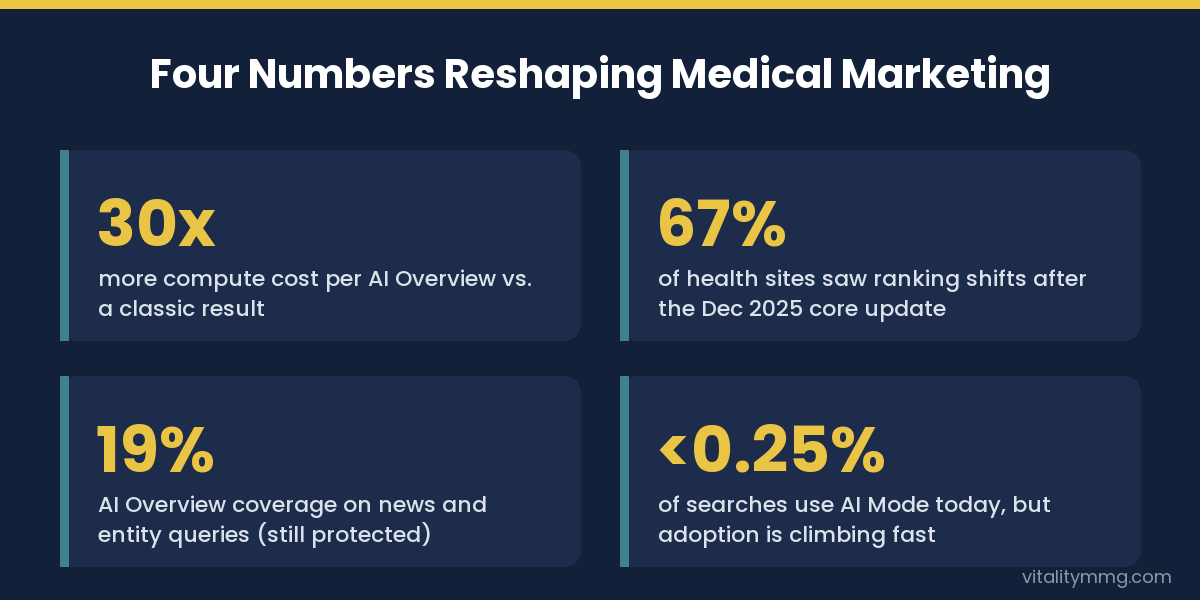
Four numbers every practice owner should track as AI search reshapes medical marketing.
Not every query is exposed to this shift equally. Coverage is uneven, and some categories remain protected. News and entity queries showed AI Overview coverage of only about 19%, compared with a much heavier presence of traditional blocks. The lesson is to know which of your target queries already trigger AI answers and which still reward classic ranking, then resource each accordingly.
For high-intent procedure searches, the practical takeaway is that branded recognition now compounds. When a patient sees your practice named in an AI answer, then searches your name directly, then lands on a credible page, each touch reinforces the next. The future of healthcare advertising rewards this kind of layered presence far more than a single well-placed ad ever did.
Why Compliance Becomes a Bigger Advantage, Not a Smaller One
As AI systems decide which sources to trust, accuracy and compliance stop being legal overhead and start being a ranking input. Google’s quality systems lean hard on Your Money or Your Life standards for health content, and the December 2025 core update moved rankings on roughly two-thirds of health-related sites. Trust is being priced into visibility.
The advertising rules are tightening in parallel. Google’s personalized advertising policy restricts targeting based on sensitive health information, and Google Ads is still not covered by a HIPAA business associate agreement. On the content side, the FTC’s endorsement guides govern how before-and-after results and patient testimonials can be presented. A generalist agency that treats these as fine print will eventually trigger a disapproval, a suspension, or worse.
This is where specialized medical marketing earns its keep. Knowing how to advertise an invasive procedure without claiming a guaranteed outcome, how to track conversions without sending protected health information into ad platforms, and how to spot threats like the paid-survey ad fraud scam is the difference between compounding visibility and a frozen account. In an AI-ranked world, the compliant practice is also the more citable one.
The strategic point is easy to miss. As the rules grow stricter, fewer competitors can play cleanly, so the barrier you treated as a burden becomes a moat. The future of healthcare advertising favors practices whose claims hold up to scrutiny, because those are exactly the sources Google’s quality systems and AI models are built to surface.
Building for the Future of Healthcare Advertising at Your Practice
Preparing for the future of healthcare advertising is concrete work, not a posture. The shift is a move from chasing traffic to earning trust, and the practices that make it deliberately will pull ahead of the ones that wait. Five moves separate the practices that will keep acquiring patients from the ones watching their click volume erode.
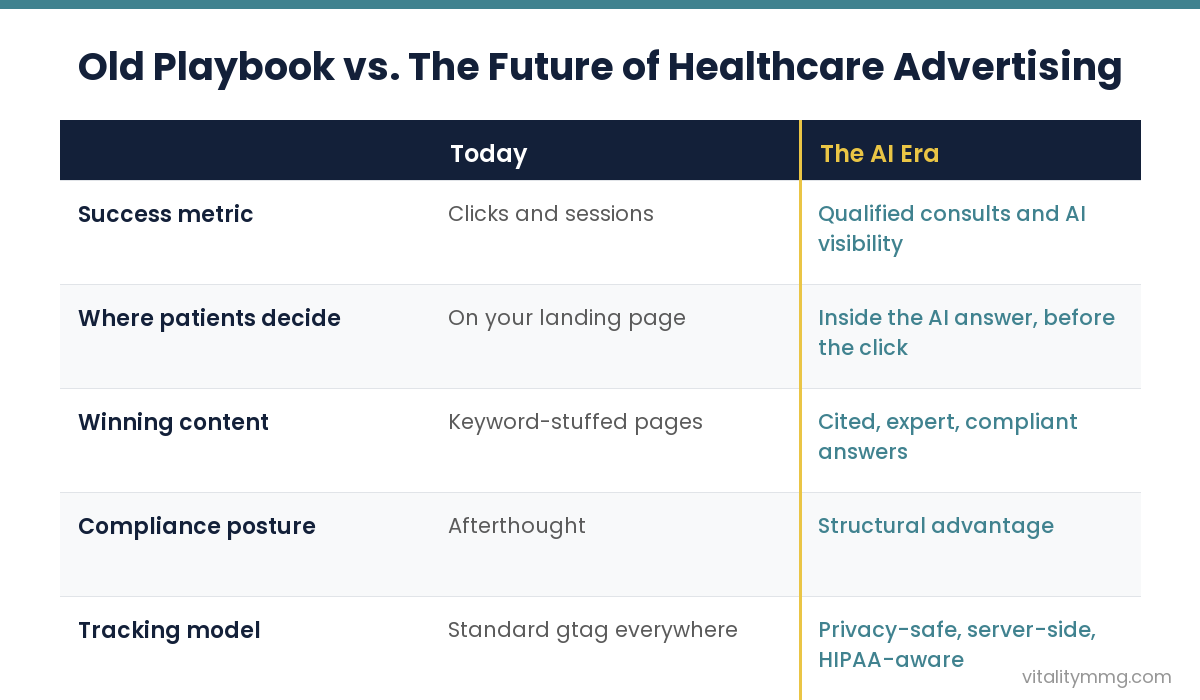
The old playbook and the future of healthcare advertising diverge on what counts as success, where patients decide, and how practices track results.
Structure your expertise for machines. Clear authorship, credentialed bios, schema markup, and direct, quotable answers make your content easy for AI systems to lift and attribute. Vague, keyword-stuffed pages get skipped.
Invest in AI and geographic visibility. Optimizing for generated answers and local intent at the same time is now a core channel, not an experiment. A combined AI and geographic search program protects you as the surface changes.
Fix your tracking before you scale spend. Privacy-safe, server-side measurement that keeps protected health information out of ad platforms is the foundation. Without it, you are optimizing toward form fills instead of booked patients.
Build a feedback loop from consult to procedure. Offline conversion data teaches the algorithm which leads became real patients, so it finds more of them. This is the engine behind a durable patient lead generation system.
Run the full funnel. Search captures demand, but paid social creates it. As zero-click search compresses the top of the funnel, the practices with a coordinated full-funnel approach hold their pipeline steady.
The Metrics That Matter in a Zero-Click World
If your reporting still leads with clicks and sessions, you are measuring a number that is designed to fall. The future of healthcare advertising rewards a revenue lens: qualified consultations, consult-to-procedure rate, and visibility inside AI answers, not raw traffic.
| Stop optimizing for | Start optimizing for |
|---|---|
| Total clicks and sessions | Qualified consultation requests |
| Keyword ranking position alone | Citation and mention in AI answers |
| Cost per lead | Cost per booked procedure |
| Bounce rate | Branded search lift after exposure |
None of these are harder to capture than a click. They require a measurement model built around the business outcome rather than the platform metric. Make that shift now, while AI search adoption is still climbing, and the transition costs you a reporting change instead of a lost quarter.
Key Takeaways
- The future of healthcare advertising is being set by Google’s move to AI Mode and AI Overviews. Adoption is small today but growing fast, so build for it now.
- Zero-click search means patients decide inside the AI answer. Being the cited source matters more than capturing every click.
- Compliance and clinical credibility are now ranking and citability inputs, which turns a specialized medical marketing partner into a measurable advantage.
- Shift reporting from clicks and sessions to qualified consults, booked procedures, and AI visibility before the metrics you rely on start to fall.
See Where Your Practice Stands for AI Search
VMMG builds compliant, AI-ready marketing programs for aesthetic, plastic surgery, and hair restoration practices preparing for the next phase of Google.
Related: Explore the hair transplant marketing markets we serve, or get a free market report for your metro.