




Most hair restoration practices don’t have a lead generation problem. They have a hair restoration consultation conversion problem. The inquiry arrives. The form gets submitted. The phone rings. And somewhere between that first contact and a scheduled procedure, the patient disappears.
The 2025 ISHRS Practice Census puts this in context: the average ISHRS member treated 156 surgical patients in 2024, up 20% from 2021. Yet across the practices we work with, the gap between inquiries received and consultations booked tells a different story. Practices generating 80 to 100 inquiries per month frequently book 20 to 30 consultations and convert fewer than half into procedures. The math means the majority of their marketing spend is subsidizing a broken intake process.
This is not a Google Ads problem. It’s a consultation conversion problem, and fixing it requires working on four distinct stages in your patient pipeline.
Where Hair Restoration Consultation Conversion Breaks Down
Most agencies measure cost per lead and call it done. That metric tells you how efficiently your media spend is generating form fills, nothing more. The actual conversion story happens in four stages, each with a measurable drop-off rate.
| Stage | What Happens | Common Failure |
|---|---|---|
| Inquiry to First Contact | Form fill or phone call arrives | Response time exceeds 30 minutes |
| First Contact to Consultation Scheduled | Intake call with coordinator | Unstructured call, no prequalification |
| Consultation Scheduled to Attended | Patient confirms and shows | No confirmation sequence; 15-25% no-show rate |
| Consultation Attended to Procedure Booked | Surgeon closes the evaluation | Missing cost anchor, deferred financing conversation |
Practices that treat consultation conversion as a marketing problem keep pouring budget into the top of a leaky funnel. Before adding spend, audit where patients are exiting this pipeline. Lead quality matters, but so does the infrastructure that handles leads once they arrive.
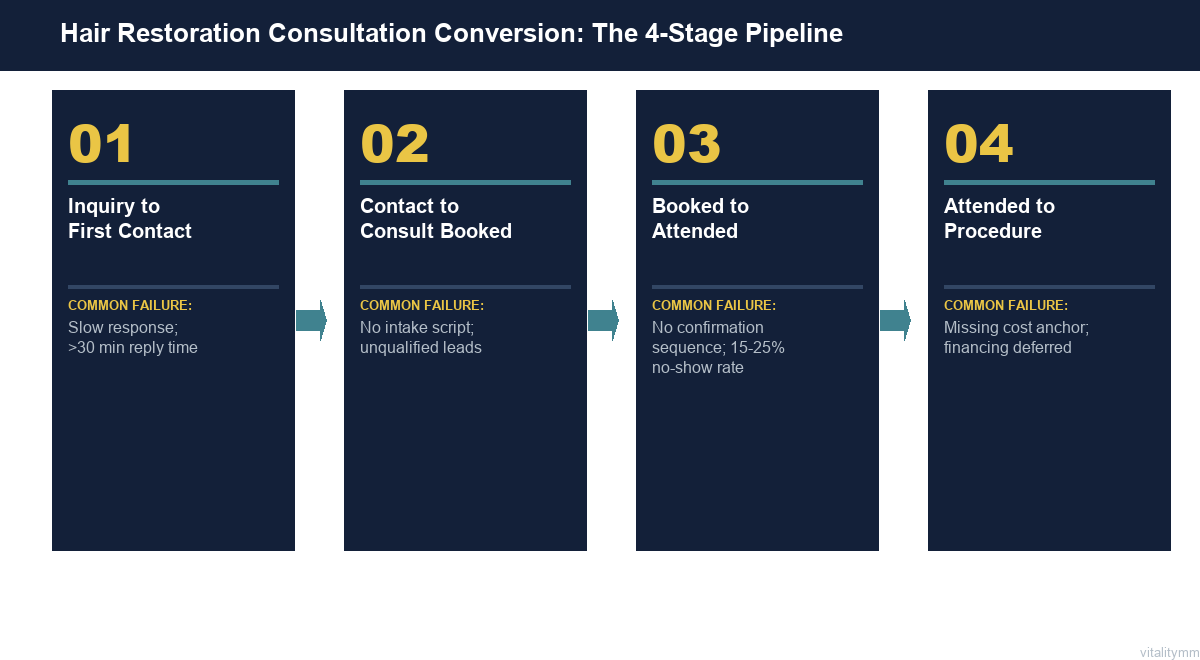
The four-stage hair restoration consultation conversion pipeline. Each stage has a distinct drop-off pattern that requires a different fix.
Speed-to-Lead: The 90-Second Rule
Speed-to-lead is the highest-leverage fix in the consultation conversion stack, and it costs the least to implement.
When a prospective patient submits a form on your website or clicks a call button from a Google Ad, they are in peak intent. They are comparing your practice against three or four others simultaneously. The practice that responds first earns the conversation. Practices that respond hours later are answering patients who have already scheduled elsewhere.
The benchmark is five minutes or fewer for a phone response and ten minutes or fewer for a text acknowledgment. For after-hours form submissions, an automated text response confirming receipt and setting a clear callback window prevents the cold lead syndrome that kills morning intake conversion.
The RootLogic platform tracks first-response time across client accounts, and the correlation between response speed and consultation booking rate is consistent. Practices that respond within five minutes average consultation booking rates two to three times higher than those responding within the hour, holding all other variables constant.
Two structural blockers account for most slow-response patterns: front desk bandwidth during peak call hours, and no after-hours intake system. Both are solvable. The first requires a call routing or triage protocol. The second requires at minimum an auto-reply text and a CRM that captures the inquiry for morning follow-up.
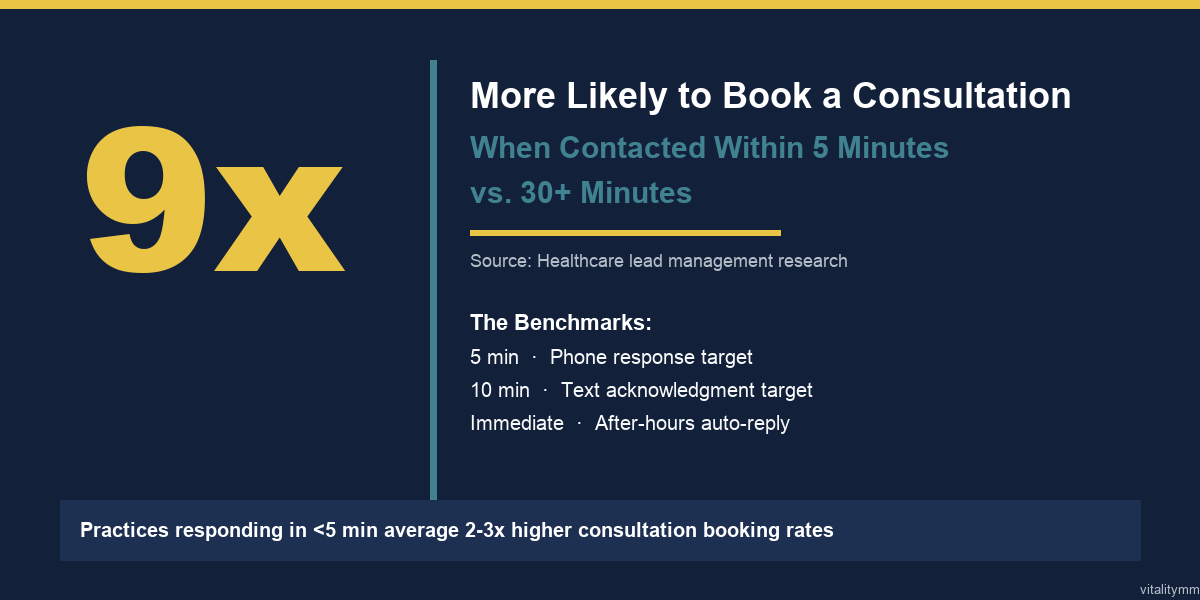
Hair restoration consultation conversion benchmarks: response time targets and their measurable impact on booking rates.
Pre-Consultation Qualification: Filtering for Surgical Candidates
Not every inquiry should become a consultation. Hair restoration surgery is not appropriate for every patient who submits a form, and scheduling unqualified candidates wastes surgeon time, inflates no-show rates, and trains your marketing algorithm on the wrong conversion signal.
Effective pre-consultation qualification screens for three things:
Candidacy basics. Is the patient’s hair loss stabilized or progressive? What is their approximate Norwood scale stage? Do they have realistic expectations about graft count and outcome? These are not deep clinical questions. A trained coordinator can gather this information in a five-minute phone screen using a structured intake script.
Financial readiness. Hair restoration surgery in the United States ranges from $6,000 to $20,000 or more depending on graft count and technique. Patients expecting cost parity with international pricing are unlikely to convert even if they book a consultation. Addressing pricing transparency early filters for serious candidates and reduces day-of withdrawals.
Procedure fit. FUE, FUT, ARTAS robotic, NeoGraft, and non-surgical options like Alma TED serve different patient profiles. A coordinator who can match the patient’s stated concerns to the appropriate procedure category improves both the consultation experience and the surgeon’s conversion rate.
The coordination between paid media lead quality and intake qualification is where this gets specific. When your paid social campaigns are generating strong in-market signals but intake conversion is low, the diagnostic is usually not the media. It’s the qualification layer.
Norwood Scale
The Hamilton-Norwood scale is the clinical standard for classifying male pattern hair loss across seven stages. It serves as the primary staging tool in hair restoration surgery planning and is the language surgeons use to communicate candidacy and graft estimates with patients during the consultation.
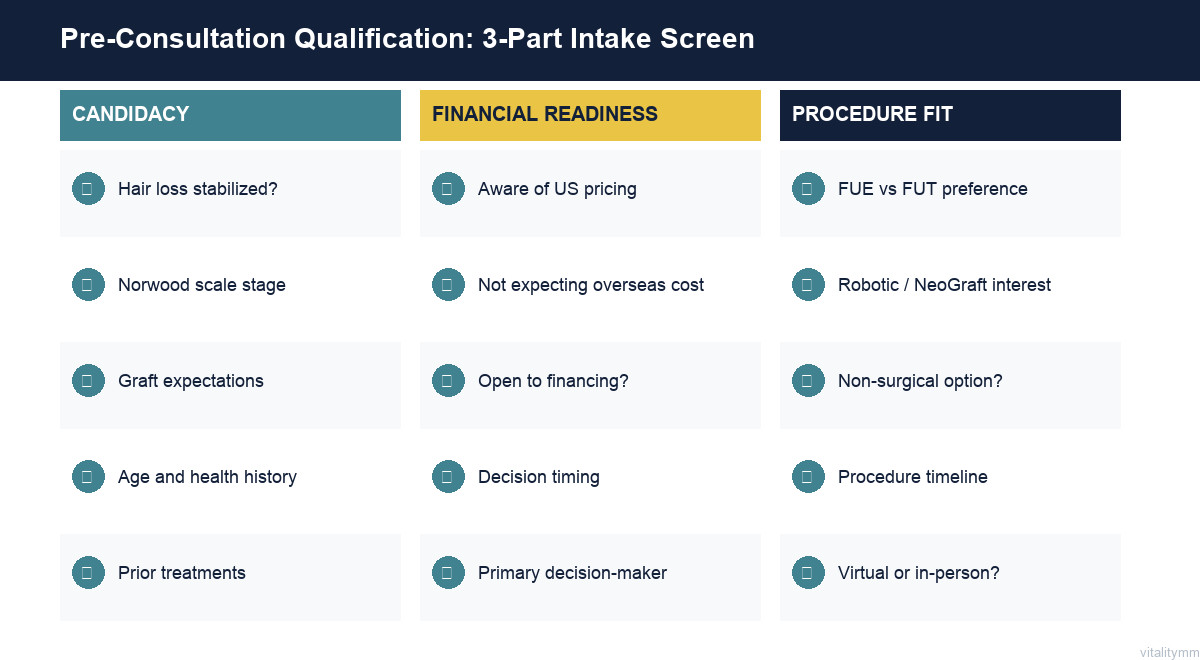
The three-part pre-consultation qualification screen used by top-performing hair restoration practices: candidacy, financial readiness, and procedure fit.
What the Consultation Itself Has to Accomplish
The in-person or virtual consultation has one objective: give the patient enough clinical clarity and confidence to make a decision. That is different from persuading someone who is not ready.
Practices with the highest consultation-to-procedure rates share four characteristics:
Photo analysis is systematic, not improvised. The surgeon reviews standardized photos under consistent lighting, maps the loss pattern to a recognized classification scale, and communicates the graft estimate with specific numbers. Patients who leave without a number have no anchor for the financial decision.
The cost conversation is not deferred. Practices that say “we’ll send you a quote” after the consultation lose the moment. The in-room estimate, tied to a specific graft count and technique, initiates the commitment. The follow-up quote confirms it.
Financing is presented as standard, not a fallback. The majority of hair transplant patients use patient financing. Practices that treat it as an afterthought, mentioned only after a patient hesitates on price, miss a significant portion of their qualified patient pool. Presenting financing as a standard part of the consultation normalizes the path to yes.
The coordinator follows up within 24 hours. The post-consultation follow-up call is where hesitant patients convert. This call answers the questions the patient didn’t ask in the room. The ISHRS 2025 Practice Census data shows that 44% of treated patients planned to recommend their practice to others. That referral behavior begins at the consultation stage, not after the procedure.
The 2025 ISHRS data also shows that repair cases from prior poor procedures rose to 6.9% of all hair transplants, up from 5.4% in 2021. When consultations fail to communicate clinical standards clearly, patients don’t wait. They find a lower-cost provider and arrive at a legitimate practice later as a repair candidate. The consultation experience is your most direct defense against that outcome.
How to Make Hair Restoration Consultation Conversion Measurable
The reason most practices don’t fix their consultation conversion rate is that they can’t see it. Their marketing report shows impressions, clicks, and form fills. The CRM might show consultations booked. But the line between a form fill, a consultation attended, and a procedure scheduled is invisible in most reporting setups.
Closing that gap requires offline conversion tracking. The technical setup pipes consultation-booked and procedure-scheduled events from your CRM back into Google Ads as offline conversions. This does two things: it gives your Smart Bidding algorithm a real outcome signal instead of a form-fill proxy, and it gives your team a visible conversion rate to optimize against.
The pipeline connects GHL to Google Ads via the offline conversions API. Every consultation booking becomes a trackable event. Every procedure scheduled gets attributed to its source campaign. The result is a report that shows not just cost per lead but cost per qualified consultation and cost per booked procedure.
That is the metric a practice owner should be managing. And it is the metric that tells you whether your conversion problem lives in the media, the speed-to-lead, the intake process, or the consultation experience itself.
If you want to put a dollar figure on that gap, our free Patient Value Calculator turns your booking, show, and close rates into the value of a new patient and the ad budget it takes to hit your procedure target.
The ISHRS Practice Census shows the average member increased patient volume by 20% since 2021. The practices driving that growth are not simply spending more on advertising. They are optimizing the full pipeline, and hair restoration consultation conversion is the highest-leverage point in it.
Key Takeaways
- Most hair restoration practices lose patients at one of four funnel stages: inquiry to first contact, first contact to scheduled, scheduled to attended, and attended to booked procedure.
- Responding to inquiries within five minutes increases consultation booking rates by 2-3x compared to practices with 30-minute or longer response times.
- Pre-consultation qualification on candidacy, financial readiness, and procedure fit improves surgeon conversion rates and reduces no-shows.
- Presenting a specific graft count and cost estimate in the consultation room, not in a follow-up quote, is the single highest-impact change most practices can make to their close rate.
- Offline conversion tracking from your CRM to Google Ads is what makes the full consultation pipeline visible and optimizable.
Fix Your Consultation Pipeline Before Spending More on Ads
VMMG builds the full conversion stack for hair restoration practices: offline tracking, intake training, and campaigns optimized to booked procedures, not form fills.
Related: Explore the hair transplant marketing markets we serve, or get a free market report for your metro.
