




ISHRS Marketing Standards Explained
The 12 banned phrases, credential rules, and how to audit your current marketing.
Run My Free Audit →Most hair restoration practices have at least one compliance problem in their marketing — and most don't know it. A phrase that sounded confident five years ago is now on a prohibited list. A credential formatted the way a vendor suggested is technically inaccurate. A before-and-after photo posted to a website triggers a Google Ads restriction on an unrelated search campaign.
This page covers the ISHRS marketing standards in full: what they require, which terms are banned, how credential claims must be worded, and how to conduct a systematic compliance audit of your practice's current marketing.
Why ISHRS Standards Apply to Every Practice
ISHRS marketing standards are not optional guidelines for members only. They sit at the intersection of four independent rule systems — any one of which can enforce them independently of the others.
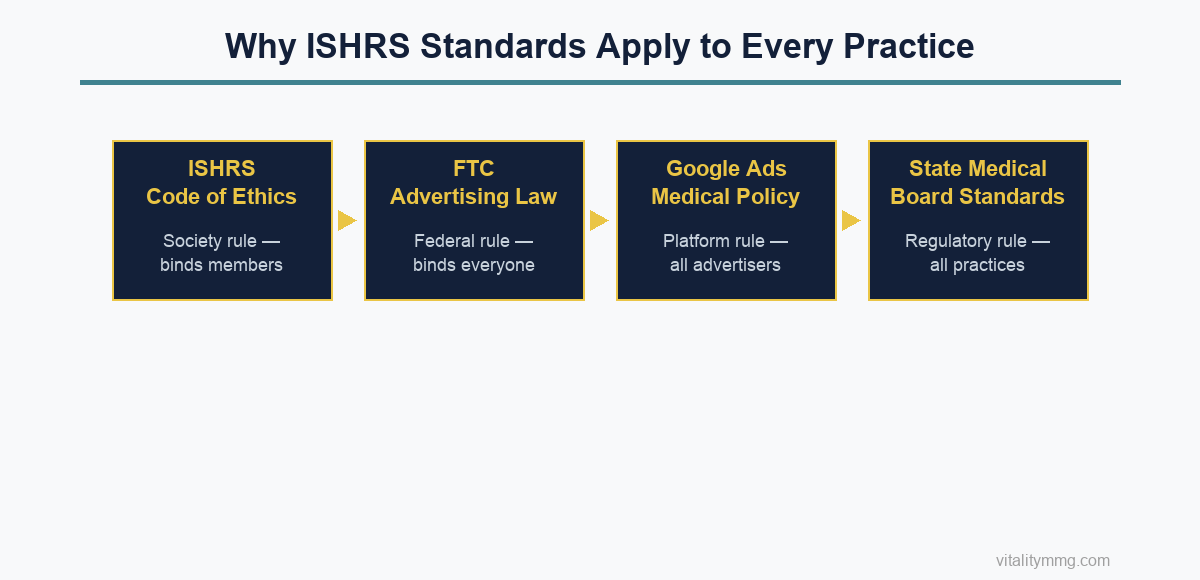
ISHRS marketing rules are reinforced by four independent rule systems — society ethics, federal law, platform policy, and state medical board regulations.
A practice that is not an ISHRS member is still subject to FTC advertising law, Google Ads Medical Policy, and its state medical board's standards on advertising accuracy. ISHRS membership adds an additional layer — and the ethical obligations that come with it.
Free ISHRS Compliance Audit
Scans for all 12 banned terms across your site. Done in 60 seconds. No email required to start.
Run My Audit →✓ Built by VMMG ✓ Used by 60+ hair practices
The ISHRS Marketing Rules That Matter Most
The ISHRS Code of Ethics contains several rules that govern member conduct in marketing and advertising. Three have direct, practical implications for how practices promote their services online and in paid media.
No banned terms in advertising or promotional copy
ISHRS maintains an Improper Messaging List of specific phrases that may not be used in advertising, promotional materials, or patient-facing communications. The list was last revised October 16, 2024. It currently contains 12 prohibited terms — covered in the section below.
Credentials must match the actual certification designation
The correct credential for a physician board-certified in hair restoration is Diplomate, American Board of Hair Restoration Surgery (ABHRS). The phrase "board certified hair restoration surgeon" is considered improper because "board certified" does not accurately describe the ABHRS diplomate process. The distinction matters: it is a factual accuracy requirement, not a formatting preference.
Before-and-after imagery must meet representativeness and disclosure requirements
Before-and-after photos are permitted under ISHRS standards with restrictions: results shown must be representative, photos must not be digitally altered to enhance outcomes, and appropriate disclosures must accompany results imagery. Note that Google Ads separately restricts before-and-after imagery in ad creatives — compliance with ISHRS Rule 4 does not automatically satisfy Google's platform requirements.
The 12 Banned Terms
The ISHRS Improper Messaging List (revised October 16, 2024) prohibits the following 12 phrases from use in advertising, promotional materials, and patient-facing content. These terms are banned because they make claims that are either factually inaccurate for hair transplant surgery or materially misleading to prospective patients.
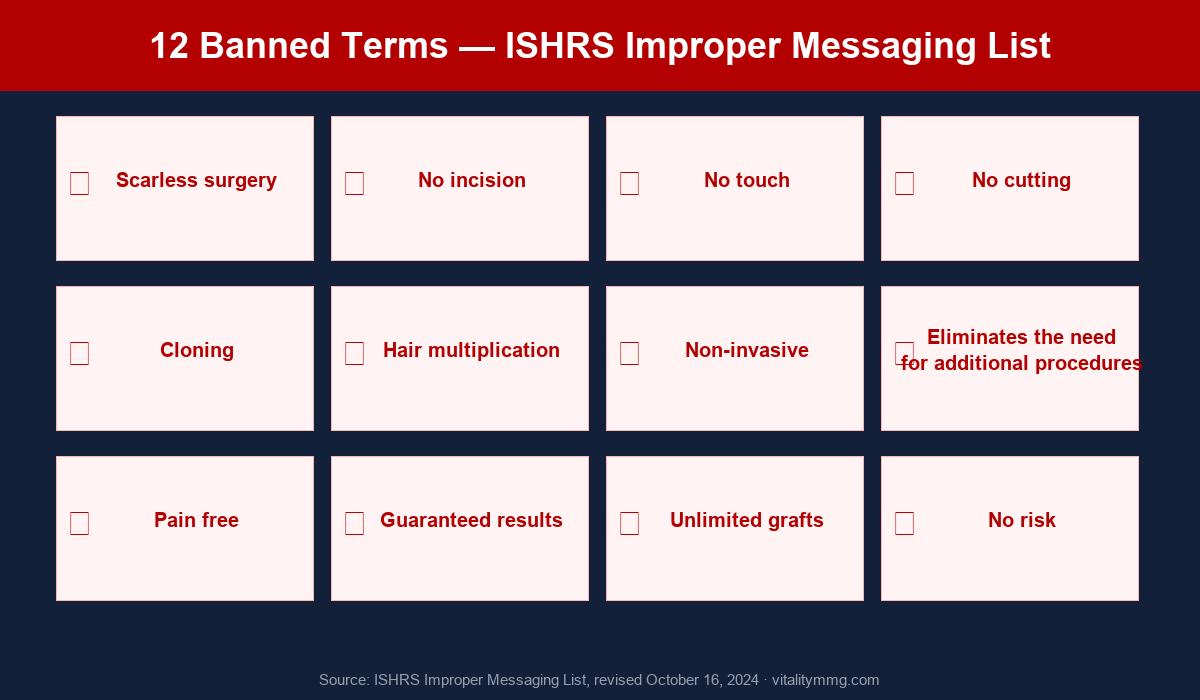
All 12 phrases prohibited by the ISHRS Improper Messaging List, revised October 16, 2024. Using any of these terms in hair restoration advertising violates ISHRS ethics standards.
If any of these terms appear in your website copy, landing pages, ad headlines, ad descriptions, or social media profiles, they represent an active compliance risk. Google's automated ad review systems flag several of these phrases directly. State medical boards in some jurisdictions treat "guaranteed results" and "pain free" as per se violations of medical advertising accuracy standards.
"We audit every ad, every landing page, every campaign before it ever goes live. Most practices learn why the expensive way, after one disapproved phrase freezes the whole account. Discipline up front costs nothing. Doing it over costs everything." —
Joe Garraffo, VMMG
How to Audit Your Marketing for ISHRS Compliance
A complete manual compliance audit covers six areas. Practices doing this for the first time typically spend 4 to 6 hours on a thorough review — longer if the practice has multiple locations, a large content library, or active paid media campaigns across several platforms.
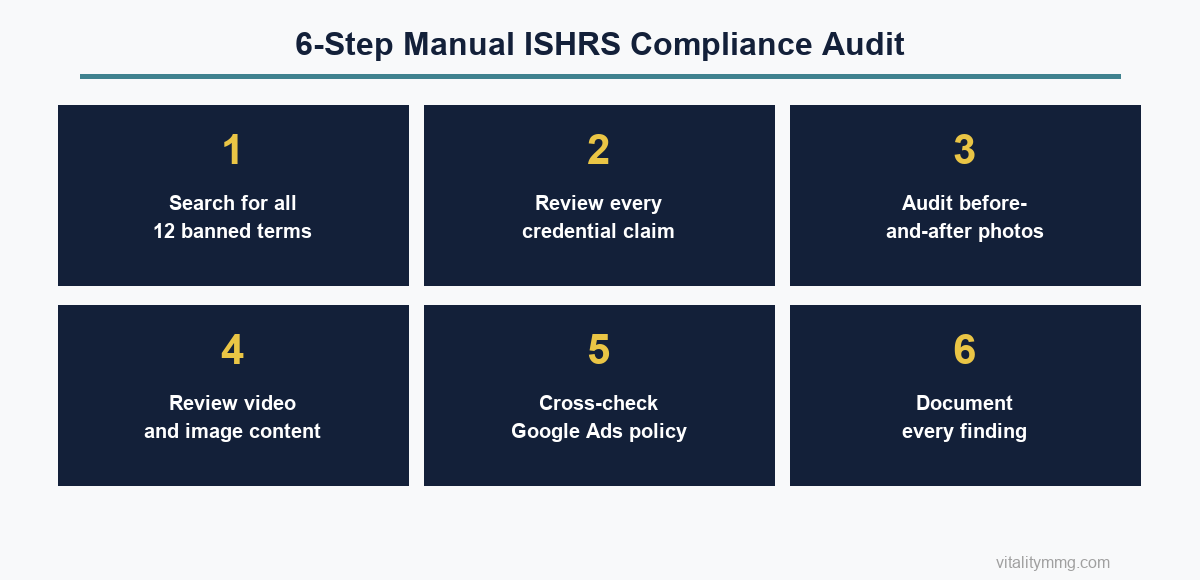
The six steps to manually audit a hair restoration practice's marketing for ISHRS compliance. This process takes 4 to 6 hours to complete without an automated tool.
Step 1 — the banned term search — is the highest-priority starting point because it is the most actionable and the most likely to surface issues. Most practices find at least two or three banned terms in active use the first time they run the search.
Step 6 is the step most practices skip: documentation. Without a record of findings and remediation dates, there is no way to demonstrate a good-faith compliance effort if a platform or board inquiry occurs.
Still reading? You could be running the audit instead.
12 banned terms. Credential check. Done in 60 seconds.
Start My Audit →FREE · NO SIGNUP WALL
Compliant vs. Non-Compliant: Side-by-Side Examples
The most common compliance failures are not the result of bad intent — they are copy patterns that felt natural to write, were used by competitors, or were inherited from older website drafts. These four examples cover the highest-frequency violations seen in active hair restoration marketing.
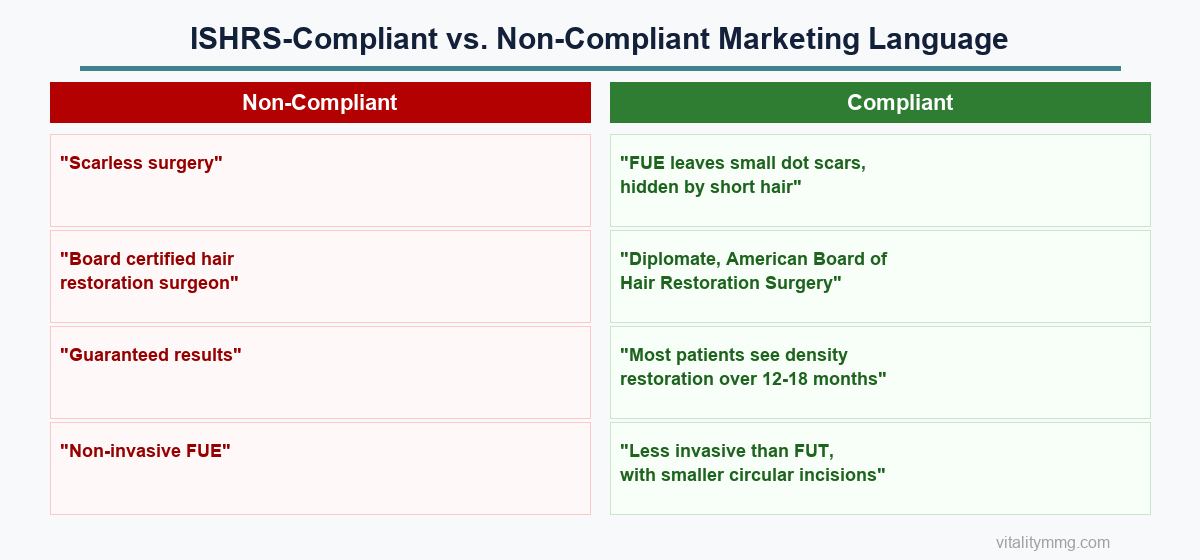
Four common non-compliant phrases in hair restoration marketing paired with their ISHRS-approved alternatives — a side-by-side reference for practice marketing teams.
The compliant alternatives are not weaker — they are more accurate, and accuracy is what builds qualified patient confidence. A prospective patient who understands what FUE actually involves is a better consultation candidate than one who arrived expecting "scarless surgery."
Frequently Asked Questions
What are ISHRS marketing standards?
ISHRS (International Society of Hair Restoration Surgery) marketing standards are ethical guidelines that govern how member physicians and their practices may advertise hair restoration services. They prohibit specific misleading phrases, define how credentials must be presented, and set standards for before-and-after photography used in promotional materials.
Do ISHRS marketing standards apply to non-members?
The ISHRS Code of Ethics formally binds ISHRS member physicians. However, overlapping rules from the FTC, Google Ads Medical Policy, and state medical boards apply to all hair restoration practices regardless of ISHRS membership. Non-members are not exempt from the underlying regulatory requirements.
What are the 12 banned terms in hair restoration advertising?
The ISHRS Improper Messaging List (revised October 16, 2024) prohibits: scarless surgery, no incision, no touch, no cutting, cloning, hair multiplication, non-invasive, eliminates the need for additional procedures, pain free, guaranteed results, unlimited grafts, and no risk.
What credentials can a hair restoration surgeon advertise?
The accurate credential designation is Diplomate, American Board of Hair Restoration Surgery (ABHRS). Phrases like "board certified hair restoration surgeon" are considered improper under ISHRS Rule 2 because "board certified" does not accurately describe the ABHRS diplomate designation.
Can a hair restoration practice use before-and-after photos in marketing?
Before-and-after photos are permitted with restrictions. ISHRS Rule 4 requires that results shown be representative, that photos not be digitally altered, and that appropriate disclosures accompany results imagery. Google Ads separately restricts before-and-after imagery in ad creatives for medical procedures — ISHRS compliance does not automatically satisfy Google's platform requirements.
What happens if my practice uses a banned term in advertising?
Consequences range from Google Ads disapprovals and account-level restrictions to ISHRS ethics violations for member physicians. In some states, use of misleading medical advertising language can also trigger state medical board review. Risk scales with how broadly the content is distributed.
How do I audit my practice's marketing for ISHRS compliance?
The manual process has six steps: search all site copy for the 12 banned terms, review every credential claim for accuracy, audit before-and-after photos for compliance, review all video and image content, cross-check against current Google Ads Medical Policy, and document every finding. The manual audit typically takes 4 to 6 hours. VMMG's free ISHRS audit tool automates all 12 term checks in under 60 seconds.
Find Out If Your Marketing Is Compliant
The free ISHRS audit tool checks your site for all 12 banned terms in under 60 seconds. No email required to start.
Run My Free Audit → Talk to VMMG