




ARTAS robotic hair transplant marketing underperforms when practices expect the device to drive local demand. The technology supports patient acquisition; building it into the local market is a separate strategic job that most practices have not staffed for.
For hair restoration practice owners running ARTAS or weighing a robotic system investment.
Why ARTAS robotic hair transplant marketing underperforms locally
A practice invests six figures in a robotic system, expects it to be the differentiator that fills the surgical calendar, and twelve months later the consultation pipeline has not moved the way they hoped. The device can absolutely support strong patient acquisition. The technology alone does not create consistent local demand.
This is not a knock on the technology. It is a question of strategy. Building the device into a practice is one job. Building local patient demand around it is a separate job, and it is the one most practices have not staffed for.
Start with how device marketing works, because it is a function, not a flaw. ARTAS is manufactured and distributed by Venus Concept, a public medical aesthetics company, and the platform originated with Restoration Robotics. Venus markets ARTAS at the category level: building national awareness for robotic hair restoration and connecting interested patients to certified providers. That is exactly what manufacturer marketing is designed to do.
What it does not do, and is not built to do, is rank your specific practice for the searches that book consultations in your city. National category awareness and local patient acquisition are two different layers. The manufacturer owns the first. The practice owns the second. The capital that bought the device did not buy the local layer, and the local layer is the one that generates revenue.
The intent mismatch
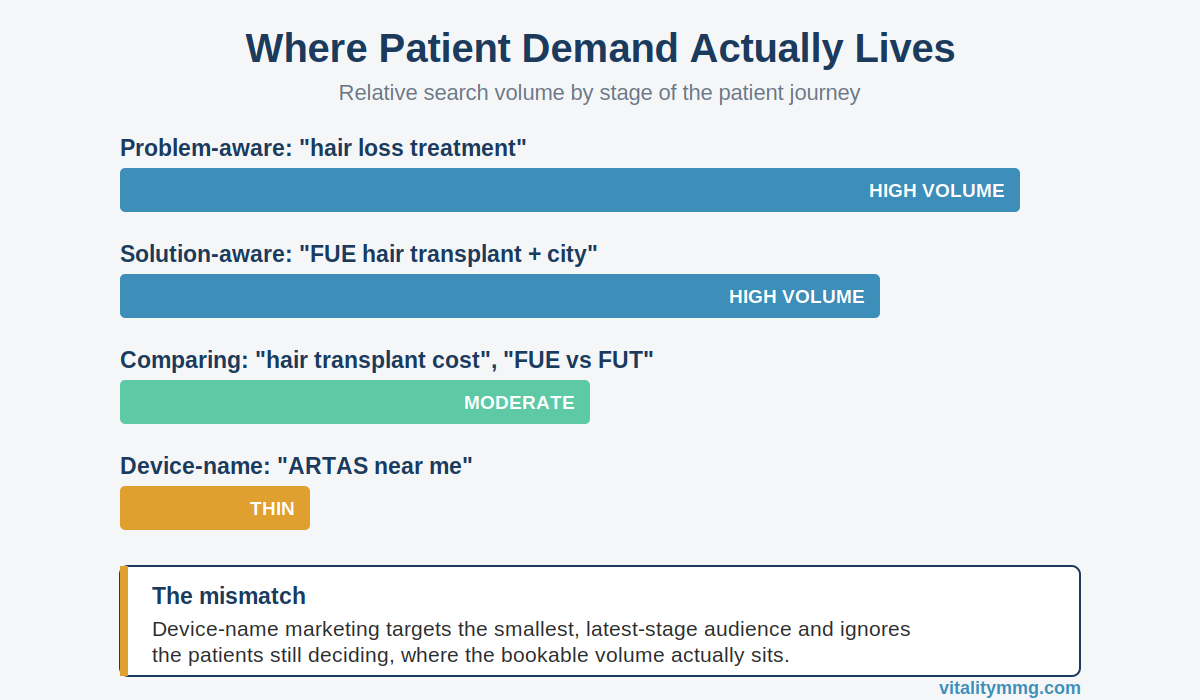
Here is the mismatch in plain terms. The volume lives in problem-aware and solution-aware searches: hair loss treatment, FUE in a given city, hair transplant cost, hairline restoration. When a site and its ads lead with the robot, they tend to reach only the smallest, latest-stage audience and miss the much larger group still weighing their options.
Device-name searches like “ARTAS near me” exist, but they sit far down the demand curve, typed by patients usually deep in research and often already loyal to a clinic. The high-volume terms are problem-aware and solution-aware, and they go to whoever targets them.
What device-centric marketing costs you
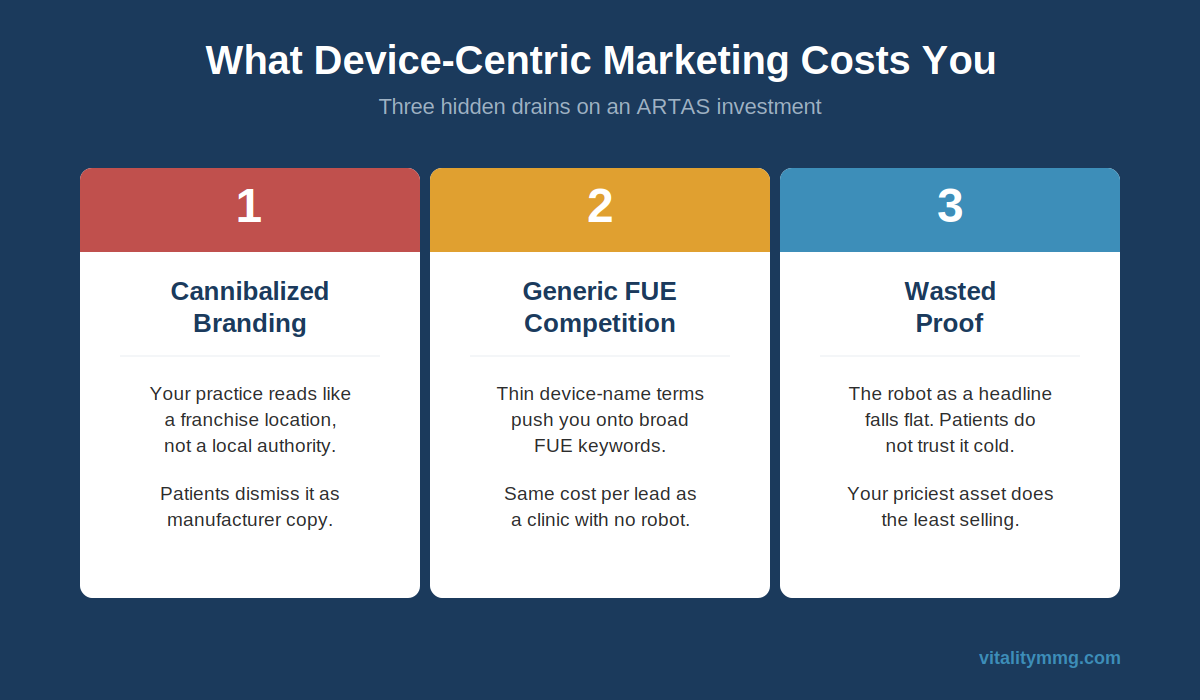
The cost shows up in three places, and none of them are obvious until you audit the account.
- Generic positioning. The consumer-facing ARTAS brand has its own look, claims, and “find a provider” funnel, built to represent the technology across every certified practice. When a practice leans only on that shared identity, its marketing reads as interchangeable with every other ARTAS provider rather than as a distinct local authority. Patients are choosing a surgeon and a practice, and forums show they discount pages that read like manufacturer copy.
- Generic FUE competition. Because the device-name terms are thin, paid and organic visibility quietly defaults to broad FUE keywords. The practice ends up competing head to head with every hand-held FUE clinic on the same terms and the same cost per lead. The robotic system is a real advantage, but a marketing approach built on the device name rather than the surgeon-led story leaves that advantage unspent where patients compare providers.
- Underused proof. The robotic system is genuine proof of investment and clinical capability, and it deserves to be in the marketing. The question is sequence. Led with as a headline, the technology asks a patient to evaluate a robot before they trust the practice. Placed as supporting evidence inside a surgeon-led story, it does powerful work. Most practices simply have the order reversed.
What actually converts: a better ARTAS robotic hair transplant marketing model
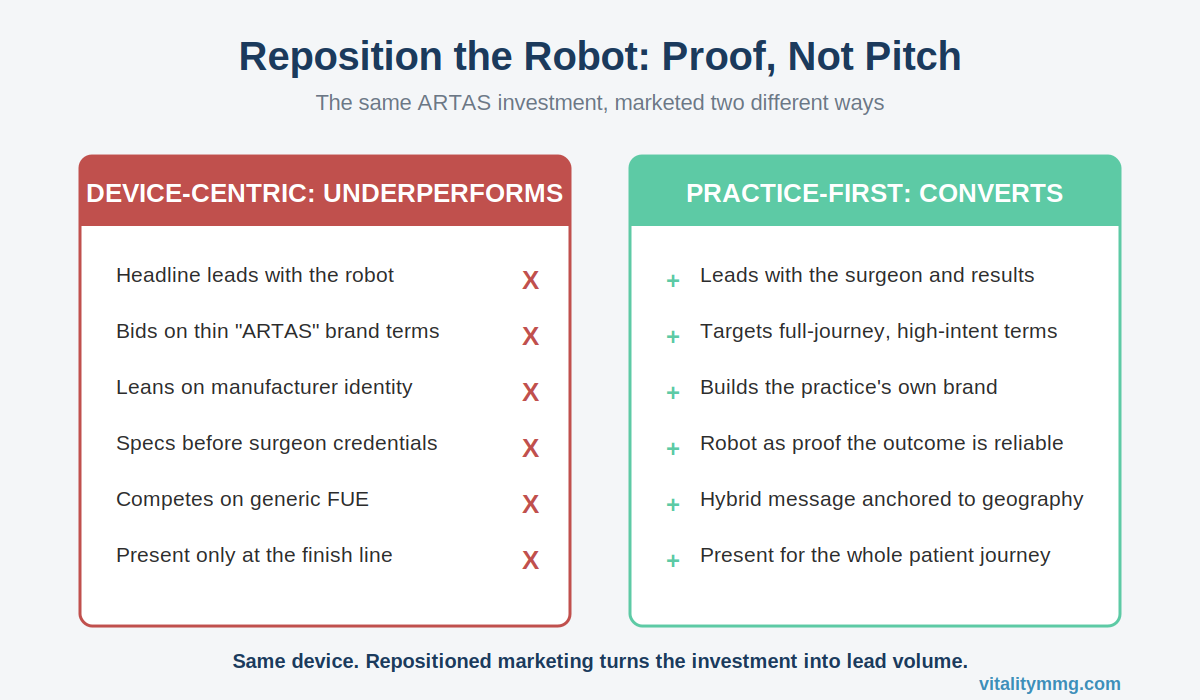
The fix is not to hide the robot. It is to reposition it. Effective ARTAS robotic hair transplant marketing treats the device as a proof point, not the pitch. Three shifts make the difference.
Lead with the surgeon, support with the system
Your marketing should foreground the surgeon’s credentials, case volume, before-and-after results, and judgment, then introduce ARTAS as the reason those results are consistent. The robot answers “why are your outcomes reliable,” and that is a strong answer. It just should not be the opening line.
Surgeon-led content also compounds. A physician explaining candidacy, donor management, and realistic expectations builds a depth of trust that technology specifications alone cannot, and it aligns with how professional bodies like the International Society of Hair Restoration Surgery frame patient education. That content ranks, earns links, and gives AI-driven search results something credible to cite.
Patients choose a person before they choose a procedure. Lead with the surgeon’s credentials and outcomes; introduce ARTAS as the reason those outcomes are consistent.
Target the whole demand curve, not just the brand term
Capture the patients who are still deciding. That means campaigns and content built around the searches people actually run: hair loss solutions, FUE versus FUT, transplant cost and financing, results timelines, and location-based terms that signal a patient ready to book. The robotic angle is the closer inside those pages, not the keyword you bid on. This is the core of any serious hair restoration lead generation strategy.
Use hybrid messaging built for local search
Hybrid messaging means pairing the human story with the technology and anchoring both to your geography. The page that wins is the one that says, clearly, that a specific credentialed surgeon in a specific city delivers natural results, and uses a robotic FUE system to do it. Local relevance plus surgeon authority plus device as evidence. That ordering matters more than any single element, and it is increasingly what Google’s helpful content guidance rewards: people-first content from a demonstrable expert.
Turning an ARTAS investment into actual lead volume
If you have already invested in the system, the goal now is to make it earn. That is an account and content problem, not a hardware problem. A practical audit looks like this.
- Check what you rank for. If your visibility concentrates on device-name terms, you are fishing in a small pond. Map content to broader, higher-intent searches and fill the gaps.
- Read your own pages as a patient. If the first thing a visitor sees is robot specifications, lead instead with the surgeon and the outcome, and move the technology to the section explaining why that outcome is dependable.
- Audit your ad copy and compliance. Hair restoration advertising carries real restrictions, and device and trademark language has its own rules. Manufacturer claims do not automatically transfer to your ads. Getting this right protects the account and the spend; our guidance on hair transplant marketing compliance covers where practices most often slip.
The pattern is consistent across the strongest-performing ARTAS practices: they add the local layer deliberately, lead with the surgeon, target the full demand curve, and use the robotic system as proof inside the story. Done right, the ARTAS investment becomes the differentiator the practice expected.
Make your ARTAS investment earn
VMMG builds the local patient acquisition layer for hair restoration practices, including those running ARTAS and other robotic platforms. If your robotic system is not generating the lead volume you expected, the marketing strategy is the first place to look.
Related: Explore the hair transplant marketing markets we serve, or get a free market report for your metro.