




Start With the Procedure Goal, Not the Lead Goal
Ten FUE or FUT procedures per month is not a random target. It happens to align with the ISHRS benchmark of approximately 15 procedures per month as the upper boundary for a single surgeon performing all non-delegable acts personally. Ten gives you headroom for cancellations, complex cases, and quality control without pushing into volume-clinic territory. At an average ticket of $8,000 to $12,000 per case, 10 procedures monthly is roughly $80,000 to $120,000 in surgical revenue. That’s the number that actually matters. Now we work backward.The Four Stages of Hair Transplant Lead Generation Math
Every hair restoration practice has the same funnel whether they track it or not. The stages are Lead → Booked Consultation → Showed Consultation → Closed Procedure. Each stage has a conversion rate. Multiply them together and you get the total lead requirement. Skip one and your math falls apart. Many practices use a simple rule of thumb to size the funnel: 10/4/1. Ten leads produce four consultations, and four consultations produce one procedure. It’s a quick mental model, but it bakes in average-to-mediocre performance. Top-performing practices hit closer to 10/6/2: ten leads produce six consultations, and six consultations produce two procedures. Same lead volume, double the procedures. The detailed stage math below is how you get from one to the other.Stage 1: Lead to Booked Consultation
A lead is anyone who fills out a form, calls the office, or messages through a chatbot. Booking that lead into a consultation is the first conversion event. Industry data from cosmetic and elective practices puts the average lead-to-consultation conversion rate at roughly 30%. Strong front-desk teams hit 40-50%. Untrained or slow-responding teams sit at 15-20%.Stage 2: Booked to Showed
Hair restoration has higher no-show rates than most aesthetic procedures because patients are emotionally fragile and prone to cold feet. A realistic show rate is 65-75%. Practices with strong nurture sequences, deposit policies, or appointment reminders push 80%+.Stage 3: Showed to Closed
This is your consultation conversion rate. For higher-ticket FUE and FUT cases, 40-50% is the normal range when the patient coordinator and surgeon work as a coordinated team. Top practices hit 55-60%. Untrained consultations close at 25-30%.Working Backward From 10 Procedures
Plug average benchmarks into each stage and the answer falls out.
- Goal: 10 procedures closed.
- Show-to-close rate of 45%: you need 22 consultations to actually happen.
- Show rate of 70%: you need to book 32 consultations.
- Lead-to-book rate of 30%: you need approximately 107 leads.
What is one new patient actually worth to your practice?
Plug in your own averages and see what you can afford to spend to win a patient, plus the exact ad budget it takes to hit your procedure target. No sign-up.
Open the Free Patient Value CalculatorWhy Fixing Conversion Beats Buying More Leads
Most practice owners default to “spend more on ads” when procedures slip. That’s the most expensive way to grow. Watch what happens when you improve conversion at each stage instead.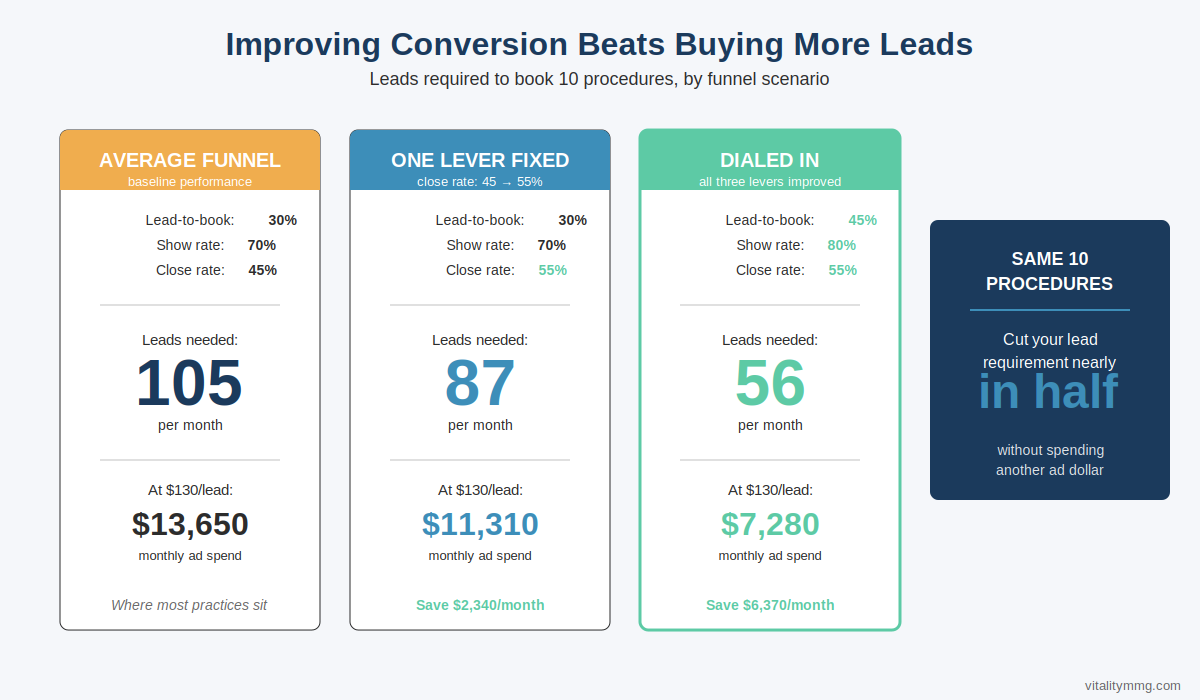
What This Means for Your Hair Transplant Lead Generation Budget
Once you know your lead target, you can size the budget. In most U.S. metro markets, qualified hair restoration leads from Google Ads cost between $80 and $200 each, depending on competition and procedure mix. At a $130 average cost per lead and a 105-lead monthly target, that’s roughly $13,500 to $14,000 in ad spend per month.
The Three Levers That Actually Change the Number
If you want to tighten your hair transplant lead generation math without scaling spend, focus on these three levers in order. They’re the same three we hammer on with every hair transplant lead generation client we onboard.- Speed-to-lead. Practices that respond in under five minutes book consultations at roughly twice the rate of practices that respond in over an hour. This is the cheapest, fastest fix in the entire funnel.
- Consultation choreography. Most consultations are clinical conversations dressed up as sales conversations. The patient is making a $10,000 emotional decision. The coordinator and surgeon need a coordinated script that addresses fear, expectation, and timing. Train it, role-play it, record it.
- Lead nurture for the not-yet patient. Roughly 70% of patients who don’t book on the first call don’t because they’re not ready, not because they’re not interested. A 90-day email and SMS nurture sequence recovers 10-20% of that audience without spending another ad dollar.
