




Hair Transplant Financing: How to Talk Price Without Losing the Consult
Most consultations don’t die because the patient can’t afford a hair transplant. They die because nobody runs the pricing conversation on purpose.
An operational playbook for hair restoration practice owners and patient coordinators.
Why hair transplant financing is a sequencing problem, not a product problem
Every practice we work with already offers financing. CareCredit, Alphaeon, PatientFi, Cherry, in-house plans, some combination. The problem is rarely the menu. The problem is when the menu shows up in the consult.
When financing is introduced after the price reveal, it reads as a save. The coordinator is reacting to a flinch, and the patient registers the shift in tone. That’s the moment trust leaks.
When financing is introduced before the price reveal, as part of how this practice helps every patient plan a procedure, it reads as standard operating procedure. The price is now a number the patient is mapping against a monthly payment they were already thinking about.
The fix is editorial, not financial. Build the financing conversation into your discovery script, not your closing script.
How to anchor cost against graft count without sounding like a calculator
Hair transplants are priced per graft. Industry pricing typically runs $4 to $10 per graft for FUE, with total procedure cost landing between $8,000 and $18,000 depending on size. That math is useful, but only if your team translates it correctly in the room.
Patients don’t compare $12,000 to other hair transplants. They compare $12,000 to a vacation, a kitchen remodel, or last year’s car repair. The number sits next to whatever they wrote a check for most recently, and it usually loses.
Graft-count anchoring fixes that. When the surgeon presents the recommendation, the language is graft-first, dollar-second. “You’re a 2,400 graft case. At our rate, that’s $X. Financed at sixty months, it’s $Y a month.” Now the patient is anchored against the clinical scope of their case, not against their last grocery bill. The price is a function of what they need, not a sticker on the wall.
Two operational notes. First, make sure your coordinator can recite the per-graft rate without checking a card. Hesitation here kills the anchor. Second, never lead with the monthly payment alone. Leading with monthly payment without graft context reads as a sales tactic and triggers the “what’s the catch” reflex.
CareCredit vs Alphaeon vs PatientFi: a structural comparison
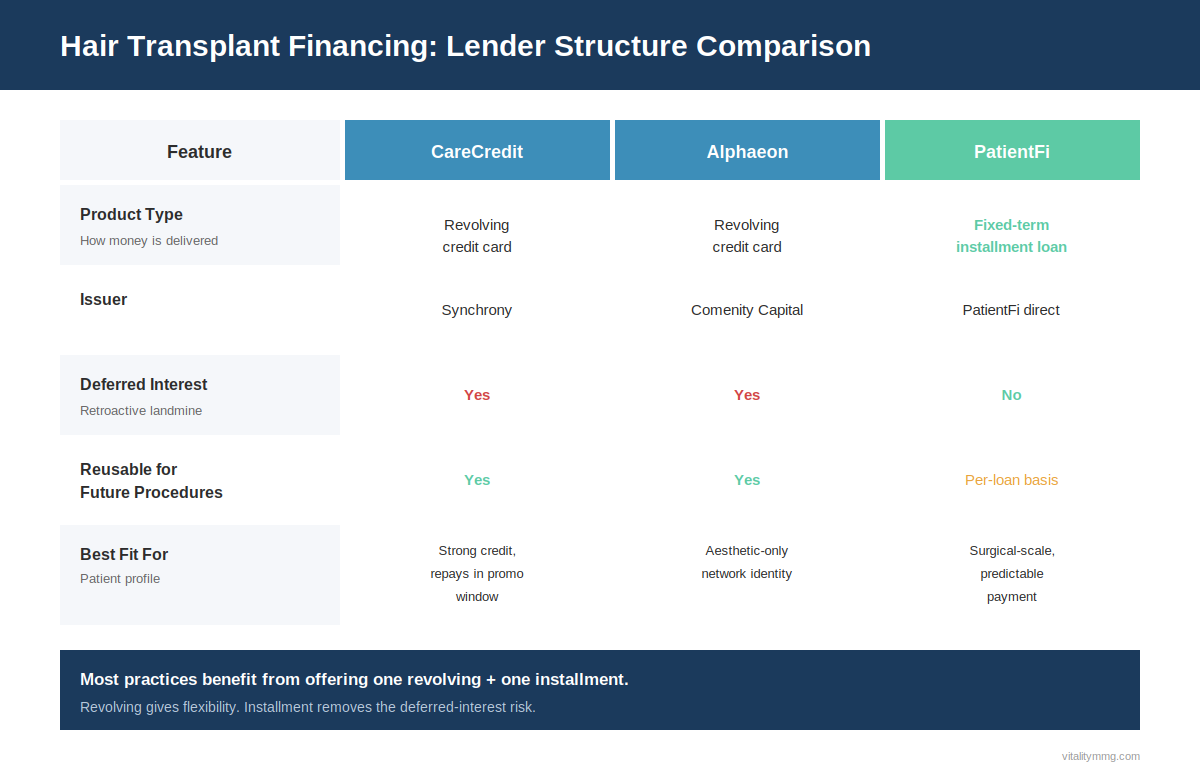
Most practice owners we audit are offering all three without a clear point of view on when to position which. That’s a problem because these products are structurally different, and that structural difference is where you either help the patient or confuse them.
| Feature | CareCredit | Alphaeon | PatientFi |
|---|---|---|---|
| Product type | Revolving credit card | Revolving credit card | Fixed-term installment loan |
| Issuer | Synchrony | Comenity Capital | PatientFi direct |
| Deferred interest risk | Yes | Yes | No |
| Reusable for future procedures | Yes | Yes | Per-loan basis |
| Best fit patient | Strong credit, repays in promo window | Aesthetic-only network identity | Surgical-scale, predictable payment |
CareCredit
A revolving healthcare credit card issued by Synchrony. Functions like a regular credit card with deferred interest promotional periods (6, 12, 18, 24 months no interest if paid in full). Best fit: patients with strong credit who plan to repay during the promotional window. Risk: deferred interest applies retroactively from the purchase date if any balance remains after the promo, at high APRs that surprise patients.
Alphaeon Credit
Also a revolving card, issued by Comenity Capital Bank, but positioned exclusively through board-certified aesthetic and cosmetic providers. Functionally similar to CareCredit in mechanics, with deferred interest promos and standard variable APRs in the high twenties. Best fit: practices that want a financing partner with a tighter aesthetic-only network identity.
PatientFi
Structurally different. A fixed-term installment loan, not a revolving card. Approval generates a single loan tied to the procedure, with a defined start date, end date, and monthly payment. No deferred interest landmine. Best fit: surgical-scale cases where the patient wants predictability and the practice wants the case fully funded at consult, not stretched across multiple promos.
The choice is revolving versus installment. Revolving products give patients flexibility and reusability. Installment products give patients predictability and remove the deferred-interest risk that drives complaint volume. Most practices benefit from offering one of each.
Scripts for the “it’s too expensive” objection
“It’s too expensive” almost never means what it says. It usually means one of four things, and your coordinator’s job is to figure out which.
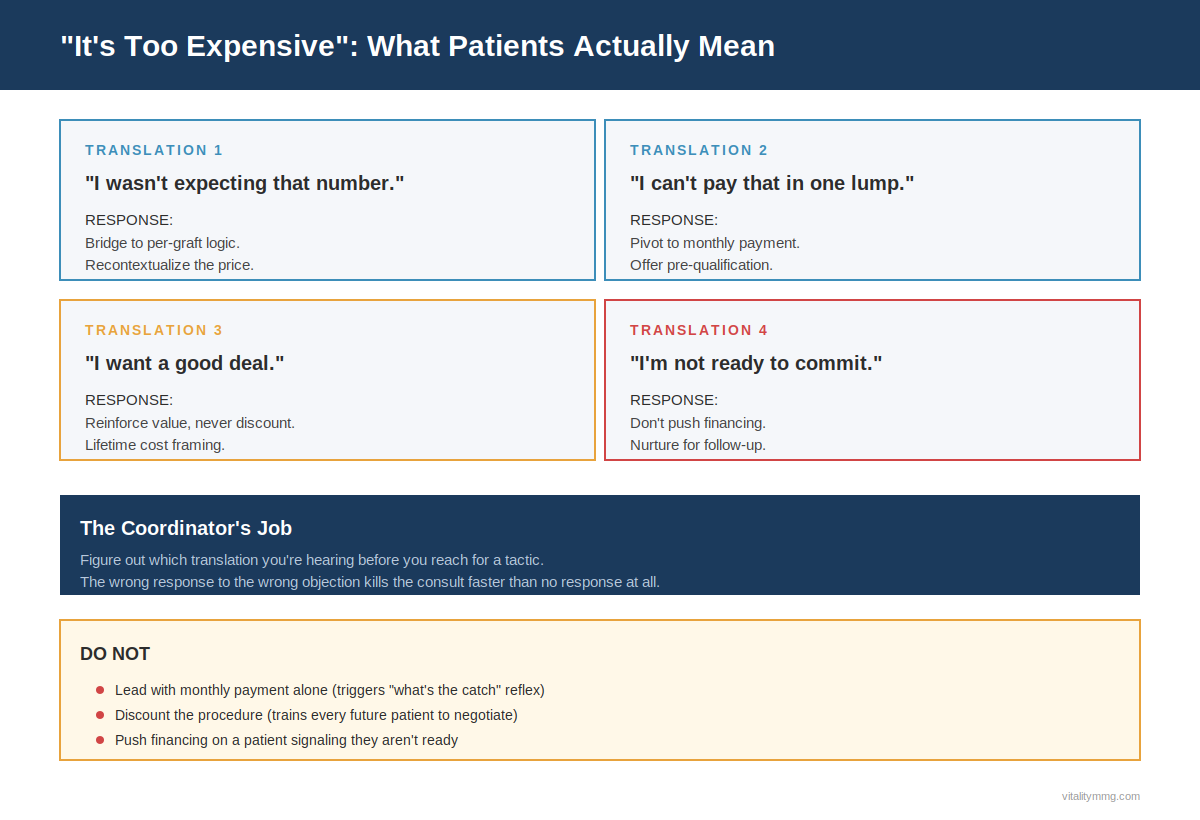
- “I wasn’t expecting that number.” Bridge to per-graft logic. “Totally fair. Let me walk you through how we got there. You’re a 2,400 graft case, which puts you in our standard FUE range.”
- “I can’t pay that in one lump.” Pivot to monthly. “Most of our patients don’t pay upfront. With a sixty month plan you’re looking at about $X a month. Want me to check what you’d qualify for?”
- “I want to feel like I’m getting a good deal.” Reinforce value, never discount. Mention surgeon experience, lifetime results, the cost of fifteen years of finasteride versus a one-time procedure. Discounting trains patients to negotiate.
- “I’m not actually ready to commit.” Don’t push financing. Schedule a follow up, send the after-care guide, stay in touch. Closing a not-ready patient with a payment plan creates buyer’s remorse and refund requests.
What to do when the patient qualifies for sixty percent of the procedure
Partial approvals are the most expensive moments in a consult, and most practices handle them poorly. The coordinator sees a $7,200 approval against a $12,000 case, mumbles something about a down payment, and the patient leaves. Three better moves.
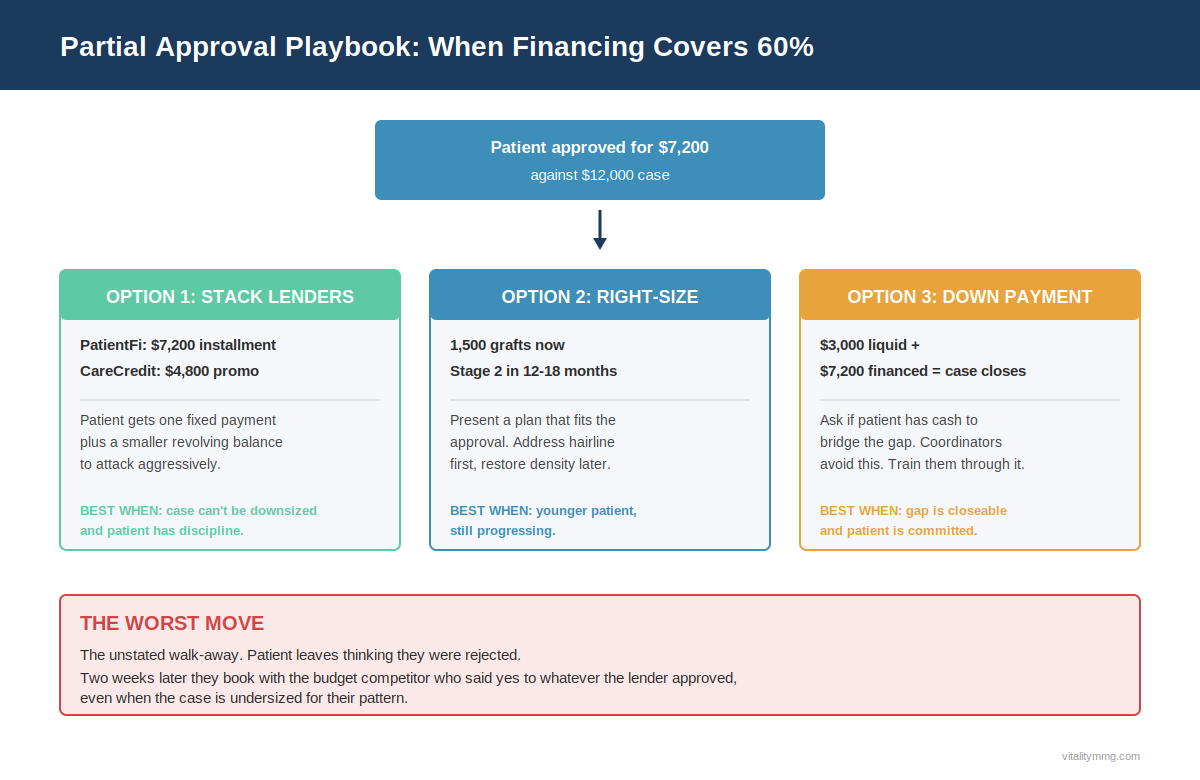
- Stack two lenders. Run PatientFi for the installment-loan portion and use CareCredit or Alphaeon for the remainder on a promotional period. Patient gets one fixed payment plus a smaller revolving balance to attack aggressively. This requires your team to actually understand both products.
- Right-size the procedure. If the patient is approved for 1,500 grafts worth of financing, present a 1,500 graft plan that addresses the hairline first. Schedule a second procedure twelve to eighteen months out. The data on staged procedures says it works, especially for younger patients still progressing through their Norwood pattern.
- Use a down payment plus financing. If the patient has $3,000 liquid and is approved for $7,200, the gap to a $12,000 case is closeable. Coordinators avoid this because asking for a down payment feels uncomfortable. Train them through it.
The worst move is the unstated walk-away. The patient leaves thinking they were rejected, then books with the budget competitor who said yes to whatever the lender approved.
How marketing supports the financing conversation
Your website, ads, and intake forms set expectations long before anyone walks in. If your hair restoration lead generation funnel is sending price-sensitive prospects into consults without pre-framing on financing, you’re starting the conversation on the back foot.
Three asks for the marketing team. Add a financing section to procedure pages that mentions per-graft pricing, monthly payment ranges, and the names of your lender partners. Make sure your hair transplant marketing compliance review covers any financing claims, because the FTC has cracked down on “as low as $X/month” language that hides qualifying conditions. And use intake forms to capture financing interest as a field, so the coordinator walks into the consult knowing whether the patient pre-qualified through your aesthetics paid social ads.
When marketing, sales, and finance work the same playbook, hair transplant financing stops being the awkward end-of-consult pivot.
And once you know what a financed case is worth, you can spend to win it with confidence. Our free Patient Value Calculator turns your average case value and close rate into a clear cost-per-patient target and ad budget.
Ready to fix your consult conversion rate?
VMMG works exclusively with hair restoration and aesthetic practices. We audit your consult flow, marketing funnel, and financing positioning as one system, not three separate problems.