




Your busiest month for leads can still be a slow month for surgery. The gap between the two is your consultation close rate, and for most hair restoration practices it is the single least-measured number in the building. You know your cost per lead to the cent. You can probably guess your consultation close rate within a shrug. That asymmetry is where revenue quietly leaks.
A booked consultation is the most expensive moment in your funnel. The patient has already cost you ad spend, front-desk time, and a calendar slot a surgeon could have used elsewhere. What happens in that room decides whether all of that converts or evaporates. The practices that grow predictably are not the ones with the most consultations. They are the ones with a consultation that runs the same disciplined way every time.
What Consultation Close Rate Actually Measures
Consultation close rate is the percentage of completed consultations that convert into a scheduled, deposit-backed procedure within a defined window. It is not the percentage of leads that book a consult, and it is not how many people say they will think about it. It measures the one handoff that turns interest into committed revenue.
Consultation close rate
Completed consultations that convert to a scheduled procedure with a deposit, divided by total completed consultations in the same period. A no-show is a separate metric and should never be folded into this number, because doing so hides whether the consultation itself is the problem.
Keep the definition tight. If you count tentative “maybes” or rebooked no-shows as closes, the number flatters you and stops being useful. The point of measuring consultation close rate is to expose whether the consultation conversation is doing its job, and a soft definition defeats that purpose.
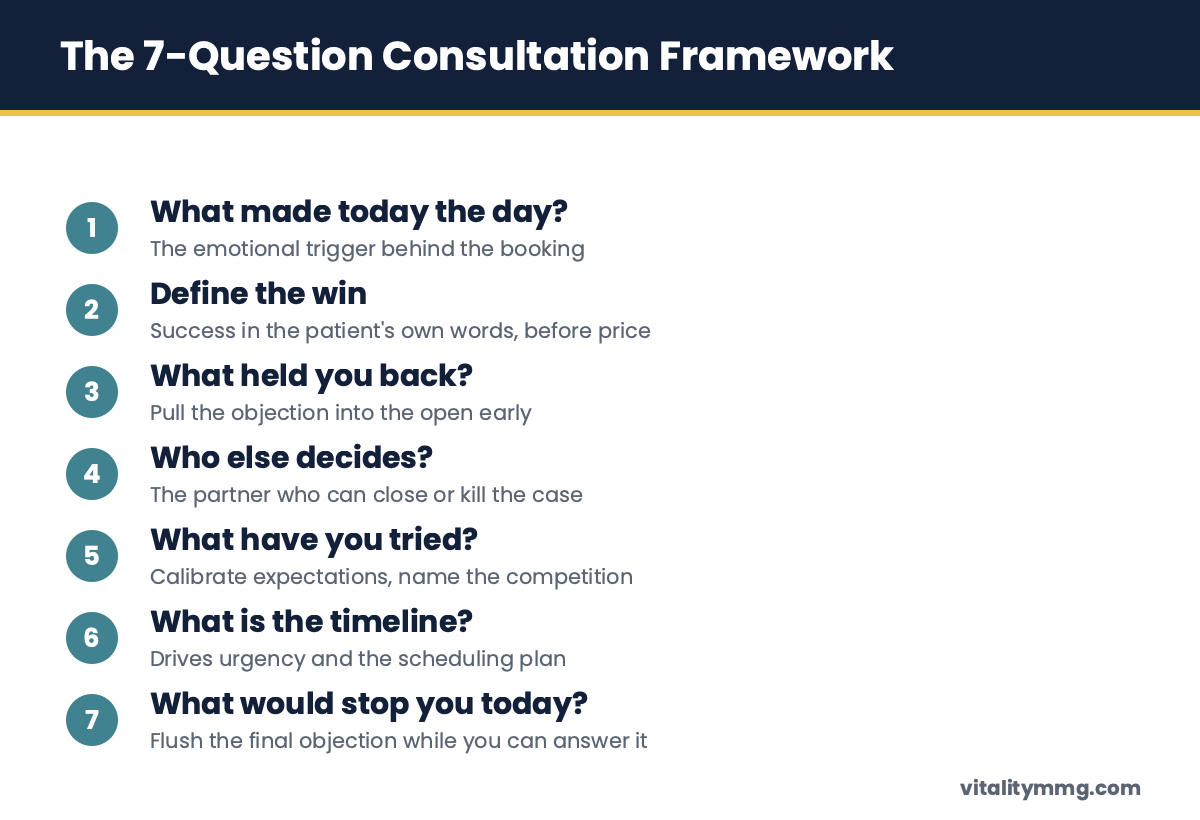
The seven questions that structure a high-converting hair restoration consultation.
Why Most Practices Track Leads but Miss the Close
Lead volume is easy to see. It shows up in the ad dashboard, the call log, and the inbox. The consultation is harder to instrument because it happens in a room, between two people, with no native report attached. So practices optimize the part they can see and leave the most valuable part to instinct.
The second reason is structural. In many practices the consultation is run differently by every coordinator and every surgeon. One asks about goals first, another leads with technique, a third spends twenty minutes on graft counts before learning the patient is comparing three clinics. When the conversation has no shared structure, the outcome swings on who happened to be in the room. You cannot improve a process that changes every time it runs.
This is also where lead quality and consultation quality get confused. When the close rate sags, the reflex is to blame the leads. Sometimes that is fair, and the fix lives upstream in how the practice generates and qualifies demand. Often it is not the leads at all. It is that strong, well-qualified prospects walk into an unstructured conversation and leave without a reason to commit today.
The 7-Question Consultation Framework
The framework below is not a script. It is a sequence of seven questions that every consultation should answer out loud before the patient leaves. Train every coordinator and surgeon to move through them in order. The structure does the heavy lifting, which is exactly why it travels from one team member to the next without degrading.
1. What made today the day you finally booked?
This surfaces the emotional trigger, the wedding, the promotion, the photo that finally landed wrong. The answer tells you what outcome the patient is really buying, and it gives you the language to use for the rest of the conversation.
2. What would make this clearly worth it to you?
Define success in the patient’s own words before anyone talks price. A patient who can describe their win is a patient who can later judge the offer against it. A patient who cannot has no internal yardstick, and undecided patients default to no.
3. What has held you back until now?
Pull the objection into the open early, while there is still time to address it. Cost, fear of an unnatural result, downtime, a bad story from a friend. An objection raised in minute five is a discussion. The same objection unspoken until the close is a lost case.
4. Who else is part of this decision?
Spouses and partners close or kill more cases than most practices track. If the decision-maker is not in the room, the consultation’s job shifts to equipping your patient to advocate at home, and your follow-up plan has to account for it.
5. What have you already tried or researched?
This calibrates expectations and reveals where the patient’s information is wrong. It also tells you who you are competing against, the other clinics, the topical routine, the wait-and-see plan. You cannot differentiate against a comparison you never named.
6. What does your timeline look like?
Timeline drives the scheduling conversation and exposes urgency or the lack of it. A patient with a hard date is a patient you can build a plan around. A patient with no timeline needs one created, gently, before they leave.
7. If we are the right fit, what would stop you from moving forward today?
This is the question most consultations skip, and it is the one that protects your consultation close rate. It flushes the final objection while you can still respond to it, and it separates a real obstacle, often a financing question you can solve on the spot, from a polite exit you will never recover.
Turning the Framework into a Repeatable System
A framework that lives in one person’s head is a liability, not an asset. The goal is a consultation that runs the same disciplined way whether your best coordinator is in the room or out sick. Three moves make it stick.
First, build the seven questions into your intake and consultation notes so answering them is the path of least resistance, not extra work. The patient’s answers become structured fields, not loose memory. Second, make sure the conversation does not start cold. The front desk sets the tone before the surgeon ever walks in, and a patient who felt rushed or unheard at check-in arrives to the consult already leaning out.
Third, respect the rules that govern what you can say in that room. Hair restoration consultations lean on photos and patient stories, and the FTC’s endorsement guidance requires that testimonials and before-and-after images reflect typical, truthful results, not cherry-picked outliers presented as the norm. Building compliant proof into the consultation is not a constraint on closing. It is what lets a sophisticated patient trust the room. This is the difference between a practice that sells and a practice a patient believes.
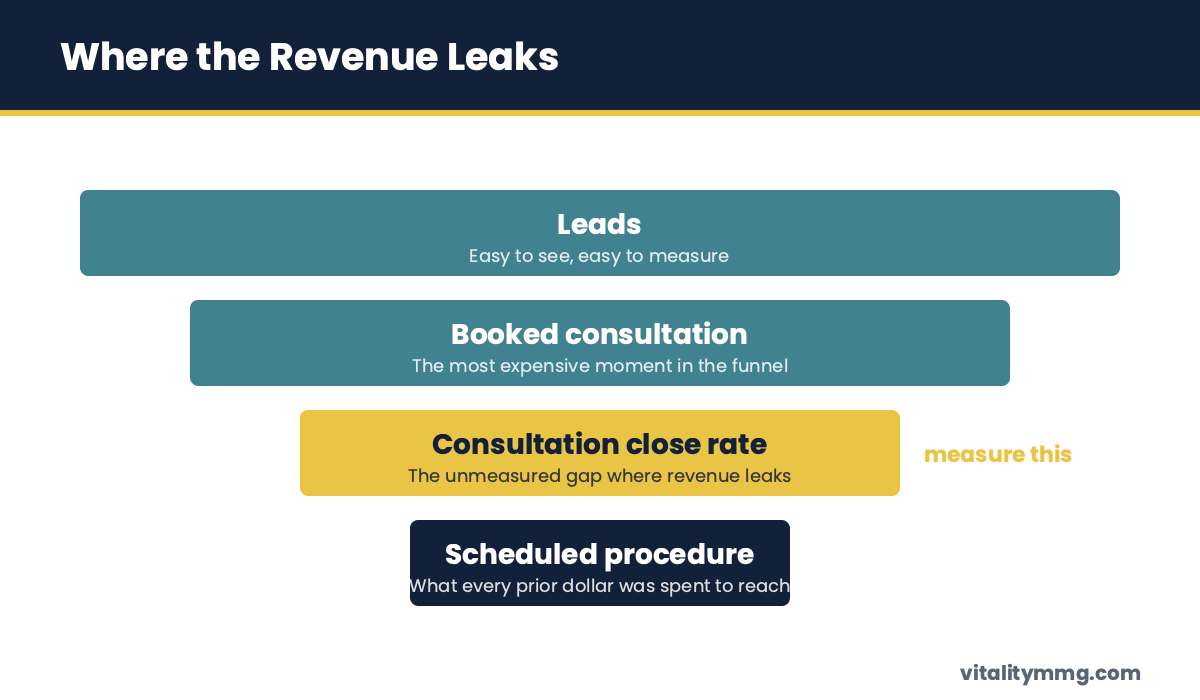
Where the revenue leaks: a strong lead funnel undone by an unmeasured consultation.
Reading Your Consultation Close Rate
Once you measure consultation close rate honestly, the number starts telling you where to look. A low close rate paired with high lead volume usually points at lead quality or qualification, and the work moves upstream. A healthy lead flow with a low close rate points squarely at the consultation itself, which is the fastest and cheapest thing on this list to fix because it costs no additional ad spend.
The fastest way to read the number is to separate the two failure modes before you spend another dollar. The table below is the diagnostic most practices never run.
| What you see | Likely cause | Where the fix lives |
|---|---|---|
| High lead volume, low consultation close rate | Lead qualification or a structureless consultation | Qualification upstream, then the 7-question framework in the room |
| Low lead volume, healthy close rate | Demand generation, not the consultation | Upstream in campaigns and targeting |
| Strong close rate that drops after a staffing change | The framework lived in one person’s head | Document and train the structure so it survives turnover |
| Closes that unwind before the deposit clears | Objection never surfaced in the room | Question seven, plus a financing answer ready on the spot |
Track the trend, not a single month. According to the International Society of Hair Restoration Surgery, patient decision-making in surgical hair restoration is deliberate and often spans multiple touchpoints, so a single slow month is noise, not signal. What matters is the direction over a quarter and whether a structural change to the consultation moves it. Pair the close-rate trend with the economics in our patient value calculator and the volume model in our guide to consultation conversion, and you can finally see which lever actually grows the practice.
The practices that win are not guessing. They know their consultation close rate, they run the same seven-question structure every time, and they treat the consultation as the most valuable and most measurable moment in the funnel, because it is.
Key Takeaways
- Consultation close rate measures completed consultations that convert to a deposit-backed procedure, and it is the least-measured high-value number in most hair restoration practices.
- When the close rate drops, diagnose before you blame leads: high volume with low close points at the consultation, not the marketing.
- The 7-question framework gives every coordinator and surgeon the same structure, so the outcome stops depending on who is in the room.
- Build compliant proof, FTC-aligned testimonials and before-and-after images, into the consultation to earn a sophisticated patient’s trust.
See Where Your Consultation Loses Patients
Vitality maps the full path from ad click to booked procedure, so you can see exactly where qualified patients slip away and what it costs you.