




Quiet luxury plastic surgery is the defining patient demand of 2026, and it rewrites what a practice should put in its ads, on its website, and in front of a consult. Patients no longer walk in asking to look transformed. They ask to look rested, balanced, and unmistakably themselves. The American Society of Plastic Surgeons now frames natural, undetectable results as the guiding philosophy of the year. For a practice owner, that shift is not a clinical footnote. It changes the message that earns the click, the photo that builds trust, and the offer that turns a browser into a booked consult.
The practices that win the next cycle are the ones that translate this clinical philosophy into a marketing system. The ones that keep running shock-value transformation ads will look dated to the exact patient they want most.
What “Quiet Luxury” Means in Plastic Surgery
Fashion borrowed the phrase first. No logos, no spectacle, just material quality that only a trained eye reads. Aesthetic medicine adopted the same standard. The best outcome is the one no one can name out loud. A deep plane facelift that restores the deep tissue support the face has lost, rather than pulling skin tight. Fat grafting that rebuilds volume instead of adding obvious filler. Low-dose neuromodulators used early to preserve movement rather than freeze it.
The category travels under several names. Quiet luxury. High-fidelity aesthetics. Stealth results. They all describe one buyer expectation: a result that reads as good genetics, not as a procedure.
High-fidelity aesthetics
Surgical and non-surgical outcomes engineered to look like the patient’s own anatomy at its best, rather than a recognizable, standardized procedure. The marketing implication is direct: the proof a practice must sell is realism and judgment, not the magnitude of change.
Where the demand is concentrated
Three categories drive the trend. Post-GLP-1 body contouring, as patients who lost significant weight on medication seek surgical refinement of loose tissue. Preservation-based facial surgery, where the goal is restored structure and a refreshed look. Fat grafting and regenerative techniques that rebuild rather than fill. Each one sells on subtlety, and each one demands a different proof model than the dramatic transformation that defined the last decade of aesthetic advertising.
Why Quiet Luxury Plastic Surgery Breaks the Old Playbook
The legacy aesthetic ad was built on contrast. The bigger the visible change between the before and the after, the stronger the implied result. That logic now works against the practice. The high-fidelity patient distrusts the obvious. A dramatic, high-contrast before-and-after signals exactly the outcome this buyer is paying to avoid, and it quietly tells them your practice optimizes for spectacle over restraint.
Quiet luxury plastic surgery rewrites every layer of the funnel, not just the imagery. The headline shifts from promised transformation to demonstrated judgment. The hero proof moves from one shocking case to a body of consistent, natural work. The fear the message must answer is no longer “will it work” but “will it be obvious.”
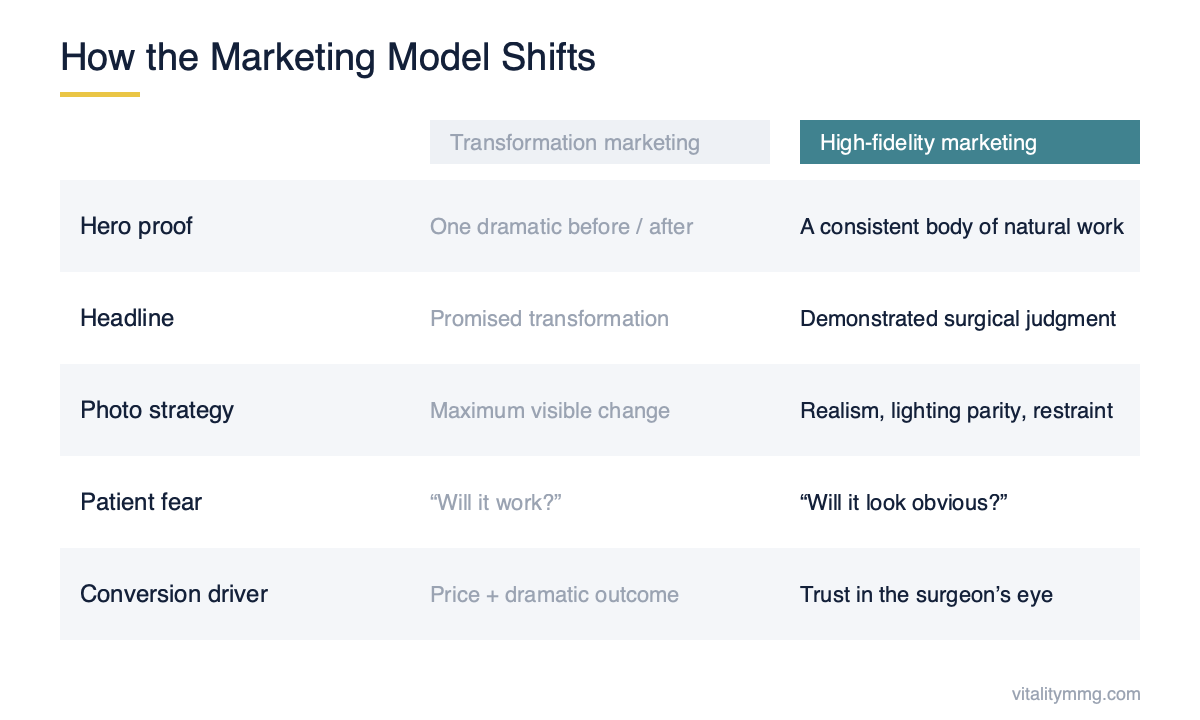
How the marketing model shifts when patients want results no one can name.
| Funnel layer | Transformation marketing | High-fidelity marketing |
|---|---|---|
| Hero proof | One dramatic before-and-after | A consistent body of natural work |
| Headline | Promised transformation | Demonstrated surgical judgment |
| Photo strategy | Maximum visible change | Realism, lighting parity, restraint |
| Patient fear addressed | “Will it work?” | “Will it look obvious?” |
| Conversion driver | Price and dramatic outcome | Trust in the surgeon’s eye |
Positioning the Practice for the High-Fidelity Patient
This patient researches before they ever fill out a form. They read technique pages, study cases with a critical eye, and screen for surgeons who say no to the wrong candidate. Restraint is the credential they are shopping for. A practice that positions on volume, discounts, or “wow” results filters this buyer out before the consult.
Lead with the surgeon’s judgment. Name the technique and the reasoning behind it on your facial plastic surgery pages, and explain when a procedure is and is not appropriate. Honesty about candidacy reads as confidence, and confidence converts the high-fidelity buyer. This is the spine of effective cosmetic surgery marketing in 2026, and it is the principle behind our marketing methodology: educate first, sell the evaluation, let the work prove itself.
The practice’s own digital presence is part of the proof. A high-fidelity buyer reads a cluttered, discount-driven website the same way they read an over-pulled facelift, as evidence of a practice that chases volume. Clean design, restrained photography, and case galleries organized by realism rather than shock value all signal the quality this patient is paying for. The website is the first before-and-after a prospect evaluates, and it judges your taste before it ever judges your surgery.
Marketing Subtle Results Without Tripping FTC Rules
The subtle-results message is harder to prove than a dramatic one, and that difficulty is where practices get into trouble. The temptation is to close the proof gap with language the evidence cannot support: “undetectable,” “flawless,” “look ten years younger, guaranteed.” Each of those is a claim a regulator can test, and aesthetic advertising sits squarely inside the Federal Trade Commission’s enforcement lane.
The FTC’s Rule on the Use of Consumer Reviews and Testimonials took effect on October 21, 2024, with civil penalties that can exceed 50,000 dollars per violation. Before-and-after photos must represent results a typical patient can expect, not a best case presented as the norm. Any editing, and even changes to lighting or skin tone, can be treated as deceptive if undisclosed. Testimonials must come from real, verified patients, backed by a signed release on file.
Typical-results standard
Under FTC guidance, a before-and-after or testimonial must reflect the result an ordinary patient can realistically expect. Showing an exceptional outcome as if it were standard, or retouching an image without disclosure, is treated as a deceptive claim.
This is the line a generalist marketing agency does not see coming. Quiet luxury plastic surgery makes the problem sharper, because “natural” and “undetectable” feel safe to write but function as performance claims. The compliant version sells the surgeon’s process, the candidacy conversation, and an honest range of outcomes. It is a harder message to write and a far safer one to run.
Building a Funnel for Quiet Luxury Plastic Surgery
Positioning and compliance set the message. The funnel turns it into booked surgery. The conversion event for quiet luxury plastic surgery is the consultation, not the procedure, because the entire buying decision rests on trust in a specific surgeon. Build every asset to move a researcher toward that evaluation.
Three components carry the load. Education-first content that answers the candidacy and realism questions this patient is already asking. A consult offer framed as an evaluation of fit, which matches how the buyer thinks. And disciplined speed-to-lead, because a patient who took weeks to choose your practice will still book with whoever answers first. The same lead generation systems that close the gap between form fill and booked patient in hair restoration apply directly to surgical aesthetics, and they are built into our full solution stack.
The consult experience has to match the message. A patient sold on judgment and restraint will not tolerate a rushed intake call or a front desk that quotes price before fit. Train the team to mirror the brand promise: ask about goals, frame the surgeon’s evaluation as the value, and treat the first phone call as part of the clinical experience rather than a booking transaction. The front desk is part of the funnel, and for this buyer it is often the moment trust is won or lost.
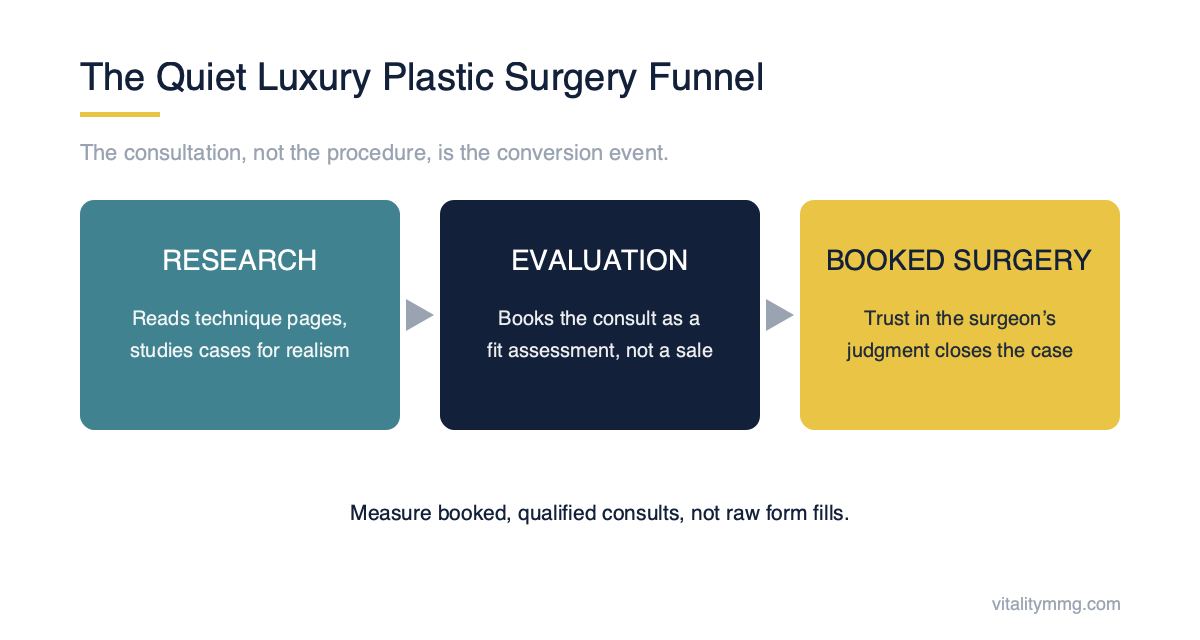
The quiet luxury plastic surgery funnel: research to evaluation to booked surgery.
None of this works without measurement that follows the patient past the form. A form fill is not a patient, and the practices that scale subtle-results surgery are the ones that track which campaigns produce booked, qualified consults rather than raw lead volume. That feedback loop is what lets a practice spend confidently on the exact message the high-fidelity buyer responds to.
Key Takeaways
- Quiet luxury plastic surgery means the patient wants results that read as good genetics, not as a visible procedure. Your marketing proof must be realism and judgment, not magnitude of change.
- The dramatic before-and-after now repels the high-fidelity buyer. Shift the hero proof to a consistent body of natural work and lead with the surgeon’s eye.
- “Natural” and “undetectable” read as safe but function as performance claims. The FTC testimonial rule carries penalties above 50,000 dollars per violation, so sell the process and an honest outcome range.
- The consultation is the conversion event. Build education-first content, an evaluation-framed offer, and fast follow-up, then track booked consults rather than raw leads.
Position Your Practice for the High-Fidelity Patient
VMMG builds compliant, conversion-focused marketing for plastic and cosmetic surgery practices selling natural, high-fidelity results.