




Hair transplant patient testimonials are the single most underused conversion asset most practices already own. A patient who booked, went through the procedure, and came out the other side happy is walking, talking proof matched to the exact fear a prospective patient carries into your consultation room. Most practices collect a handful of reviews and call it done. The practices growing fastest treat testimonials as a system: a capture cadence, a consent process, a production template, and a deployment plan across every channel that touches a prospective patient.
This guide covers that system end to end: written, video, and Google review testimonials and where each converts; when to ask; a HIPAA-compliant consent process; the legal lines the FTC and state medical boards draw around results claims; a repeatable video template; a Google review playbook; and how to deploy what you capture so it doesn’t disappear into a folder nobody opens again. A related guide on this site goes deep on video testimonial production specifically; this one covers the full strategy, written, video, and review, plus the consent and compliance mechanics underneath all three.
The Three Types of Hair Transplant Patient Testimonials
Every hair transplant patient testimonial falls into one of three formats, and each earns its keep at a different point in the funnel. Treating them as interchangeable is the most common mistake practices make when building a testimonial program. Building that program alongside a broader hair restoration lead generation strategy is what turns individual reviews into a compounding growth asset.
Written testimonials
Written testimonials are the cheapest to collect and the easiest to place. A short quote, a name (or first name and last initial), and a procedure detail work on service pages, in email nurture sequences, and inside intake packets. Written testimonials convert best mid-funnel, when a prospective patient has already found the practice and is comparing it against two or three others.
Video testimonials
Video testimonials carry the most weight and the highest production cost. A patient’s face, voice, and unscripted pauses are harder to fake and easier for a prospective patient to trust than any written quote. Video performs best on the landing page a paid search or social campaign sends traffic to, where a visitor decides in under thirty seconds whether the practice is worth a consultation request.
Google review testimonials
Google reviews do a job neither written nor video testimonials can: they influence local pack ranking and they are the first testimonial a prospective patient sees, because they see it before they ever land on the website. A steady stream of recent, detailed Google reviews is a top-of-funnel trust signal and a local SEO input at the same time.
| Testimonial Type | Best Funnel Stage | Primary Placement | Production Effort |
|---|---|---|---|
| Written | Mid-funnel (comparison) | Service pages, email nurture | Low |
| Video | Top-of-funnel (first impression) | Paid landing pages, homepage, social ads | High |
| Google Review | Top-of-funnel (discovery) | Google Business Profile, local pack | Low once a process exists |

Where each hair transplant patient testimonial format converts, from discovery to decision.
When to Ask: A Post-Procedure Milestone Framework
Timing determines whether a testimonial request gets ignored or answered. Ask too early and the patient is still swollen or anxious about shedding. Ask too late and the emotional payoff of the result has faded into routine. The milestone framework below maps to the three testimonial types above.
Day 1 to Day 10: consent, not content
This window is for securing written authorization, not collecting the testimonial itself. Present the consent form at discharge, while the patient is still engaged with the practice and before recovery discomfort creates any distance. More on the consent form in the next section.
Week 3 to Week 6: the Google review ask
Shock loss typically starts around week 2 to 4, which makes this an emotionally volatile window for outcome-specific testimonials, but it is the right window for a Google review focused on the experience, not the result: the consultation, the staff, the facility, the communication. Ask about what the patient can already speak to honestly.
Month 4 to Month 6: the written testimonial ask
New growth is visible by month 4 in most patients. This is the window for a written testimonial, because the patient has enough visible progress to speak concretely and enough distance from the procedure to describe the decision-making process a prospective patient is currently going through.
Month 10 to Month 14: the video testimonial ask
Final density assessment typically happens around month 12. This is the highest-leverage window for a video testimonial: the result is close to final, and the patient has lived with the outcome long enough to speak to it without hedging.
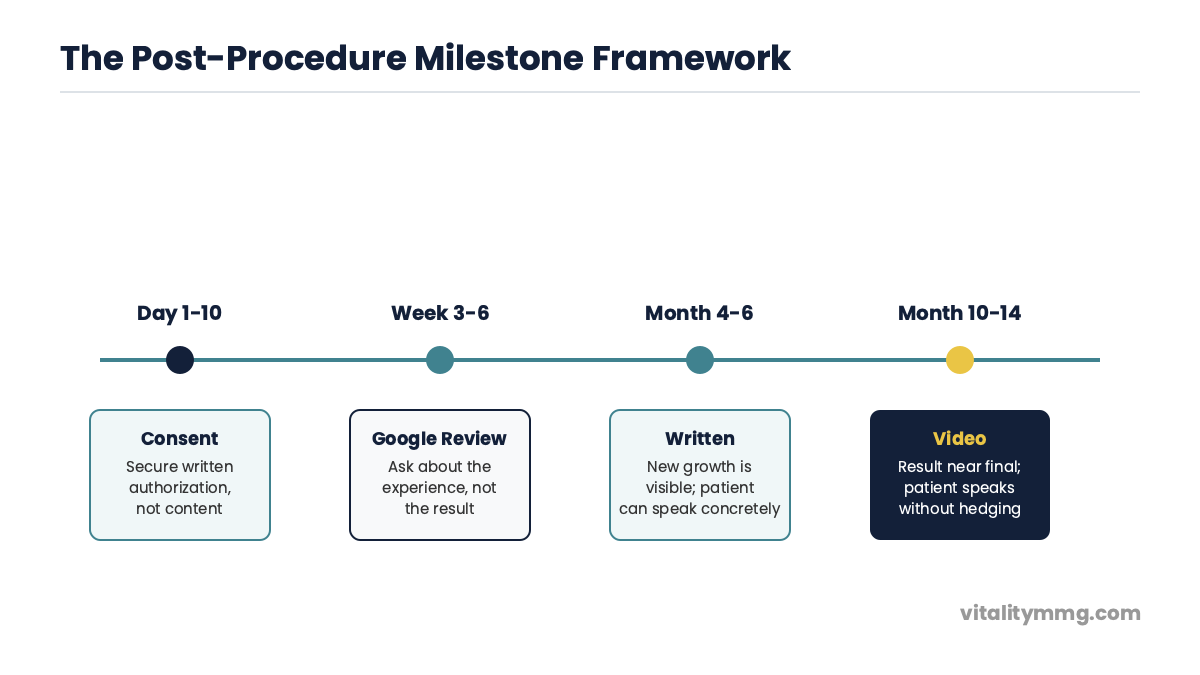
The post-procedure milestone framework: what to ask for, and when.
HIPAA-Compliant Consent and the Legal Guardrails Practices Miss
A testimonial that names a patient, shows a patient’s face, or describes a patient’s procedure is protected health information the moment it identifies who received care and what they received. Standard intake paperwork does not authorize marketing use. A dedicated, separate authorization form does. HHS’s Office for Civil Rights has issued six-figure settlements against healthcare providers for using patient photos in marketing without proper authorization, a useful reminder that this is not a formality.
What the consent form must say
A compliant testimonial authorization form is a standalone document, separate from the general HIPAA intake authorization, and it should specify, in plain language:
- Exactly what will be used: written quote, photo, video, before-and-after image, or a combination
- Exactly where it will appear: website, specific social platforms, paid ads, Google Business Profile, print material
- That the authorization has no automatic expiration unless the patient sets one, and that the patient can revoke it in writing at any time
- Who at the practice to contact to revoke consent, and how quickly the content comes down once revoked
- Whether the patient received anything of value in exchange, since that must also be disclosed publicly under the FTC rule covered below
Results disclaimers and before-and-after rules
Two federal frameworks and a growing list of state medical board rules govern how a testimonial can be presented, independent of whether consent was obtained.
The FTC’s Trade Regulation Rule on the Use of Consumer Reviews and Testimonials, effective October 21, 2024, gives the agency direct authority to fine a practice per violation for testimonials that misrepresent the reviewer’s actual experience, and it covers healthcare advertisers directly. A testimonial edited to imply a more dramatic result than the patient actually described crosses this line.
The FTC’s 2023 update to its Endorsement Guides applies a “net impression” test: it evaluates the testimonial together with the surrounding page, not the testimonial’s words in isolation. A results-focused testimonial next to a gallery of exceptional before-and-after photos and a bare “results may vary” footnote can still fail this test if the composite impression overstates what a typical patient achieves.
The International Society of Hair Restoration Surgery’s Consumer Alert on False Advertising, which most reputable hair restoration physicians have agreed to follow, prohibits testimonials or supporting copy claiming a procedure is scar-free, painless, or produces unlimited grafts. A patient quote that includes an absolute claim like that cannot run unedited, even though it is the patient’s own word choice, because the practice is the one publishing it.
Several states go further. Florida requires a testimonial disclaimer to be “reasonably related in size and location to the testimonial,” not a small-print footer. Texas and California both require disclosure that before-and-after results are not guaranteed and individual results vary. Practices that draw patients across state lines, which is common in hair restoration given how far patients travel for a specific surgeon, should apply the strictest applicable state rule fleet-wide rather than maintaining different disclaimer language by geography. Staying inside all of these lines is also what keeps testimonial content from tripping Google’s own medical advertising policy restrictions when it lives on a page that paid campaigns touch.

What a HIPAA-compliant testimonial authorization form must include.
The Three-Minute Video Testimonial Template
A three-minute video testimonial is long enough to feel unscripted and short enough that a prospective patient will actually finish it. The template below produces a consistent structure without making the patient feel like they are reading from a script.
Questions to ask, in order
- What made you start looking into hair restoration in the first place?
- What almost stopped you from booking a consultation?
- Walk me through your first visit to the practice. What stood out?
- What did recovery actually look like, week by week?
- What would you tell someone who is where you were a year ago?
Question 2 is the one most practices skip, and it is the most valuable, because the objection that almost stopped the patient from booking (cost, fear of an unnatural result, worry about what coworkers would notice) is the same objection sitting in a prospective patient’s head right now.
B-roll to capture
Shoot supporting footage before or after the interview, not during it: the patient walking into the practice and being greeted by name, a wide shot of the consultation room, a well-lit shot of the result (with consent that specifically covers close-up scalp footage), and a shot of the patient in an everyday setting, not a clinical one. The clinical footage builds credibility; the everyday footage is what a prospective patient actually pictures when imagining their own outcome.
The Google Review Request Playbook
Google review volume and recency both factor into local pack visibility, which makes review requests a growth lever, not just a reputation task. The playbook below is built around removing friction, not scripts that feel like a sales pitch. Consistent, detailed reviews also feed directly into how well a practice shows up in AI-driven local search results, which is where our AI-optimized geographic search strategy work picks up.
Timing and channel
Send the request by text message, not email. Text messages get opened within minutes; review-request emails sit in inboxes for days and get buried. Send it during the week 3 to week 6 window described above, timed to a specific touchpoint such as a follow-up call, not as a standalone ask that feels transactional.
Make the ask specific
“Would you leave us a review?” produces short, generic reviews that do little for local SEO. “Would you share what stood out about your consultation and how the team explained your options?” produces a longer, more specific review that reads as credible to a prospective patient and gives Google more relevant text to index. Provide the direct Google review link, not a search-and-find-us link, to remove every extra step.
Handle the negative review honestly
A practice with only five-star reviews looks curated, not trustworthy, and selectively suppressing negative reviews while republishing only positive ones creates its own FTC exposure under the net impression standard covered above. Respond to every review, positive and negative, without disclosing any clinical detail about the reviewer’s care in the public response. A physician’s board certification, verified through a body like ABHRS, is a credibility signal that holds up regardless of what a single review says.
Deploying Hair Transplant Patient Testimonials Across Your Funnel
A testimonial that lives only on a dedicated reviews page is doing a fraction of its possible work. The highest-performing hair transplant patient testimonials get placed at the specific point in the funnel where the objection they answer is live.
Landing pages
Place a video testimonial above the fold or immediately below the primary headline on any landing page a paid campaign sends traffic to. A written testimonial addressing cost or financing belongs directly next to the pricing or financing section, not on a separate page.
Ads
Short video testimonial clips, 15 to 30 seconds, outperform produced brand creative in paid social because they read as authentic in a feed built around authenticity. Pull the strongest 20-second segment from a longer video testimonial rather than producing separate short-form content from scratch.
Google Business Profile and nurture sequences
Feature recent reviews as GBP posts and respond publicly to every review to signal an active, attentive practice to both prospective patients and Google’s ranking algorithm. Inside a nurture sequence, order testimonials to answer objections in sequence: a Google review or short quote addressing trust in the first touch, a written testimonial addressing outcome expectations in the middle, and a full video testimonial as the asset that accompanies the consultation-booking ask.
A tracking note
Testimonial and review pages routinely sit one click from a consultation form. Keep standard analytics tags off any page where a testimonial names a specific condition or procedure alongside a lead-capture form, and route conversion tracking through a HIPAA-aware setup instead of a raw pixel tied to a treatment-specific event name.
Measuring whether the program is working
Track testimonial-influenced consultations the same way any other content asset gets measured: tag the landing pages that carry a testimonial, watch consultation request rate on those pages against pages without one, and ask front desk staff to note, at booking, whether a testimonial or a specific review was mentioned. A testimonial program that isn’t measured drifts into a folder of old video files within a year. A testimonial program that is measured earns the production budget to keep going.

Deploying hair transplant patient testimonials across landing pages, ads, GBP, and nurture sequences.
Key Takeaways
- Match testimonial type to funnel stage: written for mid-funnel comparison, video for top-of-funnel landing pages, Google reviews for local discovery.
- Ask on a milestone schedule tied to what the patient can honestly speak to at that point in recovery, not on a single fixed date.
- Use a standalone marketing authorization form, separate from HIPAA intake paperwork, with no automatic expiration and a clear revocation path.
- Keep every testimonial and its surrounding page inside the FTC’s Consumer Reviews and Testimonials Rule, the Endorsement Guides net impression test, and ISHRS’s ban on scar-free and painless claims.
- Deploy testimonials at the specific funnel point where they answer a live objection, and measure whether they move consultation requests.
Turn Patient Stories Into Booked Consultations
VMMG builds the capture, consent, and deployment system that turns a handful of good outcomes into a testimonial engine your ads, landing pages, and GBP profile actually use.