




If your Google consent mode remarketing audiences have quietly shrunk over the past few weeks, the campaigns did not get worse. The measurement did. On June 15, 2026, Google made ad_storage the sole control for whether advertising data flows from GA4 into linked Google Ads accounts, and practices running without a properly configured Consent Management Platform are seeing the fallout in their remarketing lists and their reporting, not in their creative or their targeting.
This is not a small technical footnote. It is a structural change to how patient-marketing data reaches the algorithm that decides who sees your ads. Practice owners who treat it as a compliance checkbox will misread the resulting dip as a performance problem and start pulling levers that were never broken. Diagnosing a Google consent mode remarketing gap correctly, before touching creative or bids, is the difference between a two-week fix and a quarter spent chasing the wrong problem.
Why Your Google Consent Mode Remarketing Numbers Just Changed
Before June 15, 2026, two separate settings jointly governed whether Google Ads could use cookies and identifiers sourced from GA4: the Google Signals toggle inside GA4 Admin, and the ad_storage parameter inside Consent Mode. A practice could have Google Signals enabled and still lose ad data if consent mode was misconfigured, or vice versa. That dual-control model created ambiguity, and ambiguity is exactly what breaks under a compliance audit.
Google closed that ambiguity by collapsing the decision into one signal. Per Google’s own consent mode documentation, ad_storage is now the single parameter that determines what advertising data GA4 is permitted to pass into a linked Google Ads account. Google Signals still exists, but it is narrowed to analytics-only functions, associating sessions with signed-in users for behavioral reporting inside GA4 itself. It no longer carries any weight over what reaches Google Ads. If you have followed Google’s history of tightening advertiser categorization and landing page review (a pattern we broke down in our Google Ads policy changes analysis), this consolidation fits the same trajectory: fewer parallel settings, one authoritative gate, and less room for a practice to claim it did not know a signal was misconfigured. The practical result is that a properly configured Google consent mode remarketing signal now travels through exactly one gate, not two, which makes it easier to audit and easier to break if nobody checks it.
What ad_storage Actually Controls Now
Consent Mode operates on two connected states: granted and denied. When a site visitor accepts advertising cookies, ad_storage is set to granted and Google Ads cookies and identifiers pass through GA4 into your linked Ads account normally: full remarketing eligibility, full conversion attribution, full audience-list growth.
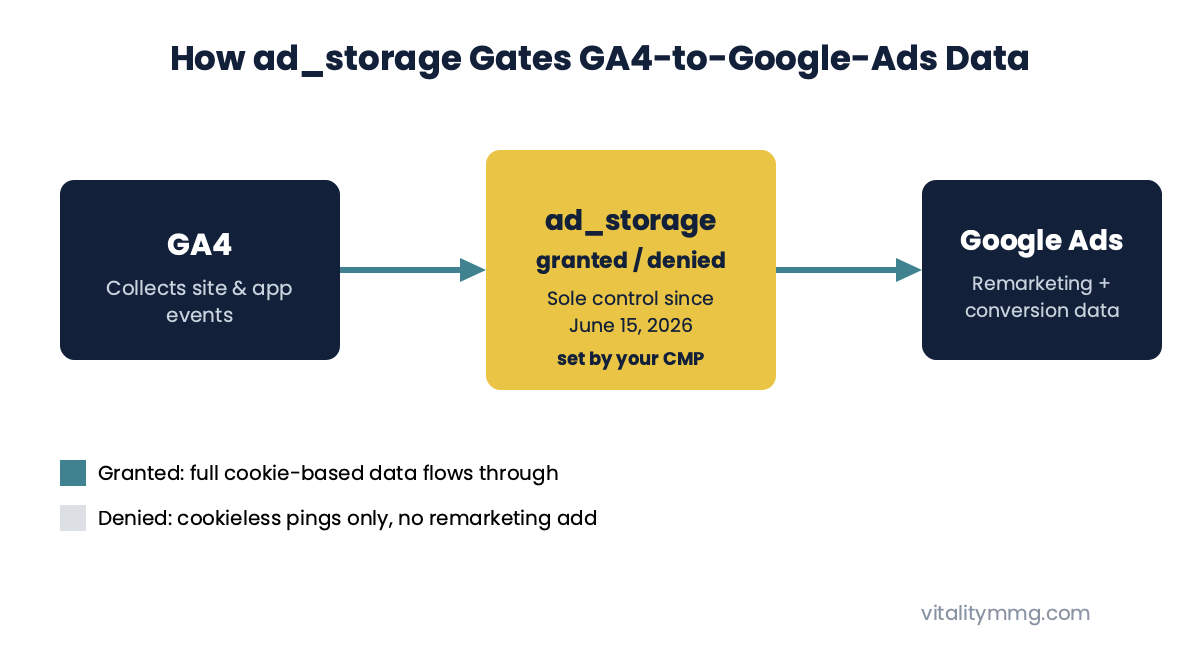
How ad_storage gates advertising data between GA4 and a linked Google Ads account.
When a visitor declines, or when no consent signal is captured at all, ad_storage is denied. Google’s tags stop storing advertising cookies and instead send cookieless pings, aggregated signals that carry no personal identifiers. Those pings keep the platform aware that an event happened without violating the visitor’s stated preference. What they do not do, by default, is add that visitor to a remarketing list or attribute a specific, deterministic conversion.
Consent Management Platform (CMP)
Software layered on a website that captures a visitor’s consent choice, sets the correct ad_storage and analytics_storage states in real time, and passes those states to Google’s tags before any advertising data is collected. Without a CMP wired correctly into consent mode, Google defaults to treating the visitor as unconsented, whether or not that reflects reality.
Consent Granted vs. Consent Denied
| Signal state | What Google Ads receives |
|---|---|
| ad_storage: granted | Full cookie-based tracking, deterministic conversions, remarketing list growth |
| ad_storage: denied (CMP configured correctly) | Cookieless pings, modeled conversions, no remarketing list addition |
| ad_storage: denied (no CMP, or CMP misconfigured) | Inconsistent or absent signal; Google Ads may default to a fully denied state with no modeling input |
The Measurement Problem Behind Plateauing Campaigns
Here is where most practices get the diagnosis wrong. A campaign that has been converting steadily for months suddenly plateaus. The instinct is to blame the creative, the offer, or the targeting, and to start testing new ad copy or expanding keyword lists. That instinct is usually pointed at the wrong system.
Without a CMP properly passing consent signals into GA4 and Google Ads, remarketing audiences shrink without any accompanying explanation in the interface. Google Ads does not surface a banner that says “your consent signal is broken.” The audience count simply drifts down, and the campaigns built on that audience quietly lose reach. Meanwhile, the conversion count that feeds Smart Bidding may also be undercounting, not because fewer patients are actually converting, but because fewer of those conversions are being reported as consented, deterministic events.
This is a measurement problem, not a creative problem or a targeting problem, and the distinction matters because the fix is entirely different. Our own attribution methodology exists precisely because a form fill, or a tracked ad click, was never the real question. The real question is whether the signal reaching the ad platform reflects what is actually happening with your patients. When that signal degrades at the consent layer, every downstream optimization decision, Smart Bidding included, is working from a smaller, distorted picture of your actual demand.
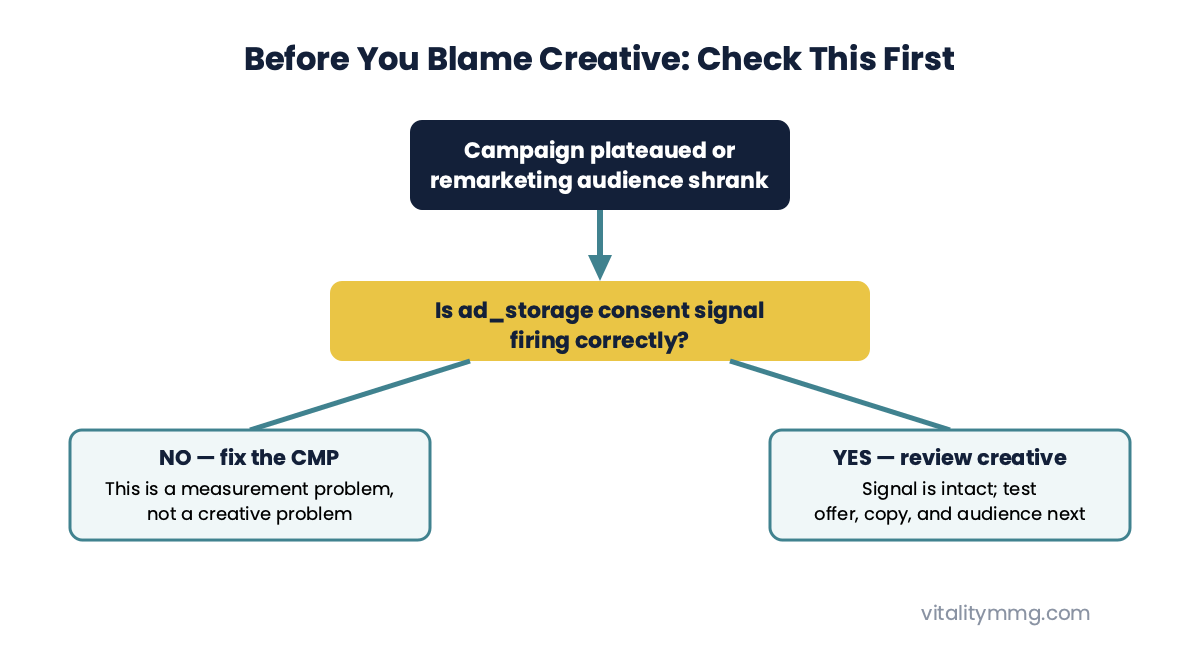
Before diagnosing a plateau as a creative or targeting problem, check consent signal health first.
The practical tell: if remarketing audience sizes have dropped and cost-per-conversion has crept up at the same time your creative and offer have stayed constant, check your consent signal configuration before you touch a single ad group.
How a CMP Fixes Google Consent Mode Remarketing Gaps
A correctly configured CMP does not eliminate the effect of consent denial. It cannot; a visitor who declines advertising cookies is exercising a real choice that Google, and the law behind Google’s policy, requires you to honor. What a correctly configured CMP does is make sure the denial is registered accurately and passed to Google’s tags in real time, so the platform can respond with modeling rather than simply losing the signal entirely. Fixing that hand-off is the entire practice of protecting Google consent mode remarketing performance without overriding a single patient’s stated preference.
The difference between a practice with a working CMP and a practice with none, or a broken one, is not whether some visitors decline consent. It is whether Google Ads can tell the difference between “this visitor declined, and I know that clearly” and “I have no idea what this visitor chose.” The second state is worse for measurement than an honest denial, because it gives the platform nothing reliable to model against.
Getting this right is a configuration exercise, not a policy debate: verify the CMP banner is firing before any advertising tag loads, confirm the ad_storage and analytics_storage states update the moment a visitor makes a choice, and confirm those states are actually reaching the GA4 tag rather than being set only in a cookie the tag never reads. Practices that want a fast read on where they stand can run our free compliance audit tool, which flags several of the same signal-health issues alongside standard ad-policy exposure.
Advanced Consent Mode and Cookieless Pings, Explained
Google offers two implementations of consent mode: basic and advanced. Basic implementation blocks Google’s tags entirely until consent is granted, which means denied visitors contribute nothing at all to measurement. Advanced Consent Mode is the meaningfully better option for practices that want to stay signal-complete under consent denial.
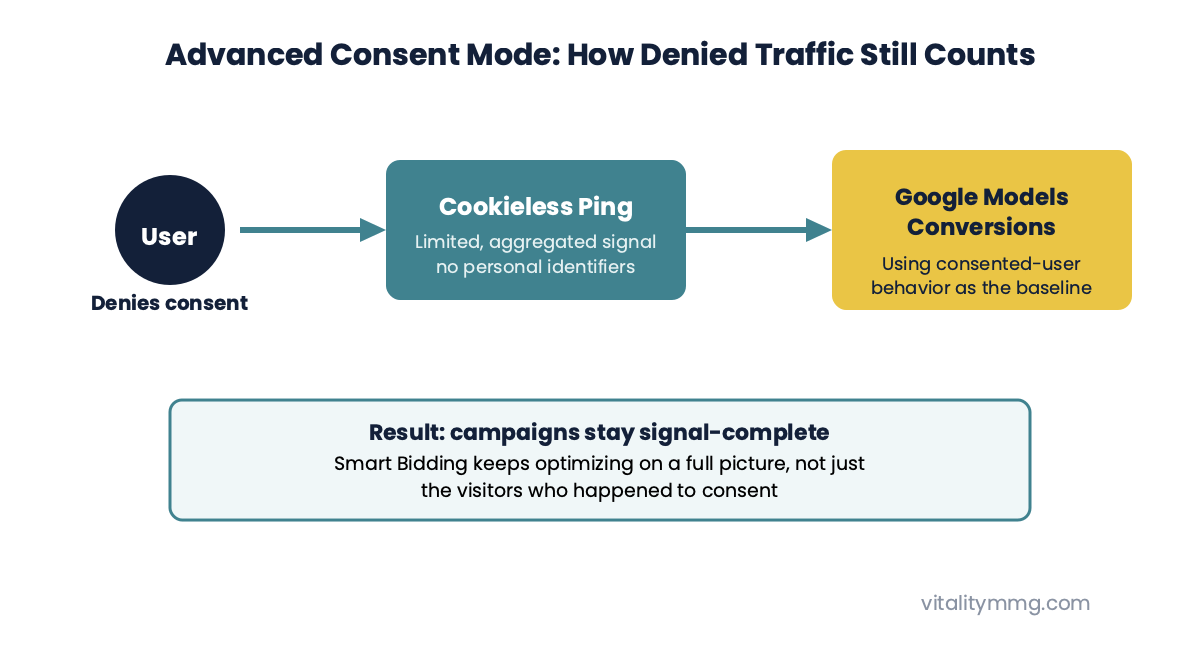
Advanced Consent Mode sends cookieless pings from denied users, which Google uses to model conversions.
Under Advanced Consent Mode, tags still load with default settings and adjust their behavior based on the visitor’s actual choice. When a visitor denies consent, the tag does not disappear; it sends a cookieless ping, a signal that carries limited, aggregated information and no personal identifiers. Per Google’s consent mode modeling documentation, Google uses those cookieless pings, in combination with observed behavior from consented visitors on the same site, to model the conversions and behavior of unconsented traffic.
This modeling is what keeps campaign optimization signal-complete even when a meaningful share of your visitors decline tracking. It does not restore remarketing list eligibility for denied visitors, and it should not be sold to you as doing so. What it does is prevent your Smart Bidding algorithms from optimizing against an artificially small, skewed dataset, which is exactly what happens when denied traffic simply vanishes from the picture instead of being modeled. That is the mechanism behind resilient Google consent mode remarketing performance even as consent rates shift from month to month.
What to Ask Your Agency This Week
This is a distinct engineering surface from HIPAA-incompatible tracking on treatment or consultation pages, where the risk is a standard gtag or remarketing pixel firing on a page with health intent. Consent signal configuration governs whether GA4 can legally pass advertising data to Google Ads at all; HIPAA-safe tracking governs whether that data should ever include a treatment-page visit in the first place. A practice can have one problem without the other, and an agency that conflates the two is not giving you an accurate diagnosis.
Ask your agency, or your internal team, four direct questions: Is a CMP installed and firing before any advertising tag loads? Is it configured in Advanced Consent Mode rather than basic? Has anyone verified, in the GA4 DebugView or Tag Assistant, that ad_storage actually changes state when a visitor makes a choice? And has anyone checked whether the drop in remarketing audience size lines up with the June 15, 2026 change, rather than with anything your creative or media buying team did?
Hair restoration, aesthetic, and med spa practices are especially exposed here because they tend to run heavier remarketing budgets against long consideration cycles. A shrinking Google consent mode remarketing audience hits those campaigns harder than a single-visit, low-consideration category. If your practice runs a hair restoration lead generation program or a plastic surgery lead generation program built on remarketing, this is worth confirming this month, not next quarter.
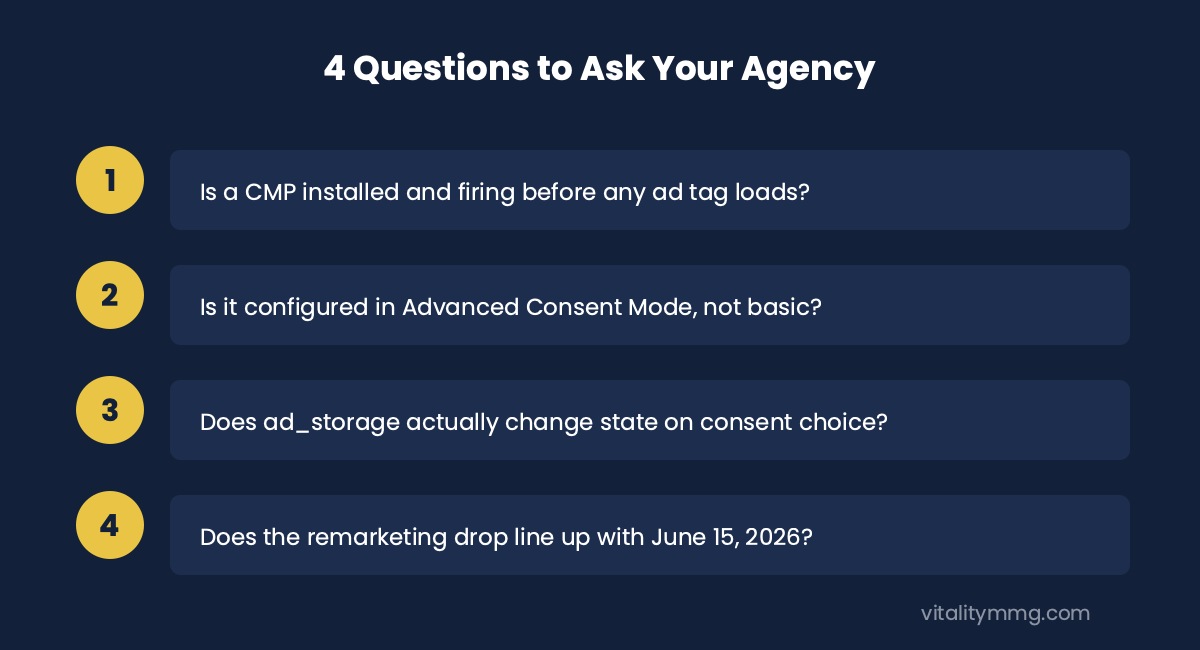
Four questions to ask before you assume a campaign plateau is a creative problem.
Key Takeaways
- As of June 15, 2026,
ad_storageis the sole control for whether GA4 passes advertising data to a linked Google Ads account. Google Signals no longer carries weight over that flow. - A shrinking Google consent mode remarketing audience combined with a flat or declining conversion count is a measurement signal problem first, not automatically a creative or targeting failure.
- Advanced Consent Mode lets denied visitors still send cookieless pings, which Google uses to model conversions and keep optimization signal-complete, but only when the CMP is configured correctly.
Get Your Consent Signal Checked
VMMG audits consent signal health as part of every Practice Growth Audit, so you know whether a plateau is a measurement problem before you touch your ad account.