




Why FUE vs FUT Marketing Decisions Shape Your Ad Spend
Every hair restoration practice runs an FUE vs FUT marketing decision whether it names it that way or not. The headline on your landing page, the keyword you bid on, the before-and-after set you feature on your ad account all commit you to one technique or a comparison of both. Get that commitment wrong and you spend against demand that isn’t there.
This isn’t a coin flip. Search volume, patient preference data, and Google’s own ad policy treatment of surgical claims all point in a direction, and that direction has shifted meaningfully in the last several years. A practice still running 2019-era messaging that treats FUE and FUT as equally weighted options is leaving qualified consults on the table.
The practices winning this decision aren’t guessing. They’re reading the same census data available to every clinic and building campaign architecture around it, then keeping FUT in reserve for the specific patient profile it still serves.
The bid strategy angle matters as much as the messaging angle. Keyword research consistently shows “FUE hair transplant” and its city-modified variants carrying far more monthly search volume than “FUT hair transplant” in nearly every market VMMG has audited. That volume gap means an account structured around FUE keywords has more inventory to work with, more Quality Score data to optimize against, and a lower cost-per-click ceiling before the auction gets competitive. An account still splitting budget evenly across FUE and FUT ad groups is diluting spend against demand that isn’t there in most markets.
The Clinical Differences Your Ads Can’t Get Wrong
Before any ad copy gets written, the account team needs the clinical distinction correct. Getting FUE and FUT mixed up in ad copy or a landing page FAQ is a fast way to lose a prospective patient’s trust, and it’s an easy thing for a competitor or a skeptical commenter to call out publicly.
FUE (Follicular Unit Extraction)
Individual follicular units are extracted one at a time directly from the donor area using a small punch tool, leaving tiny dot-shaped marks rather than a linear scar. No stitches, faster return to normal activity.
FUT (Follicular Unit Transplantation)
A strip of scalp is surgically removed from the donor area, then dissected under microscope into individual follicular units for transplant. Leaves a linear donor scar, closed with sutures or staples.
| Factor | FUE | FUT |
|---|---|---|
| Donor scarring | Dot-pattern scars, easily concealed even at short lengths | Linear scar, requires hair length to cover |
| Recovery time | Faster return to normal activity, typically days | Longer, sutures/staples removed at 10-14 days |
| Graft yield per session | High, but session length constrains volume | Can harvest more grafts in a single session |
| Patient satisfaction (12-month) | 90-98% average | 72-80% average, driven down by scar dissatisfaction |
| Best-fit candidate | Most patients, especially those who wear hair short | Patients needing maximum graft count in one session |
The recovery timeline difference is the detail most marketing copy underplays. FUE patients are typically cleared for light activity within a few days and back to a full workout schedule inside two to three weeks, which is a genuinely persuasive point for working professionals who can’t take extended time off. FUT patients face a longer window before the donor site fully settles, and sutures or staples need a follow-up visit for removal. Neither timeline should be promised as a guarantee in ad copy; both should be framed as typical ranges the surgeon confirms at consult.
What the ISHRS Data Says About Patient Preference
The International Society of Hair Restoration Surgery runs the most-cited practice census in the field, and the numbers explain why FUE now dominates hair restoration marketing. According to ISHRS data on FUE vs FUT harvest methods, roughly three out of four patients worldwide now choose FUE. Satisfaction scores tell the rest of the story.
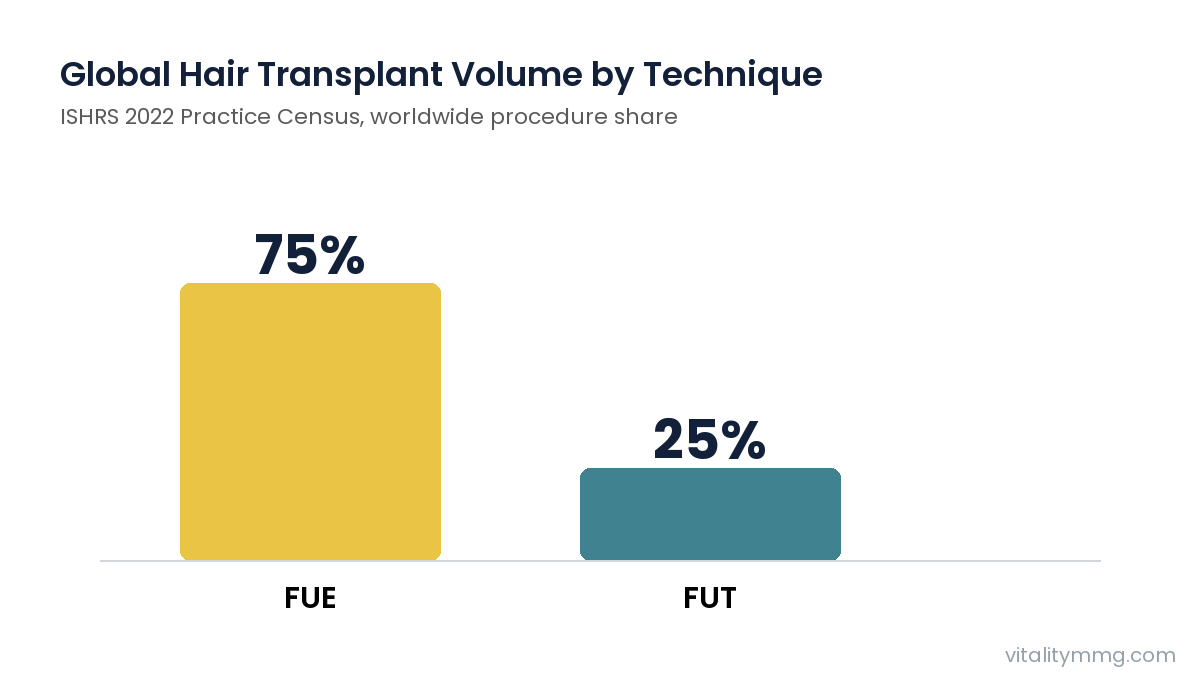
FUE now accounts for roughly three-quarters of global hair transplant volume, per the ISHRS Practice Census.
That satisfaction gap is the single most useful number in this entire decision. Patients aren’t rejecting FUT because it fails to grow hair. They’re rejecting the scar. Any FUE vs FUT marketing plan built around that distinction, rather than a vague “which is better” framing, gives a prospective patient a real reason to trust the practice’s judgment.
This also shows up downstream in consult-to-booking conversion. Practices that publish honest, source-backed comparison content see fewer no-shows and fewer “second opinion” consults than practices running generic technique pages, because the patient arrives at the first meeting already understanding the trade-off instead of discovering it from the surgeon for the first time. A comparison page doing real work reduces friction later in the funnel, not just clicks earlier in it.
Building Your FUE vs FUT Marketing Message by Funnel Stage
The ISHRS numbers don’t mean FUT disappears from your account. They mean the two techniques play different roles depending on where a prospect sits in the funnel.
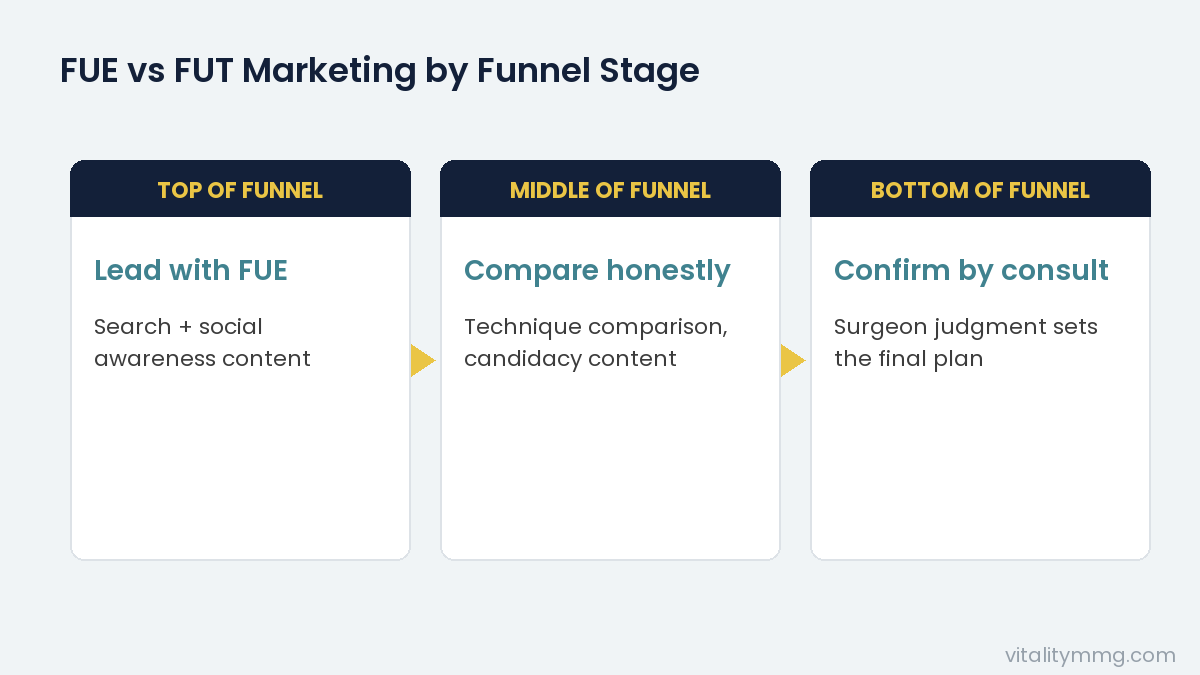
Match the technique framing to the funnel stage instead of running one static message across every campaign.
Top of funnel: Search and social awareness content should lead with FUE. It’s what the majority of searchers are already looking for, it carries the strongest satisfaction data, and it photographs well in short-hair before-and-after sets that Google’s ad review process tends to approve more consistently than strip-scar imagery.
Middle of funnel: This is where an honest FUE vs FUT comparison page earns its keep. A prospect who has done some research wants to see the practice address FUT directly rather than pretend it doesn’t exist. A comparison page that cites real trade-offs, graft yield versus scarring, builds more credibility than a page that only sells FUE.
Bottom of funnel: Once a lead books a consult, the technique decision moves to the surgeon. Marketing’s job stops at getting the right patient in the chair with realistic expectations; it should never promise a specific technique before a clinical evaluation.
Ad copy should mirror this structure line for line. A top-of-funnel headline like “FUE Hair Restoration, No Linear Scar” earns clicks from the broad audience actively searching that term. A middle-of-funnel ad promising “Compare FUE and FUT: Which Fits Your Goals” filters for the more deliberate researcher and sends them to the comparison page instead of a generic service page. Neither ad should ever state or imply a guaranteed outcome, and neither should reference the visitor’s own hair loss directly, since that language pattern is exactly what triggers Google’s personalized advertising enforcement on health-adjacent accounts.
Compliance Guardrails for FUE and FUT Advertising
Technique-comparison content sits close to several Google Ads and FTC tripwires. A practice that gets the clinical framing right but skips the compliance layer still risks disapprovals or, worse, an account-level restriction.
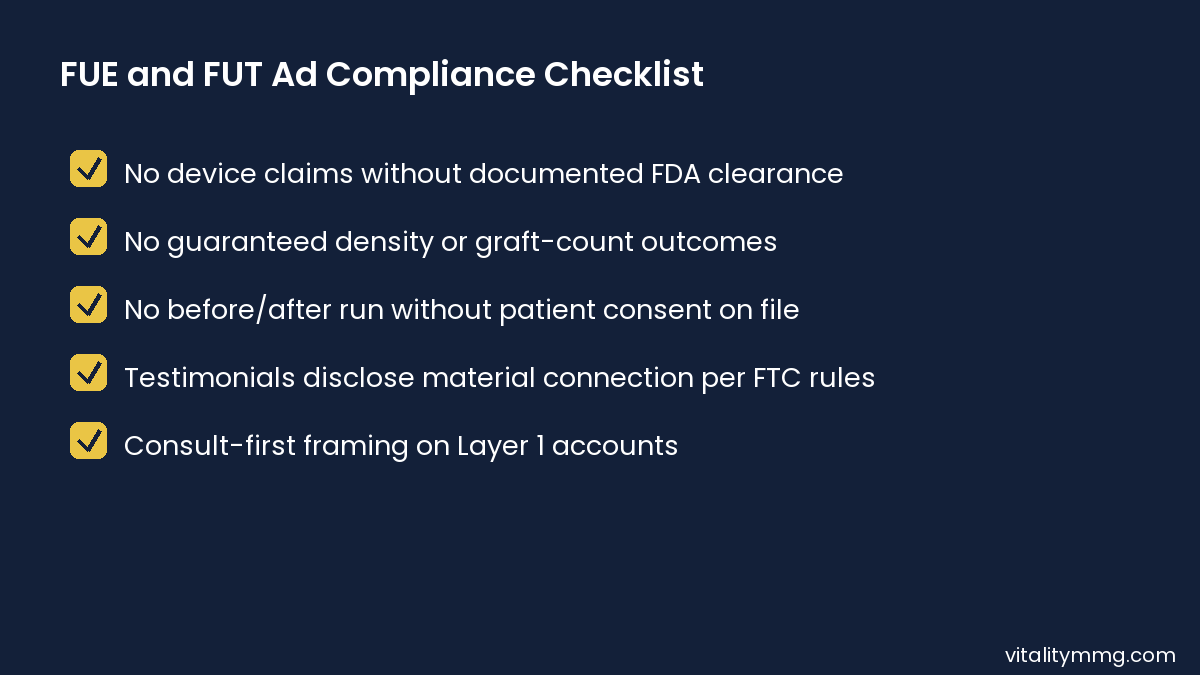
Run every FUE and FUT ad, page, and testimonial through these five checks before it goes live.
Device-specific claims (ARTAS, NeoGraft, SmartGraft) require documented authorized-provider status before they appear in ad copy. Graft-count or density guarantees are a fast path to a “misleading claims” disapproval under Google’s healthcare and medicines policy. Before-and-after imagery needs documented patient consent on file, not just a verbal agreement. Testimonials need to disclose any material connection per FTC endorsement guidance, and Layer 1 accounts should stay consult-first in headline and landing page copy rather than naming the procedure as the conversion action.
None of this is unique to FUE vs FUT content, but comparison pages tend to invite more clinical specificity than a standard service page, which means more chances to trip one of these rules if the writer isn’t watching for it.
Language discipline matters just as much as claim accuracy. Copy that references “your hair loss,” “your thinning,” or leans on shame-adjacent phrasing like “tired of hiding it” violates Google’s Personalized Advertising policy regardless of how accurate the surrounding clinical claim is. The fix is straightforward: describe the procedure and the outcome data, never the reader’s body or self-perception. That discipline alone prevents a large share of the disapprovals VMMG sees when auditing new hair restoration accounts.
When FUT Still Belongs in Your Campaign Mix
FUT is not a legacy technique your marketing should quietly retire. It remains the right answer for a specific patient profile: someone who needs a high graft count in a single session and who plans to wear their hair at a length that covers a linear scar. Practices that perform both techniques should keep a dedicated FUT page live, just not as the primary landing experience for cold traffic.
The stronger play is architecture, not elimination. Send broad search and social traffic to FUE-led pages. Reserve FUT-specific keywords, the ones with clear intent like large-session graft counts, for a page that treats FUT as a deliberate clinical choice rather than an afterthought. That structure respects the ISHRS data without abandoning a segment of patients FUT still serves well.
Practices that get this right treat the FUE vs FUT marketing question the same way they’d treat any other segmentation problem: match the message to the demand, back every clinical claim with a source, and let the surgeon, not the ad account, make the final call.
FUE vs FUT Marketing: Common Questions
Is FUE always the right technique to lead with in ads?
For most search and social campaigns, yes. FUE carries the higher search volume and the stronger satisfaction data. FUT still deserves a dedicated page for the graft-count-driven patient segment; it just shouldn’t be the default landing experience for cold traffic.
Can a comparison page hurt conversion by mentioning a competing technique?
Done well, no. A page that compares FUE and FUT honestly, with sourced data, tends to reduce no-shows and second-guessing later in the funnel because the patient already understands the trade-off before the consult.
What’s the biggest compliance risk in FUE vs FUT ad copy?
Language that references the reader’s own hair loss or implies a guaranteed graft count or density outcome. Both trigger Google’s Personalized Advertising and healthcare claims policies regardless of how clinically accurate the surrounding copy is.
Key Takeaways
- ISHRS data shows roughly 75% of patients now choose FUE, with 12-month satisfaction of 90-98% versus 72-80% for FUT, driven mainly by donor scarring, not growth outcomes.
- Lead top-of-funnel campaigns with FUE; reserve FUT messaging for prospects who need maximum graft yield and can wear longer hair over a donor scar.
- Run every technique claim, device name, and testimonial through Google Ads and FTC compliance checks before it goes live, especially on comparison pages.
Get Your FUE vs FUT Strategy Audited
VMMG builds hair restoration ad accounts around the clinical and compliance data, not guesswork about which technique to lead with.