




Plastic surgery consult follow-up is the biggest revenue leak in most practices. The patients showed up, asked the right questions, and left undecided. The practice never built a system to bring them back.
For plastic surgery and cosmetic practice owners watching booked consults disappear after the visit.
Why the plastic surgery consult follow-up breaks down
A prospective patient sits in your office, asks the right questions, seems engaged, and then leaves with “I need to think about it.” Your coordinator sends one email the next day. No reply. The lead gets filed as dead. Multiply that by every consult that does not book on the spot, and you are looking at the single largest leak in most practices: roughly 80% of booked-but-not-scheduled leads going cold.
This is not a lead quality problem. These people showed up. They were interested enough to take time off work, drive to your office, and undress in front of a stranger. The problem is what happens, or does not happen, in the days after they walk out the door.
Elective cosmetic surgery is an emotional, high-consideration decision. Patients weigh cost, downtime, anesthesia risk, and how they will explain the change to people in their life. Almost nobody resolves all of that in a single visit. The consult is the start of the decision, not the end of it.
Most practices treat it the opposite way. The consult is the finish line, and follow-up is an afterthought handled by whoever has a free minute. One email goes out. When it gets no response, the patient is quietly written off. Nobody decided to lose that revenue. The system just let it slip.
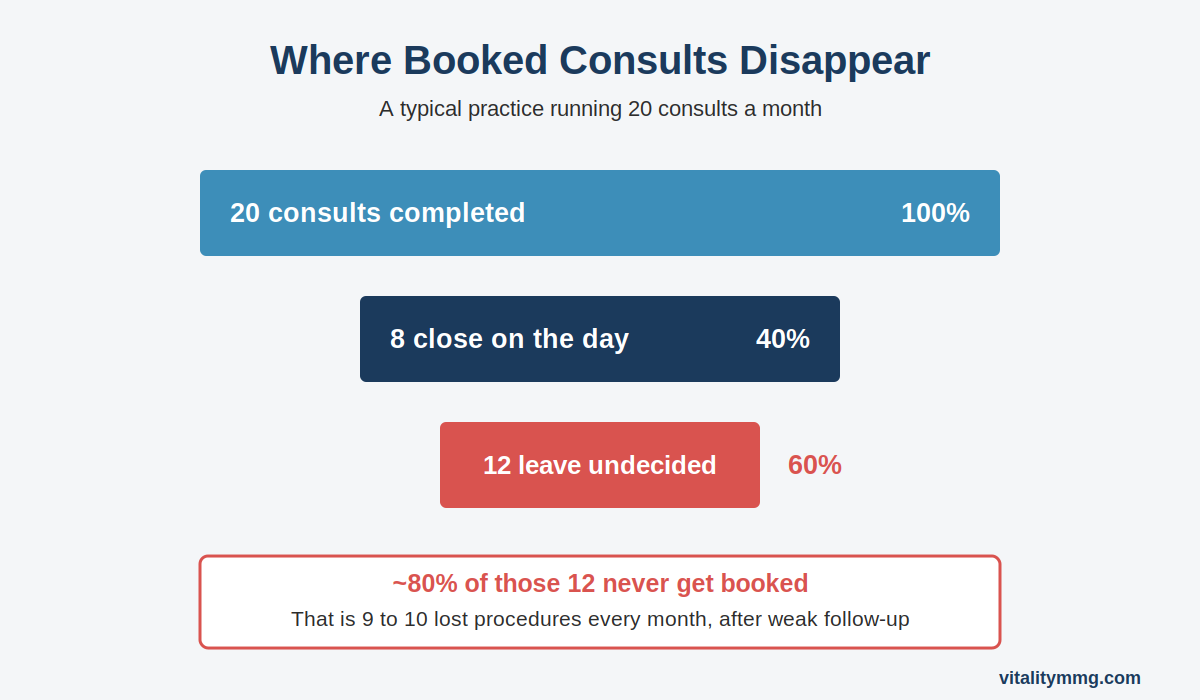
The cost is brutal when you do the math. If a practice runs 20 consults a month and closes 8 on the day, the other 12 represent real procedure revenue. Lose 80% of those to a weak plastic surgery consult follow-up, and you are leaving 9 or 10 cases a month on the table. At cosmetic surgery price points, that is the difference between a practice that grows and one that treads water. Our approach to improving consultation show rates and procedure bookings starts with treating that gap as the priority it actually is.
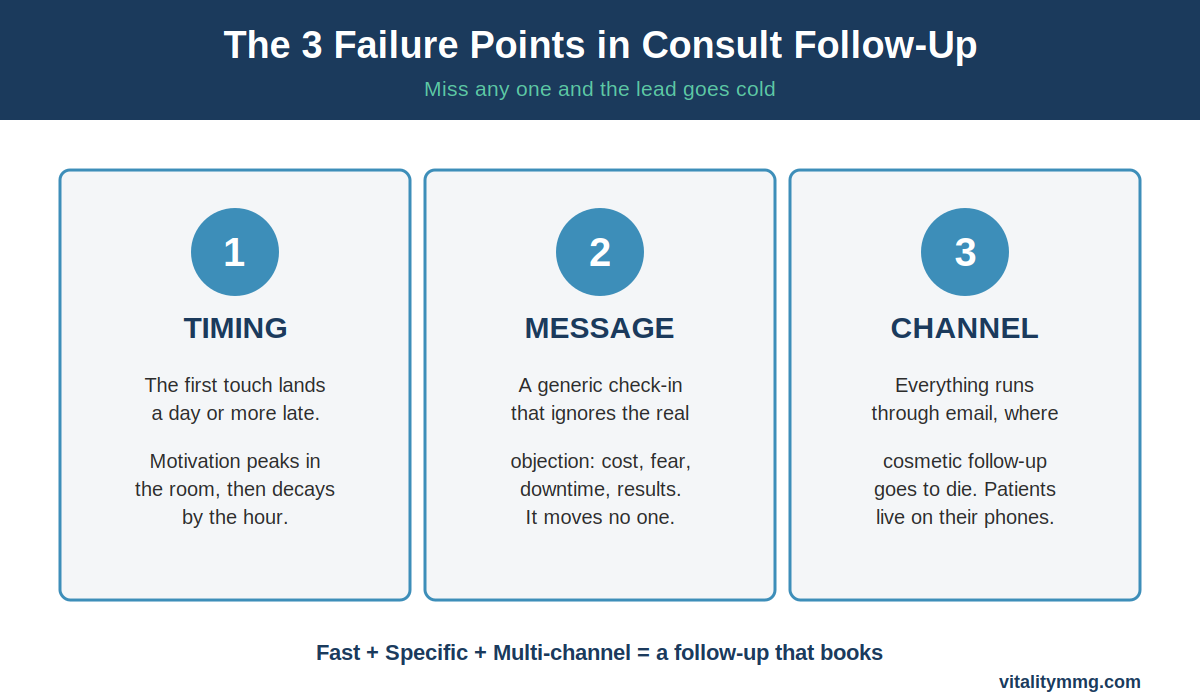
Failure point 1: Timing
The single biggest variable in lead conversion is speed, and almost every practice gets it wrong. Research published in Harvard Business Review’s study of online sales leads found that firms contacting a prospect within an hour were nearly seven times more likely to have a meaningful conversation with a decision maker than those who waited just one hour later, and more than 60 times more likely than those who waited 24 hours.
A consult patient is more time-sensitive than a web lead. Their motivation peaks in the room and starts decaying the moment they leave. A follow-up that lands 24 hours later is already late. One that lands three days later is talking to a different, colder person.
Speed also decides who the patient picks. Across industry benchmark data on lead response time, the first business to respond wins roughly half of competitive deals. If a patient consulted with two surgeons, the one who re-engages first looks organized and attentive, exactly the signal someone wants before an elective procedure.
Timing failure is rarely about effort. It is about the absence of a system. When follow-up depends on a busy coordinator remembering to act, it will always lose to whatever is on fire that day.
Failure point 2: Message content
The second failure is what the follow-up actually says. The standard message is some version of “It was great meeting you, let us know if you have any questions.” That is polite, and it is useless. It puts the entire burden of the next step back on a patient who is already anxious and hesitant.
A patient who left saying “I need to think about it” almost never means “I need to think.” They mean something specific that they did not say out loud. The downtime scares them. They are not sure they can afford it. They want to see results from someone with their body type.
A generic check-in answers none of that. It does not move anyone closer to a decision because it does not address the actual reason they hesitated. Effective plastic surgery consult follow-up messaging is built around the real objections, not around politeness. It anticipates the hesitation, speaks to it directly, and gives the patient a reason to re-engage that does not require them to admit what they are afraid of.
Failure point 3: Channel mismatch
The third failure is channel. Most follow-up runs entirely through email, and email is where cosmetic surgery follow-up goes to die. Patients researching an elective procedure often do not want it sitting in a personal inbox a partner or family member might see. Open rates are low, and the messages compete with everything else fighting for attention in a crowded inbox.
Meanwhile the patient is on their phone all day. They respond to texts. They notice a missed call with a voicemail. They see retargeting content while they scroll. A follow-up that lives only in email is reaching a channel the patient is barely using for this decision.
The fix is not to abandon email. It is to stop treating one channel as the whole strategy. A patient who ignores three emails may answer the first text, and the practices that recover cold consults are the ones present across the channels patients actually use. This is the same multi-touch logic behind effective paid social campaigns that nurture prospects from curiosity to consultation, applied to the post-consult window.
What a real plastic surgery consult follow-up system looks like
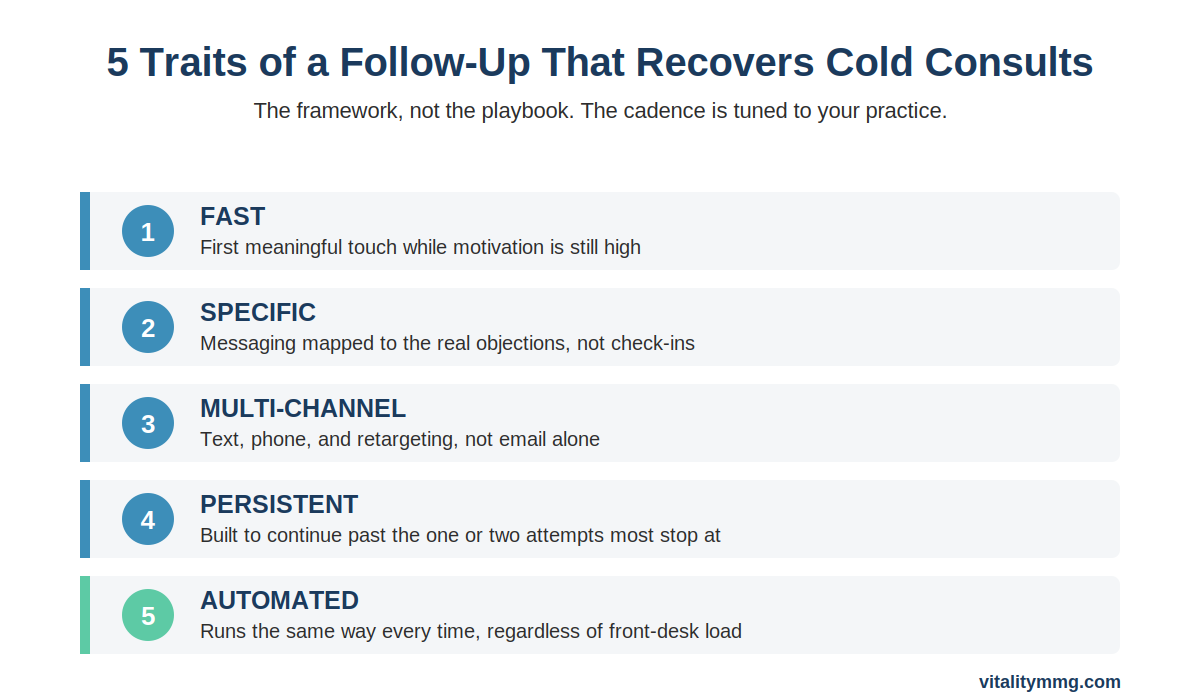
Fixing this does not mean working harder. It means replacing improvisation with a system. At a conceptual level, a follow-up framework that recovers cold consults has five non-negotiable traits.
- Fast. The first meaningful touch lands while motivation is still high, not whenever someone gets to it. Every hour of delay measurably reduces re-engagement rates.
- Specific. Messaging is mapped to the real objections patients carry out of the room (cost, downtime, body type, partner reaction) rather than generic “let us know if you have questions” check-ins.
- Multi-channel. Meets patients on text, phone, and retargeting, not just email. The patient who ignores three emails may answer the first text.
- Persistent. Structured to continue well past the one or two attempts most practices stop at. The booking often comes from touch five, not touch one.
- Automated. Runs the same way every time regardless of how busy the front desk is. Removes the dependency on a coordinator remembering to act.
The day-to-day cadence, the exact message sequence, and the channel timing are where the real engineering lives, and they should be tuned to your procedures, your price points, and your patient demographics. That is the work. But even understanding the five traits above puts you ahead of most practices, because it reframes follow-up from a clerical task into a revenue system.
Stop losing booked consults to cold follow-up
VMMG builds patient acquisition and nurture systems for plastic surgery, cosmetic, and aesthetic practices, closing the gap between a consult and a booked procedure. If cold consults are draining your revenue, let us show you where the leak is and how to seal it.